Douay-Rheims Bible 1582–1610
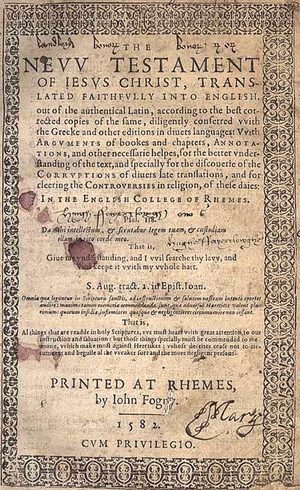

The Douay-Rheims is the English translation of the Latin Vulgate made by Catholic exiles at the English College of Douai and Rheims: the New Testament appeared in 1582 and the Old Testament in 1609–10. Bishop Richard Challoner's revision of 1749–52 became the standard English Catholic Bible into the twentieth century, and it is the Douay-Rheims text quoted on this site (see Primary sources). Protestants answered it within a few years, and every tradition has taken a position on the questions it raised: which text to translate, which books to print, and who should read Scripture in English.
| Published | New Testament, Rheims, 1582; Old Testament, Douai, two volumes, 1609 and 1610; Challoner's revision, 1749–52 |
|---|---|
| Translators | Gregory Martin did most of the translating at the English College, founded at Douai in 1568 by William Allen; colleagues including Richard Bristow and Thomas Worthington revised the text and helped with the notes |
| Language | English: Latinate in 1582, smoothed by Challoner in the eighteenth century |
| Old Testament from | The Latin Vulgate |
| New Testament from | The Latin Vulgate, "diligently conferred with the Greeke and other editions" (1582 title page) |
| Books | 73 books: the Old Testament list of the Council of Trent, with the deuterocanonical books in their places; the 1610 volume also carried the Prayer of Manasses and 3 and 4 Esdras in an appendix |
| Approach | Close to the Vulgate, even where Latin words came into English; Challoner moved the wording nearer to common English |
| Copyright | Public domain |
| Used by | English-speaking Catholics from 1582, as the standard Bible until the 1940s; today Catholics who prefer the traditional text, which Baronius Press keeps in print |
How it was made
William Allen founded the English College at Douai in 1568 for English Catholics who could not study at home. Political troubles moved it to Rheims in 1578, and there the New Testament was printed in 1582 by John Fogny. Its title page says the annotations were meant "specially for the discouerie of the Corruptions of diuers late translations." Lack of money delayed the Old Testament; by 1609 the college was back at Douai, and the Bible was completed in two quarto volumes in 1609 and 1610 (Catholic Encyclopedia).
The Council of Trent had declared on 8 April 1546 that the old Vulgate edition, approved by long use in the Church, was to be held "authentic" in public lectures, disputations, sermons and expositions. The 1582 preface applies this: "We translate the old vulgar Latin text, not the common Greek text" (text as modernized by Kevin P. Edgecomb). Pius XII's encyclical Divino afflante Spiritu (1943, paras. 21–22) later described that authenticity as "juridical" rather than critical and said the original texts should now be consulted.
Bishop Challoner revised the New Testament in 1749, 1750 and 1752 and the Old Testament in 1750. He wanted a smaller, cheaper and more readable Bible with fitting notes. John Henry Newman said his changes "almost amounted to a new translation," and most of them moved the text toward the Authorized Version. Haydock's annotated edition appeared at Manchester in 1811–12 and Archbishop Kenrick's American revision in 1849–59 (Catholic Encyclopedia). The Confraternity Bible (1941) replaced Challoner as the standard text (bible-researcher.com).
How it translates
Both Testaments render the Vulgate, not the Hebrew or Greek directly. The translators' introduction to the Old Testament asks "Why we translate the Latin text, rather then the Hebrew, or Greke" and answers in favor of the Vulgate. The Psalms follow Vulgate numbering: the psalm that begins "The Lord ruleth me" is Psalm 22 in the Douay and Psalm 23 in the KJV. Book names follow the Vulgate: Josue, Isaias, Apocalypse. For the books printed, see the Apocrypha and the canon.
The Rheims translators kept many technical words rather than translate them, "pasch," "azymes" and "parasceve" among them, and explained their meaning in the margin or a table. Other Latin words were given English forms, such as "exinanited" in Philippians 2 (Catholic Encyclopedia). Challoner replaced that word with "emptied himself" (Philippians 2:7). He kept "supersubstantial bread" in Matthew 6:11, with a note that Luke renders the same word "daily bread" (Douay-Rheims Bible online).
The Rheims annotations argue for Catholic doctrine against Protestant readings. Allen wrote them, with help from Bristow and Worthington (Catholic Encyclopedia). Challoner removed most of the polemical notes and kept milder ones that still support Catholic teaching (bible-researcher.com).
Reception and revisions
The first printed answer came from the Puritan minister William Fulke, who in 1589 set the Rheims New Testament beside the Bishops' Bible with his own confutation, in reply to Gregory Martin's charge that Protestant translators had corrupted the text. The book also made the Rheims text more widely available (Museum of the Bible). Thomas Cartwright's Confutation of the Rhemists Translation, Glosses and Annotations was printed in 1618. The Catholic Encyclopedia judges that the Rheims New Testament, which came out nearly thirty years before the King James Version, likely influenced it; see the King James Version.
Challoner's text spread through Irish, English and American editions and remained the standard English Catholic Bible until the Confraternity version of 1941. After Divino afflante Spiritu (1943) Catholic translations were made from Hebrew and Greek, and the Second Vatican Council asked that translations be made "especially from the original texts" (Dei Verbum 22). Since 2002 the only English Lectionary for Mass in United States dioceses (apart from the children's Lectionary) is based on the New American Bible (NAB) (USCCB). The Douay-Rheims is still printed: Baronius Press publishes the 1899 text with Cardinal Gibbons's approbation for "Catholics looking for the traditional Catholic Bible in English."
Where each church stands on the the Douay-Rheims
- Catholic:
The Council of Trent (Session IV, 1546) made the Vulgate the authentic Latin text and listed the Old Testament books that the Douay prints, including the deuterocanonical books. The Douay-Rheims follows that decree. It is no longer the Bible of the Mass in the United States, where the Lectionary has been based on the NAB since 2002, and the Second Vatican Council (Dei Verbum 22) asked for translations from the original texts. Baronius Press, a publisher of traditional Catholic books, keeps the 1899 Challoner text in print and recommends it to those seeking "the traditional Catholic Bible in English." The USCCB's list of approved translations names no Douay edition.
- Orthodox:
The Orthodox Church has made no statement about the Douay-Rheims. Its Old Testament is the Greek Septuagint, not the Latin Vulgate. The Synod of Jerusalem (1672, Confession of Dositheus, question 3) defines the canon to include Wisdom, Judith, Tobit, the Maccabees and Sirach, while Philaret's Longer Catechism (1830, Q. 31–35) lists them as books read in the Church outside the Hebrew canon (see the Apocrypha).
- Lutheran:
Lutheran churches have made no statement about the Douay-Rheims. The Formula of Concord (Epitome, Rule and Norm) names the prophetic and apostolic writings of the Old and New Testaments as the only rule of doctrine, without listing the books. Luther's 1534 Bible printed the Apocrypha in a separate section, as books "not held to be equal to Holy Scripture, but useful and good to read" (Lutheran School of Theology at Chicago), an arrangement different from the Douay's.
- Reformed:
John Calvin answered Trent's Vulgate decree in his Antidote (1547), writing that those who know the languages "perceive that this version teems with innumerable errors." The Westminster Confession (1646) holds that the Hebrew Old Testament and Greek New Testament are the final appeal in disputes (1.8) and that the Apocrypha have no more authority than other human writings (1.3). Thomas Cartwright's Confutation was a Puritan answer to the Rheims notes.
- Anglican:
The Puritan minister William Fulke answered the Rheims text in 1589, and the Church's own Bible, the 1611 King James Version, is judged by the Catholic Encyclopedia to have been likely influenced by it. Article VI of the Thirty-Nine Articles lists books the Church reads "for example of life and instruction of manners" but does not use "to establish any doctrine"; the list includes the Douay's deuterocanonical books and also 3 and 4 Esdras and the Prayer of Manasses (see the Apocrypha).
- Methodist:
The Methodist churches have made no statement about the Douay-Rheims. Article V of the Methodist Articles of Religion (1784) names the Old Testament books and receives the New Testament books "as they are commonly received"; Wesley left out the Anglican paragraph on the other books, so the Articles say nothing of the Apocrypha.
- Baptist:
Baptist bodies have made no statement about the Douay-Rheims. The Second London Confession (1689, 1.3) says that the books commonly called Apocrypha, "not being of Divine inspiration," are no part of the canon and "of no authority to the Church of God," so Baptists who hold it do not receive the Douay's Old Testament list.
Sources
- Catholic Encyclopedia, "Douay Bible" (New Advent) dates, translators, Latinisms, Challoner, Haydock, Fulke
- Council of Trent, Session IV (Waterworth translation)
- Pius XII, Divino afflante Spiritu (1943), paras. 21-22
- Vatican II, Dei Verbum (1965), para. 22
- Introduction to the Douai-Rheims New Testament, 1582 (preface, modernized by Kevin P. Edgecomb)
- Preface of the 1582 Douay-Rheims, including the Old Testament introduction (DRBO)
- Title page of the Rheims New Testament (1582), Wikimedia Commons (public domain)
- bible-researcher.com, "The Challoner Revision of the Douay Bible"
- Douay-Rheims Bible online: Matthew 6, with Challoner's note
- Douay-Rheims Bible online: Philippians 2
- Douay-Rheims Bible online: Psalm 22
- Museum of the Bible, Fulke's Rheims-Bishops' Parallel New Testament (1589)
- Cartwright, A Confutation of the Rhemists Translation (1618), catalog record
- USCCB, The New American Bible: Liturgy (Lectionary since 2002)
- USCCB, Approved Translations of the Bible
- Baronius Press, The Holy Bible: Douay-Rheims
- Calvin, Acts of the Council of Trent with the Antidote, in Tracts, vol. 3 (Calvin Translation Society, 1851)
- Westminster Confession of Faith, ch. 1 (OPC)
- Thirty-Nine Articles, Article VI (Church of England)
- Methodist Articles of Religion (1784), in Schaff, Creeds of Christendom, vol. 3
- Second London Baptist Confession (1689), ch. 1
- Confession of Dositheus (Synod of Jerusalem, 1672), in Schaff, Creeds of Christendom, vol. 1
- Luther Bible 1534, title page of the Apocrypha (Lutheran School of Theology at Chicago)
- Formula of Concord, Epitome (Book of Concord)