Jacobus Arminius 1560–1609
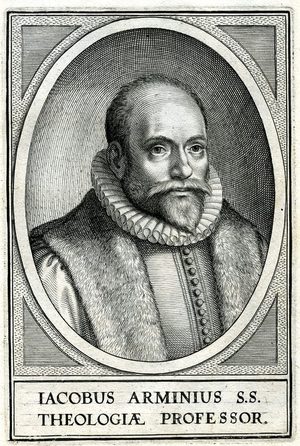

Jacobus Arminius was a minister of the Dutch Reformed Church and professor of theology at Leiden whose objections to the Reformed teaching on predestination began the dispute that led to the Synod of Dort (1618–19). He lived and died a minister of that church, which is why he is listed with the Reformed. His name now stands for the conditional-election view taught in the Wesleyan and several Baptist traditions, and each tradition has taken a position on it.
| Lived | 10 October 1560 (some sources give 1559), Oudewater, to 19 October 1609, Leiden |
|---|---|
| Church | Dutch Reformed Church; minister at Amsterdam and professor at Leiden until his death |
| Role | Minister in Amsterdam (ordained 1588; some sources give 1586); professor of theology at Leiden from 1603 |
| Influenced by | Theodore Beza, his teacher at Geneva; the Belgic Confession and Heidelberg Catechism, which he said he never contradicted; Jesuit scholastics (historians debate how far) |
| Influenced | Johannes Wtenbogaert and Simon Episcopius, leaders of the Remonstrants; Hugo Grotius's party |
| Writings | Declaration of Sentiments (30 October 1608); disputations, orations and letters, collected in English as The Works of James Arminius |
Life
Arminius (Jacob Harmenszoon) was born at Oudewater in Holland on 10 October 1560. His father died while he was a child, and in 1575, while he was studying at Marburg, Spanish troops took Oudewater and killed his mother, sister and brothers. He studied at Leiden from 1576 and in 1582 went to Geneva to study under Theodore Beza, Calvin's successor. He was ordained at Amsterdam in 1588 and served as a minister there until 1603. About 1590 he began to doubt Beza's supralapsarian scheme, which places the decree of election and reprobation before the fall. In 1603 he became professor of theology at Leiden, and from 1604 his colleague Franciscus Gomarus, a strict supralapsarian, attacked his view of predestination. On 30 October 1608 he set out his position before the States of Holland at The Hague in his Declaration of Sentiments. He died of tuberculosis at Leiden on 19 October 1609.
On 14 January 1610 about forty ministers led by Johannes Wtenbogaert presented the Remonstrance in five articles; they became the Remonstrants, and their opponents, who answered with a Counter-Remonstrance in 1611, the Contra-Remonstrants. A national synod met at Dordrecht from 13 November 1618 to 9 May 1619, with delegates from foreign Reformed churches, and rejected the five articles in the Canons of Dort. The Remonstrants, led by Simon Episcopius, were summoned as defendants and left the synod in January 1619; more than 200 ministers were deposed, and those who would not stop preaching were banished. Hugo Grotius, a jurist who sided with the Remonstrants, was arrested on 29 August 1618 together with the statesman Johan van Oldenbarnevelt. Oldenbarnevelt was beheaded shortly after the synod; Grotius, sentenced to life imprisonment, escaped from Loevestein castle in a trunk in March 1621.
What he taught
In the Declaration of Sentiments Arminius listed God's decrees concerning salvation: to appoint Christ as Mediator and Savior; to receive in Christ those who repent and believe and persevere, and to leave the impenitent under wrath; to supply the means sufficient for repentance and faith; and to save particular persons whom he foreknew would believe through his "preventing grace" and would persevere. Election is therefore conditional on faith that God foresees, not an unconditional choice of individuals. He rejected the high supralapsarian scheme, said he had never contradicted the Belgic Confession or Heidelberg Catechism, and asked that the confession be examined by a synod.
He taught that fallen man cannot of himself think, will or do what is truly good (original sin), so that grace must come first: he ascribed to grace "the commencement, the continuance and the consummation of all good." The whole dispute, he said, was whether grace is "a certain irresistible force"; he held that many "resist the Holy Spirit and reject the grace that is offered." On perseverance he said believers in Christ have strength, with the Spirit's help, to overcome sin and cannot be plucked from Christ's hand, and that he had "never taught" that a true believer can fall away totally and finally; but he asked the next synod to inquire from Scripture whether some might through negligence forsake their life in Christ.
The Remonstrance of 1610 put the matter in five articles: election of those God foresees will believe and persevere; Christ's death for all, though only believers enjoy forgiveness; man's inability to do good without regeneration; grace that is not irresistible; and perseverance by Christ's help, with the possibility of falling left to further study. The Canons of Dort answer them head by head, which gave rise to the "five points of Calvinism."
What historians say
Arminius claimed to conform to the Reformed confessions; Gomarus and the Synod of Dort judged that he did not, and the Christian Reformed Church describes the Canons as a judicial decision on the points in dispute. Carl Bangs's Arminius: A Study in the Dutch Reformation (1971) and Keith Stanglin and Thomas McCall's Jacob Arminius: Theologian of Grace (2012) are the main modern English studies.
Historians also debate his sources. Eef Dekker (Sixteenth Century Journal, 1996) argues that Arminius's formulations echo those of the Jesuit Luis de Molina and that middle knowledge is central to his doctrine of God's knowledge. Richard Muller (1991) agrees that Arminius adopted scientia media for Molina's reason but notes that he never cites Molina or Suárez. Rumors of Jesuit influence led to an inquiry in his lifetime that declared him orthodox (Catholic Encyclopedia).
The treatment of the Remonstrants is disputed. Critics, among them Methodist writers, ask whether a synod could settle doctrine when the accused were summoned as defendants and Oldenbarnevelt and Grotius were imprisoned or executed. Reformed answers are that the Canons rest on Scripture, that Dort included delegates from eight foreign countries, and that the arrests were acts of Prince Maurice and the States; Philip Schaff calls Oldenbarnevelt's condemnation unjust. The banishment ended after 1625, when Frederick Henry allowed Episcopius and Wtenbogaert to return; the Remonstrants were tolerated from 1632 and recognized as a church in 1795 (Dort and the Remonstrants; the Reformed record).
How the churches see Arminius
- Catholic:
The Catholic Church has issued no act naming Arminius. The Council of Trent, years before his birth, taught that in adults the beginning of justification comes from prevenient grace, yet that a person "is also able to reject it" (Session 6, ch. 5), and anathematized the view that the will "cannot refuse its consent" (canon 4). The Catholic Encyclopedia (James F. Loughlin) summarizes the Remonstrants as teaching that Christ died for all and that grace is not irresistible, and makes no comparison with Catholic doctrine. Within the Church, Paul V's decree of 5 September 1607 let Dominicans and Jesuits each defend their own account of grace and free will and forbade each to condemn the other; no final decision has been made. Dekker and Muller compare Arminius's account of God's knowledge with Molina's (above).
- Orthodox:
No Orthodox council or patriarchate has named Arminius. The Orthodox answer on predestination is in the Confession of Dositheus, approved by the Synod of Jerusalem (1672) in reply to the Confession attributed to Cyril Lucaris. Its third decree says God predestined to glory those whom he chose, but, since he foreknew who would make right use of free will and who wrong, "He predestinated the one, or condemned the other"; it rejects the view that the divine will is "solely and without cause" the author of condemnation,.
- Lutheran:
Lutheran teaching differs from both sides at Dort. The Solid Declaration of the Formula of Concord (art. XI) distinguishes God's foreknowledge, which extends to good and evil, from election, which concerns "only the children of God" chosen in Christ, and says election is not only a foreknowledge but "a cause which procures, works, helps, and promotes" salvation (paras. 4–8). It says that those who reject the Word "resist the Holy Ghost" and that the cause of such contempt is "the perverse will of man," not God's foreknowledge (paras. 40–41). In the 1880s the Ohio and Norwegian synods held that election is made in view of foreseen faith (intuitu fidei), the Missouri and Wisconsin synods that its cause lies wholly in God's grace; Ohio left the Synodical Conference in 1881 and the Norwegian Synod in 1883 (Christian Cyclopedia).
- Reformed:
The Canons of Dort (1619), which with the Belgic Confession and Heidelberg Catechism form the Three Forms of Unity, were adopted as a judgment on the five Remonstrant articles. They teach that God chose "a definite number of particular people" in Christ and that election did not take place "on the basis of foreseen faith" (I.7, I.9), and the Synod declares its explanation "derived from God's Word." The Protestant Church in the Netherlands, formed in 2004 from the Dutch Reformed Church and others, still lists the Canons among its confessions (PKN). The Remonstrant Brotherhood, recognized as an independent church in 1795, describes itself today as an open and hospitable faith community of 44 congregations.
- Anglican:
Article XVII of the Thirty-Nine Articles holds that predestination to life is God's purpose to deliver "those whom he hath chosen in Christ," and that "we must receive God's promises in such wise, as they be generally set forth to us in holy Scripture." The Articles do not name Arminius or the Remonstrants, and English delegates sat at Dort. In the 1620s opponents called Richard Montagu, made bishop of Chichester in 1628, and later William Laud's circle "Arminians"; Montagu denied it, and historians after Nicholas Tyacke's Anti-Calvinists debate whether "anti-Calvinist" fits them better.
- Methodist:
No Methodist church has made an act naming Arminius, but John Wesley used the name. His 1770 tract opens: "To say, 'This man is an Arminian,' has the same effect on many hearers, as to say, 'This is a mad dog.'" In 1778 he began the Arminian Magazine to defend God's universal offer of salvation against Calvinist periodicals (Wesley Corpus). Article VIII of the Methodist Articles of Religion says there is no power to do good works without "the grace of God by Christ preventing us," and Wesley's 1784 revision of the Anglican Articles dropped Article XVII on predestination (election and foreseen faith).
- Baptist:
Baptists are divided. The English General Baptists' 1611 Declaration of Faith (Thomas Helwys's congregation, Amsterdam) says God "before the Foundation of the World hath Predestinated that all that believe in him shall-be saved" (art. 5). The National Association of Free Will Baptists, says that because people have "the power of choice" salvation depends on their response, and that a believer may "make shipwreck of his faith and be lost." The Southern Baptist Baptist Faith and Message (2000) calls election "consistent with the free agency of man" and says "All true believers endure to the end." In 2012 Eric Hankins and other Southern Baptists issued a "Traditional Statement" urging Baptists to move beyond Calvinism as a reference point; Calvinist and Arminian critics both objected.
Sources
- Wesley Center Online, Arminius, "Declaration of Sentiments" (Works, vol. 1) delivered 30 October 1608; decrees, grace, perseverance
- Schaff, Creeds of Christendom, vol. 3, "The Five Arminian Articles, A.D. 1610"
- Christian History Institute, "Defender of God's justice" (Arminius) life dates; Gomarus; Dort; birth year and ordination year vary among sources
- Encyclopedia.com, "Jacobus Arminius" birth 10 October 1560, ordination 1588, death 19 October 1609
- Schaff-Herzog Encyclopedia, "Remonstrants" 1610 to 1795
- Canons of Dort (Christian Reformed Church)
- Stanford Encyclopedia of Philosophy, "Hugo Grotius" arrest, sentence, escape
- Canon van Nederland, "Hugo de Groot"
- Catholic Encyclopedia, "Arminianism" (Loughlin)
- Catholic Encyclopedia, "Congregatio de Auxiliis" decree of 5 September 1607
- Council of Trent, Session 6 (Waterworth translation)
- Evangelical Arminians, "Dekker and Muller on Middle Knowledge in Arminius' Theology" Dekker, Sixteenth Century Journal 27 (1996); Muller, 1991
- Confession of Dositheus (1672), Decree 3
- Schaff, Creeds of Christendom, vol. 1, on the Synod of Jerusalem (1672)
- Solid Declaration of the Formula of Concord, art. XI (Book of Concord)
- Christian Cyclopedia (LCMS), entries "Intuitu fidei" and "Synodical Conference"
- Remonstranten (Remonstrant Brotherhood)
- Church of England, Articles of Religion (Article XVII)
- Tyacke, Anti-Calvinists: The Rise of English Arminianism c. 1590-1640 (review, Grace Evangelical Society)
- Britannica, "Protestantism: Events under Charles I"
- Wesley, "The Question, What Is an Arminian?" (Wesley Corpus)
- Wesley Corpus, introduction to the Arminian Magazine (1778)
- United Methodist Church, Articles of Religion (Article VIII)
- Helwys Confession (1611), art. 5
- National Association of Free Will Baptists, What We Believe
- Baptist Faith and Message 2000, art. V
- Journal for Baptist Theology and Ministry 9.2 (2012), essays on the "Traditional Statement"
- Arminius portrait by Swanenburg, Wikimedia Commons (public domain)