Billy Graham 1918–2018
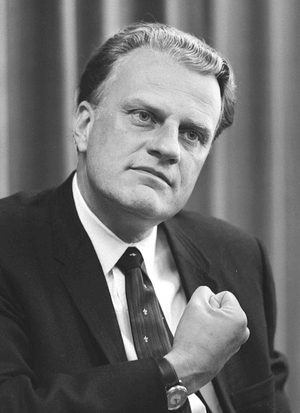

Billy Graham was a Southern Baptist evangelist who preached to an estimated 215 million people in 185 countries, according to the Southern Baptist Convention, and who advised American presidents from Eisenhower on. His practice of working with any church that would sponsor a call to decision, Catholic and mainline Protestant churches included, divided fundamentalists from evangelicals, and every tradition has had to say what it makes of him.
| Lived | 7 November 1918, near Charlotte, North Carolina, to 21 February 2018, Montreat, North Carolina |
|---|---|
| Church | Raised in an Associate Reformed Presbyterian family; baptized as a believer and ordained a Southern Baptist minister (14 January 1939, Peniel Baptist Church, Palatka, Florida); for more than fifty years a nonresident member of First Baptist Church, Dallas |
| Role | Pastor, Western Springs Baptist Church, Illinois (1943); president of Northwestern Schools, Minnesota (1948–52); evangelist; founder of the Billy Graham Evangelistic Association (1950) |
| Influenced by | The evangelist Mordecai Ham, at whose 1934 revival he was converted; his father-in-law L. Nelson Bell, a Southern Presbyterian leader |
| Influenced | Christianity Today (1956); the Lausanne congress on world evangelization (1974); the Billy Graham Center at Wheaton College (dedicated 1980) |
| Writings | Peace with God; How to Be Born Again; the autobiography Just As I Am; the radio program The Hour of Decision (from 1950) |
| Honored | Templeton Prize (1982); Congressional Gold Medal (1996, with Ruth Bell Graham); lay in honor in the US Capitol Rotunda, 28 February to 1 March 2018 |
Life
Graham was born on a dairy farm near Charlotte. In 1934, at sixteen, he was converted at a revival led by Mordecai Ham in the city. He left Bob Jones College and in 1937 moved to Florida Bible Institute, where he changed from the Associate Reformed Presbyterian Church to the Southern Baptists; he was ordained at Peniel Baptist Church in Palatka on 14 January 1939. He enrolled at Wheaton College in 1940, graduated in 1943, married Ruth Bell that year and took the pastorate of Western Springs Baptist Church. He then worked for Youth for Christ, and in 1948 became president of Northwestern Schools in Minnesota, resigning in 1952.
The Los Angeles meetings that began on 25 September 1949 were planned for three weeks and ran eight; press attention made him a national figure. In 1950 he incorporated the Billy Graham Evangelistic Association, began the radio program The Hour of Decision and first called his meetings "crusades." He led the Greater London Crusade at Harringay Arena (1 March to 22 May 1954), helped found Christianity Today (1956) with Bell, and in 1957 held a sixteen-week crusade at Madison Square Garden, which opened on 15 May. In 1953 he removed the ropes that separated black and white attendees at Chattanooga, and in 1957 he welcomed Martin Luther King Jr. to his New York platform. In July 1974 he convened the Lausanne congress, with about 2,400 delegates from 150 countries. In May 1982 he took part in a Moscow conference of religious leaders on nuclear war, opened by Patriarch Pimen.
He was a friend of Eisenhower and of Richard Nixon, later counseled every president, and preached at Nixon's funeral (1994). He died at his home in Montreat on 21 February 2018, aged 99. His body lay in honor in the Capitol Rotunda, and the funeral was held in Charlotte on 2 March 2018.
What he taught
Graham preached human sin, Christ's death for sinners and the need for a personal decision, summed up in the words to Nicodemus, "Ye must be born again" (John 3:7, KJV); two of his best-known books are Peace with God and How to Be Born Again. At the close of a sermon he invited hearers to come forward, and trained counselors spoke with those who did. Some question the method (see below); the larger comparison of assurance, justification and baptism is set out elsewhere.
He held that the Bible is the word of God. The historian Grant Wacker argues that Graham later moved from calling it "inerrant" to calling it "authoritative," often in evasive language (as summarized by David Hollinger in The Christian Century). His policy on church cooperation was stated when the Protestant Council of New York invited him in 1957: "I intend to go anywhere, sponsored by anybody, to preach the gospel of Christ." He is also quoted as saying that "the one badge of Christian discipleship is not orthodoxy but love" (Christian History). Bob Jones, a leading fundamentalist, replied that Graham was peddling a "discount type of religion," and the break with the separatist fundamentalists became final with the New York crusade.
What historians say
Grant Wacker's America's Pastor (Harvard University Press, 2014) is a leading study. As reviewed by David Hollinger, Wacker argues that Graham borrowed popular culture for evangelical moral reform, reinforced middle-American ideals, and moved many Protestants toward a more pluralistic evangelicalism that treated Catholics, Jews and ecumenical Protestants with respect. Hollinger answers that Wacker's own evidence shows Graham perpetuating conservative attitudes more than challenging them, and calls him "an enabler" of the evangelical politics Wacker distances him from. In 1957 The Christian Century said the New York preparation did its "mechanical best to 'succeed'" whether or not the Holy Spirit was present (Christian History).
On race, Graham integrated his meetings and Wacker examines a record that remains contested: Hollinger reads it as Graham seeking changed hearts rather than the force of civil law, and as "too little too late" (the Southern Baptist record is at Segregation). In 1982 he said there was "a measure of religious freedom" in the USSR and sat on the platform with leaders of the Russian Orthodox Church at the Moscow conference, which drew criticism; he said he was there for peace and against nuclear war.
On 1 February 1972 Graham and Nixon spoke in the Oval Office with H. R. Haldeman, and the tape, released by the National Archives in February 2002, records Graham saying that Jews had a "stranglehold" on the American media. Graham said he could not recall the conversation, and apologized, saying of the remarks: "They do not reflect my views and I sincerely apologize for any offense caused by the remarks" (Christianity Today). Christianity Today notes that the tape has gaps, so it is unclear whether he meant Jews generally or Jewish liberals.
How the churches see Graham
- Catholic:
No papal or conciliar document judges Graham's teaching. The record is one of cooperation and courtesy. In 1964 Cardinal Richard Cushing of Boston said that although Catholics did not join the crusade "in body," they joined "in spirit and heart" in praying for it (Christianity Today, 9 October 1964); in 1996, 119 Catholic parishes were among the churches supporting the Twin Cities crusade. At his death a message from Pope Francis was released by Bishop Peter Jugis of Charlotte. Cardinal Daniel DiNardo, then president of the US bishops' conference, said "Thanks be to God for the ministry of Billy Graham," and Bishop Joseph Bambera of Scranton said Graham showed that "what we had in common in Christ was greater than what divided us."
- Orthodox:
The Orthodox statements honor the man and their joint work, and (as reported) do not examine his teaching. In May 1982 Patriarch Pimen of Moscow opened the Moscow conference in which Graham took part. In late February 2018 Patriarch Kirill of Moscow wrote to Franklin Graham that Graham loved and respected the Russian Orthodox Church and that the churches had worked together to protect persecuted Christians in the Middle East and North Africa. Metropolitan Tikhon of the Orthodox Church in America represented it at the funeral on 2 March 2018 and said that Graham "was the voice of the Gospel for many millions of people on every continent." Orthodox teaching on baptism and salvation is set out separately.
- Lutheran:
No Lutheran church body's statement on Graham is cited here. The documented Lutheran involvement is congregational: 269 Lutheran congregations were among the 1,075 churches of 60 denominations that supported the Twin Cities crusade at the Metrodome (19–23 June 1996; Christianity Today, 15 July 1996). Lutheran teaching on baptism and the means of grace is set out separately.
- Reformed:
Graham's family was Presbyterian, and as a youth he memorized the Westminster Shorter Catechism (Stephen Nichols, Ligonier Ministries, who calls him "the other architect of modern evangelicalism"). His father-in-law L. Nelson Bell, a leader of the southern Presbyterian conservatives, served on the board of Christianity Today and of the Billy Graham Evangelistic Association and was moderator of the Presbyterian Church in the US General Assembly in 1972 (Sean Michael Lucas, The Gospel Coalition). Iain Murray of the Reformed publisher Banner of Truth questioned the invitation system in The Invitation System (1967), which weighs its three standard defenses, and a reviewer on the publisher's page says it was used repeatedly in Graham's crusades and that Murray found its scriptural basis lacking. See predestination for the Reformed teaching behind this objection.
- Anglican:
Archbishop Justin Welby called Graham "an exemplar to generation upon generation of modern Christians" and Archbishop John Sentamu of York recalled the new life that came to English churches through his missions, including Mission England (1984). Ian Parkinson of CPAS, a Church of England evangelical agency, said he was "possibly the greatest single catalyst for vocations to Anglican ordained ministry in the late 20th century." Presiding Bishop Michael Curry of the Episcopal Church credited him with insisting on interracial crusades.
- Methodist:
Methodist leaders have spoken as friends and beneficiaries. Bishop Bruce Ough, then president of the United Methodist Council of Bishops, said he first gave his life to Christ at sixteen after watching a televised Graham crusade, and Bishop Paul Leeland called Graham "an inspirational leader who transcended denominational identities." The United Methodist Association of Evangelists gave Graham its Philip Award in 1976. Graham never addressed a United Methodist General Conference (United Methodist News Service, 21 February 2018). The page on John Wesley gives the Methodist teaching on the new birth.
- Baptist:
The Southern Baptist Convention, meeting in Dallas on 12–13 June 2018, resolved that Graham's relationship to it "was one of affection, cooperation, and church membership," and that his life "modeled integrity, modesty, lifelong fidelity to one's spouse, and humility." He was baptized as a believer and ordained by Southern Baptists, and he was for more than fifty years a nonresident member of First Baptist Church, Dallas (Southern Baptist Theological Seminary; Baptist Standard). R. Albert Mohler Jr. called his death the close of "an epic era of evangelical history." Some Southern Baptists thought him "too close to the powerful" (Charlotte Observer, 1971), and fundamentalists criticized his cooperation with churches in the National and World Councils of Churches (Christian History). See the Southern Baptist Convention.
Sources
- Christian History Institute, "The Life and Ministry of Billy Graham" (timeline)
- Christian History Institute, "Billy Graham" Bob Jones; 1957 policy statement; 1957 and 1971 criticisms; Lausanne
- NCpedia, "Billy Graham (1918–2018)" (North Carolina History)
- Billy Graham Evangelistic Association of Canada, Peniel Baptist Church, Palatka (ordination 14 January 1939)
- Evangelical Alliance, "Harringay Crusade" (1 March to 22 May 1954)
- Ligonier Ministries, 5 Minutes in Church History, "Billy Graham" (Nichols)
- Lucas, "Vastly Underrated Leader in 20th-Century Evangelicalism" (L. Nelson Bell), The Gospel Coalition
- Hollinger, review of Wacker, America's Pastor, The Christian Century (September 2014)
- Christianity Today, "Mea Culpa: Graham Laments '72 Comments on Jews" (2002)
- Miller Center, Nixon White House tapes, conversation of 1 February 1972
- Christianity Today, "Mass Evangelism: Billy Graham: Back to Boston" (9 October 1964)
- Christianity Today, "Lutheran, Catholic, and Black Churches Join Graham Effort" (15 July 1996)
- Arlington Catholic Herald, "Rev. Graham recalled for deep faith, integrity" (22 February 2018)
- WCNC, "Pope Francis responds to Rev. Billy Graham's death" (2018)
- Pravmir, "Patriarch Kirill extends condolences over the death of Pastor Billy Graham" (27 February 2018; DECR release of 22 February)
- Orthodox Church in America, "Metropolitan Tikhon represents OCA at funeral of Rev. Billy Graham"
- Banner of Truth, Iain H. Murray, The Invitation System (1967)
- Anglican Journal, "Anglican leaders pay tribute to iconic evangelist Billy Graham" (February 2018)
- Anglican Ink, "Mixed messages following the death of Dr. Billy Graham" (22 February 2018)
- United Methodist News Service, "Graham influenced many United Methodists" (21 February 2018)
- Southern Baptist Convention, "On Commemorating the Life and Ministry of Billy Graham" (2018)
- Southern Baptist Theological Seminary, "Billy Graham, Southern Baptist preacher and evangelist, dies at 99"
- Baptist Standard, "Texans recall famous evangelist Billy Graham as humble servant"
- House Office of the Clerk, "Reverend Billy Graham" (lying in honor, 28 February 2018)
- Christian Science Monitor, "Billy Graham on hand in Moscow A-war meeting" (11 May 1982)
- Billy Graham Library, "1957 New York Crusade"
- Portrait, Wikimedia Commons (public domain, Library of Congress)