George Whitefield 1714–1770
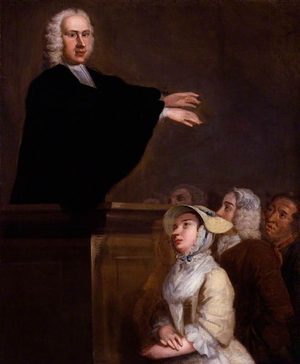

George Whitefield was a priest of the Church of England and the most widely heard preacher of the eighteenth-century revival in Britain and North America. A friend of John Wesley at Oxford, he began preaching in the open air before Wesley did, then parted from him over election and led the Calvinistic wing of Methodism. His orphanage in Georgia was supported in part by enslaved labor, and he argued for the legalization of slavery in that colony.
| Lived | 16 December 1714, Gloucester, to 30 September 1770, Newburyport, Massachusetts |
|---|---|
| Church | Church of England: ordained deacon 20 June 1736 and priest 14 January 1739 |
| Role | Itinerant preacher in Britain and America; founder of the Bethesda orphanage near Savannah (begun 1740); chaplain to the Countess of Huntingdon (1748) |
| Influenced by | The Oxford society of Charles and John Wesley, which he joined in 1735 |
| Influenced | The Welsh Calvinistic Methodists, who sided with him against Wesley; the Countess of Huntingdon's circle; New Light preachers such as Shubal Stearns (attributed) |
| Writings | Journals (from 1738); some sixty-three sermons published in his lifetime; a letter to the inhabitants of Maryland, Virginia and the Carolinas about their enslaved people (1740); a letter to Wesley against Free Grace (dated 24 December 1740, printed 1741); Works, ed. John Gillies (1771–72) |
| Honored | 15 November, with Francis Asbury, in the Episcopal Church's Holy Women, Holy Men; buried beneath the pulpit of the Federal Street meeting-house, Newburyport |
Life
Whitefield was born at the Bell Inn, Gloucester, and entered Pembroke College, Oxford, as a servitor, a student who earned his fees by serving others. In 1735 he was admitted to the Wesleys' society. Bishop Martin Benson ordained him deacon on 20 June 1736, and he preached his first sermon a week later at St Mary de Crypt, Gloucester. He sailed for Georgia in early 1738, returned in August to raise money for an orphan house, and was ordained priest at Christ Church, Oxford, on 14 January 1739.
He began open-air preaching at Rose Green, Kingswood, near Bristol, on 17 February 1739. Three days later he was summoned before the Bristol chancellor's court for preaching without a license, and the city's churches were closed to him. Wesley's funeral sermon says that his Sunday audience at Kingswood was "supposed" to be ten thousand; Wesley himself first preached outdoors at Bristol on 2 April. Whitefield sailed again in August 1739 and in all crossed to America seven times. In 1740 he began building Bethesda near Savannah. He opened a Tabernacle at Moorfields, London, about April 1741, and the Tottenham Court Road chapel followed in 1756. In August 1748 the Countess of Huntingdon made him one of her chaplains.
He died on 30 September 1770 at the manse of Jonathan Parsons in Newburyport, the day after preaching at Exeter, New Hampshire. At his own request he was buried in a vault beneath the pulpit of the Federal Street meeting-house. At his request Wesley preached his funeral sermon in London on 18 November 1770.
What he taught
Whitefield preached extempore, in churches, meeting-houses and fields, and held that sinners must be born again (John 3:7, KJV). Wesley summed up his doctrine as "the new birth, and justification by faith" (justification). He was a Calvinist: he preached on election in 1739 and, in his letter dated 24 December 1740, answered Wesley's sermon Free Grace, which opposed the doctrine of election. The two leaders met in 1741 without agreeing, and by October 1742 relations between them were cordial again. Whitefield left mourning rings to both Wesley brothers.
He remained a priest of the Church of England. At the Calvinistic Methodists' conference at Watford in January 1743, the participants agreed not to separate from the established church. He preached to mixed audiences that included enslaved Africans, urged slaveholders to teach them the gospel, and in his open letter of 1740 wrote: "I think God has a quarrel with you, for your cruelty to the poor negroes."
What historians say
His preaching. Benjamin Franklin, who printed Whitefield's works, wrote in his Autobiography that he thought the orphan house should be built in Philadelphia rather than Georgia and "silently resolved he should get nothing from me," but gave when the collection came. Franklin also "computed that he might well be heard by more than thirty thousand" when Whitefield preached from the courthouse steps in Market Street.
The break with Wesley. Christian History describes the split of 1740–41 as dividing the revival into two camps, with perfection as well as predestination at issue between the leaders. The Welsh reformers sided with Whitefield, while Howel Harris steadfastly supported the Wesleys' efforts for union (Dictionary of Welsh Biography). The same magazine says the two kept a "closer union in affection" until Whitefield's death.
Slavery. Georgia's trustees prohibited slavery when Bethesda was founded. By 1747 the orphanage was in financial difficulty, and a plantation with enslaved workers was acquired in South Carolina to support it. On 6 December 1748 Whitefield wrote to the trustees urging that slavery be allowed in Georgia, arguing that it was the only way to sustain Bethesda and the colony. Slavery was legalized in Georgia in 1751 (some sources say 1752). His will left Bethesda, with its "lands, negroes" and other property, to the Countess of Huntingdon, and a probate inventory of July 1771 lists forty-nine enslaved people by name (Dartmouth Libraries).
Historians weigh this differently. Thomas Kidd, who admires Whitefield, writes that he was arguably central in bringing slavery to Georgia and calls his role in it a serious moral failing; Kidd rejects both ignoring it and dismissing Whitefield's Christian work because of it. Mark Galli (Christian History) argues that Whitefield was unconventional as an evangelist but conventional on slavery, and notes that by 1776 only the Quakers among American denominations had declared slaveholding a sin. Philippa Koch (Church History, 2015) finds that Whitefield and the Halle Pietists read slavery through the doctrine of providence. The Dartmouth project describes Whitefield as seeing slavery as providentially ordained and a means of economic stability, with his concern fixed on the souls of the enslaved rather than their legal status. See also the Anglican record on slavery and the Methodist record.
How the churches see Whitefield
- Catholic:
No Catholic official act or document naming Whitefield is known. The question on which he divided the Methodists, election, is set out for all seven traditions on the predestination page.
- Orthodox:
The Orthodox Church has made no statement about Whitefield that is known. The question of election that divided him from Wesley is set out on the predestination page.
- Lutheran:
No Lutheran church body is known to have made a statement about Whitefield. Philippa Koch (Church History, 2015) has studied his correspondence with August Hermann Francke and Gotthilf August Francke and the Halle Pietist missionaries in Georgia, and finds that Whitefield and the Pietists alike understood slavery in terms of God's providence and the conversion of enslaved people.
- Reformed:
The Welsh Methodists under Howel Harris and Daniel Rowland sided with Whitefield against Wesley on predestination, and Welsh Methodism took a Presbyterian form (Britannica). It became a separate church in 1811, when Thomas Charles ordained nine laymen; it adopted a Confession of Faith in 1823 and a General Assembly in 1864, and is now the Presbyterian Church of Wales. Whitefield himself remained an Anglican priest; he was buried beneath the pulpit of the Federal Street Presbyterian meeting-house in Newburyport (Dictionary of National Biography).
- Anglican:
The Church of England ordained him, and its authorities also resisted him: the Bristol chancellor's court threatened him in February 1739; Bishop Benson, who had ordained him, admonished him on 9 July 1739 to preach only where he was lawfully appointed; and Bishop Gibson of London's pastoral of 1 August 1739 condemned "enthusiasm" as shown in his journals (Dictionary of National Biography). He was a chaplain to the Countess of Huntingdon from 1748. The Episcopal Church's Holy Women, Holy Men commemorates him with Francis Asbury as an evangelist on 15 November; its collect says that God inspired them "with evangelical zeal" and that their proclamation "caused a great awakening."
- Methodist:
Wesley preached the funeral sermon at the Tottenham Court Road chapel and the Tabernacle on 18 November 1770, on Numbers 23:10 ("Let me die the death of the righteous," KJV). He called him "your beloved brother, friend, and pastor; yea, and father too," held up "the new birth, and justification by faith" as the doctrines to keep, and said that on lesser doctrines about which sincere believers have long been divided, "we may think and let think." The World Methodist Council describes Whitefield, Howell Harris and the Countess of Huntingdon as Calvinistic Methodists and the Wesleys as Arminian.
- Baptist:
Whitefield was a priest of the Church of England, not a Baptist. The Encyclopedia of North Carolina reports that Shubal Stearns, a Connecticut Congregationalist, experienced the new birth after hearing Whitefield (the date is given as 1740 or 1746; other accounts say 1745), became a Separate Baptist, and organized the Sandy Creek church in North Carolina on 22 November 1755; the churches of its association, formed in 1758, became known as New Light Baptist churches.
Sources
- Dictionary of National Biography, "Whitefield, George" (1900) dates of the life; Church of England responses; Countess of Huntingdon; death and burial
- Wesley, Sermon 53, "On the Death of the Rev. Mr. George Whitefield" (1770)
- Christian History Institute, "Wesley vs. Whitefield"
- Christian History Institute, Galli, "Slaveholding Evangelist" (issue 38, 1993)
- Dartmouth Libraries, Dartmouth and Slavery Project, "George Whitefield, Early Supporter" 1740 letter; 1748 letter to the trustees; will; 1771 probate inventory
- Thomas Kidd on slavery and George Whitefield (2014)
- Koch, "Slavery, Mission, and the Perils of Providence," Church History 84 (2015)
- Franklin, Autobiography (ushistory.org)
- Episcopal Church, Holy Women, Holy Men: Francis Asbury and George Whitefield, Evangelists
- Britannica, "Presbyterian Church of Wales"
- Dictionary of Welsh Biography, "Harris, Howel"
- NCpedia, "New Lights"
- North Carolina History Project, "Shubal Stearns (1706-1771)"
- Whitefield portrait, Wikimedia Commons (public domain)