Richard Hooker 1554–1600
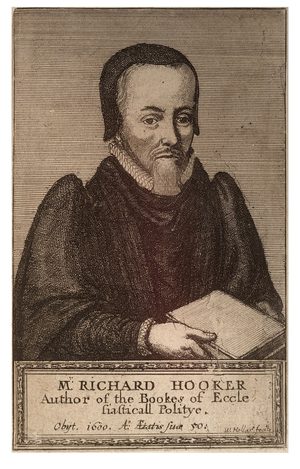

Richard Hooker was an English priest whose Of the Laws of Ecclesiastical Polity (1593–1662) answered the Puritan demand that the Church of England be rebuilt on a pattern found in Scripture. Later Anglicans came to honor him as the first great theologian of their church; historians dispute whether he was a Reformed theologian or the author of something distinct, and the other traditions have met him mostly through that book.
| Lived | Probably March 1554 (some sources, 1553), Heavitree, near Exeter, to 2 November 1600, Bishopsbourne, Kent |
|---|---|
| Church | Priest of the Church of England |
| Role | Fellow of Corpus Christi College, Oxford (1577); Master of the Temple, London (1585–91); rector of Boscombe, Wiltshire (1591), and of Bishopsbourne, Kent (1595) |
| Influenced by | Bishop John Jewel and Edwin Sandys, his patrons; the medieval scholastics and John Calvin, with whom Nigel Voak compares him |
| Influenced | Seventeenth-century Church of England writers, who made him an authority; John Keble and the Oxford Movement, which edited and claimed him |
| Writings | Of the Laws of Ecclesiastical Polity: Books I–IV (1593), V (1597), VI and VIII (1648–51), VII (1662); A Learned Discourse of Justification (preached 1586, printed 1612) |
| Honored | 3 November: Lesser Festival in the Church of England ("Richard Hooker, Priest, Anglican Apologist, Teacher of the Faith, 1600"); "Richard Hooker, Priest, 1600" in the Episcopal Church calendar |
Life
Hooker was born at Heavitree, near Exeter, probably in March 1554, into a family whose name was also written Vowell. He attended Exeter grammar school; his uncle John Hooker arranged support for his studies, and Bishop John Jewel paid his parents an annual sum. After Jewel's death in 1571 Edwin Sandys, then bishop of London, became his patron. Hooker was elected a scholar of Corpus in 1573, took his M.A. in July 1577 and became a fellow that year. He took holy orders about 1581 and preached at Paul's Cross in London. Walton says he then married Joan Churchman, a draper's daughter, and vacated his fellowship; the Dictionary of National Biography treats Walton's story of the marriage with caution. In December 1584 he was presented to the living of Drayton Beauchamp, Buckinghamshire.
On 17 March 1585 (1584 by the old calendar year) Hooker became Master of the Temple, the church of the London lawyers, with the support of Archbishop John Whitgift. Walter Travers, the Temple's afternoon lecturer since 1581 and a leading English Calvinist, whom Lord Burghley had backed for the post, was passed over. In 1586, over four Sundays, Hooker preached in the morning and Travers in the afternoon from the same pulpit. Hooker argued that God might save Roman Catholic forebears who had erred in ignorance; Travers held that those who held Roman Catholic beliefs could not be saved. Thomas Fuller later summed it up: "The pulpit spake pure Canterbury in the morning, and Geneva in the afternoon." In March 1586 Whitgift forbade Travers to preach, and Travers appealed to the council, charging Hooker with heresy. Hooker's sermons on the subject were printed in 1612 as A Learned Discourse of Justification.
In 1591 Hooker resigned the Temple and was presented to Boscombe, Wiltshire, where he finished about half of the Laws. The first four books were licensed for printing on 29 January 1593 (new style); the first edition is undated and sources give 1593 or 1594. Book V followed in 1597, dedicated to Whitgift. In July 1595 the crown presented him to Bishopsbourne, near Canterbury, where he died on 2 November 1600 and was buried in the chancel. Of the last three books, Books VI and VIII appeared in 1648–51 and Book VII in 1662, from his manuscripts.
What he taught
The Laws is a reply to Puritans who held, as the contents of its books put it, that Scripture is "the only rule of all things, which in this life may be done by men" (Book II), that Scripture must contain "a Form of Church Polity, the Laws whereof may in no wise be altered" (Book III), and that the English church was corrupted with "Popish Orders, Rites, and Ceremonies" (Book IV). Book I sets out a theory of law, ending: "Of Law there can be no less acknowledged, than that her seat is the bosom of God, her voice the harmony of the world" (I.16.8). Book V treats the church's public worship and the sacraments; Book VI answers the claim of lay elders to jurisdiction, Book VII treats the jurisdiction and honor of bishops, and Book VIII the supreme authority of the prince, including the claims of the Bishop of Rome. The last three books were compiled from his notes.
On authority, Book V ranks the sources: "what Scripture doth plainly deliver, to that the first place both of credit and obedience is due; the next whereunto is, whatsoever any man can necessarily conclude by force of reason; after these, the voice of the Church succeedeth" (V.8.2). Anglicans often summarize this as Scripture, tradition and reason (how Anglicans answer; Holy Tradition). On the Lord's Supper he wrote that Christ's body and blood are bound to the believer by "a far more divine and mystical kind of union," and that the real presence "is not therefore to be sought for in the sacrament, but in the worthy receiver of the sacrament" (V.67.6). On justification his 1586 Discourse grants that Roman Catholics who err in ignorance may be saved.
In Book VIII, as the Catholic Encyclopedia (1913) summarizes it, Hooker holds that a Christian monarch cares for his subjects' spiritual as well as temporal welfare and may therefore be head of the church, that church law needs the consent of the laity, whom Parliament represents, and that the king may appoint bishops (crown and Parliament).
What historians say
Historians divide over what kind of theologian Hooker was. Through the later nineteenth and much of the twentieth century, W. J. Torrance Kirby reports, he was seen as the defender, and by some the inventor, of an Anglican via media between Rome and continental Protestantism; a more recent view makes him a defender of the Reformed character of the Elizabethan settlement (the via media). Diarmaid MacCulloch presents him as a typical Elizabethan Reformed Protestant whose views shifted in a short career. Nigel Voak (2003) argues that Hooker's early sermons are explicitly Reformed but that his later manuscripts, the incomplete reply to A Christian Letter known as the Dublin Fragments, depart from Calvin, because he gives the human reason and will more power than Reformed teaching did. Kirby, reviewing Voak, answers that Hooker and Calvin shared both a high view of natural reason and a doctrine of total depravity, and in his own book describes Hooker as a magisterial reformer with a Platonist philosophy.
His standing as an Anglican founder is also debated. Michael Brydon argues that the seventeenth century, not the nineteenth, made Hooker a leading father of the Church of England; MacCulloch adds that after 1660 both Tories and Whigs used him and that the Oxford Movement "largely monopolised his memory." The image of a "three-legged stool" does not occur in Book V; the passage above gives an order, not a stool. Hooker did not see the last books through the press: the Dictionary of National Biography doubts that Book VI is as he planned it, Books VII and VIII come from rough notes, and Walton reports that two ministers burned or tore some of his papers after his death.
The record chapters do not treat Hooker himself, but his defense of the established church belongs to the period of the penal laws and the executions of Catholic priests (Elizabethan executions; the Anglican record).
How the churches see Hooker
- Catholic:
The Catholic Church has made no formal statement about Hooker. Walton tells, as a story he had heard, that either Cardinal Allen or Thomas Stapleton read the first book of the Laws to Pope Clement VIII, who is said to have replied that "this man indeed deserves the name of an Author." Walton says only that it was one of the two, and that he had been told it more than forty years before; it is tradition, not a Vatican record. The Catholic Encyclopedia (1913) says one "can, perhaps, take" the Laws as "an authoritative exposition" of one phase of Anglicanism, and sets its account of the monarch's headship against the Catholic ideal of the relation of Church and State.
- Orthodox:
The Orthodox Church has made no statement about Hooker. Its teaching on how Scripture and Tradition relate is set out under Holy Tradition.
- Lutheran:
The Lutheran confessions do not mention Hooker. On church order, Article VII of the Augsburg Confession says agreement on the gospel and the sacraments is enough for unity, and that "Nor is it necessary that human traditions, that is, rites or ceremonies, instituted by men, should be everywhere alike." Hooker's Book III takes up whether Scripture fixes one unalterable form of church polity.
- Reformed:
Hooker's first Reformed critic was Walter Travers, who opposed him in the Temple pulpit in 1586 and charged him with heresy. In 1599 A Christian Letter, signed "certain English Protestants, unfeigned favourers of the present state of religion," asked him to reconcile his books with the Church of England's articles on predestination and the Lord's Supper and with the standing of Calvin and the Reformed churches, and accused him, in Kirby's summary, of promoting "Romish doctrine." Hooker left an unfinished reply. Reformed historians of the Reformation have since taken different sides: Kirby holds that Hooker belonged to magisterial reform alongside Calvin, while Voak argues that he moved away from it.
- Anglican:
The Church of England keeps 3 November as a Lesser Festival, "Richard Hooker, Priest, Anglican Apologist, Teacher of the Faith, 1600," with a collect that asks grace "after the example of your servant Richard Hooker"; the Episcopal Church lists "Richard Hooker, Priest, 1600" on the same day. Walton records that King James said he had received more satisfaction from a paragraph of Hooker than from long treatises by others; this is Walton's report of the king's words.
- Methodist:
The Methodist churches have made no formal statement about Hooker. John Wesley, answering the Reverend Mr. Church in The Principles of a Methodist Farther Explained (1746), took up words Church had cited from "our learned and judicious Hooker," that Scripture "is not the only rule of all things, which, in this life, may be done by men," to defend practices that he said Scripture neither commanded nor forbade.
- Baptist:
The Baptist churches have made no statement about Hooker. The Second London Confession (1677; 1689), which many Baptists hold, says the whole counsel of God is "either expressely set down or necessarily contained in the Holy Scripture," with nothing to be added by "traditions of men," while allowing that some "circumstances" of worship and church government are ordered by "Christian prudence according to the general rules of the Word" (1.6).
Sources
- Dictionary of National Biography, 1885–1900, "Hooker, Richard" (Wikisource) dates of the life, livings, publication of the Laws, the Christian Letter, the posthumous books
- Temple Church, "Hooker, Travers and the Battle of the Pulpit" the mastership and the 1586 dispute
- Izaak Walton, The Life of Mr. Richard Hooker (1665; Project Canterbury) the Clement VIII and King James reports
- Hooker, Works, Keble's arrangement (Internet Archive): Book I and Book V I.16.8; contents of Books II–IV; V.8.2; V.67.6
- Hooker, Works, vol. 2 (Internet Archive), Book V
- Church of England, Morning Prayer for 3 November 2026 (calendar entry and collect)
- Episcopal Church, The Calendar of the Church Year
- MacCulloch, "Richard Hooker: Invention and Re-invention," Ecclesiastical Law Journal 21 (2019), abstract
- Kirby, review of Voak, Richard Hooker and Reformed Theology (OUP, 2003), Sixteenth Century Journal 36/1 (2005) Voak's thesis; the Christian Letter; MacCulloch, English Historical Review 117 (2002), 773–812
- Kirby, Richard Hooker, Reformer and Platonist (publisher's description)
- Brydon, The Evolving Reputation of Richard Hooker (OUP, 2006)
- A Christian Letter of certain English Protestants (1599; Early English Books Online text)
- Catholic Encyclopedia (1913), "Erastus and Erastianism"
- Augsburg Confession, Article VII (Book of Concord)
- Wesley, The Principles of a Methodist Farther Explained (1746), Works vol. 8
- Second London Baptist Confession (1689), ch. 1
- Hollar portrait of Hooker, Wikimedia Commons (public domain)