Francis Asbury 1745–1816
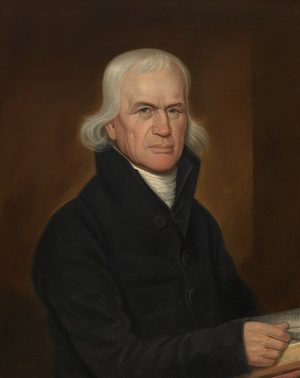

Francis Asbury was a Staffordshire metalworker's son who volunteered in 1771 to preach in America for John Wesley and stayed for the rest of his life. He became, with Thomas Coke, one of the first two superintendents, soon called bishops, of the Methodist Episcopal Church, and he shaped its church order: preachers sent round circuits by a bishop, in a church without a parish system. His title and his handling of slavery have been debated ever since.
| Lived | 20 or 21 August 1745, Hamstead Bridge, parish of Handsworth, Staffordshire, to 31 March 1816, Spotsylvania County, Virginia |
|---|---|
| Church | Methodist; a lay preacher sent out by John Wesley; ordained deacon, elder and superintendent at the Christmas Conference, Baltimore (25–27 December 1784) |
| Role | Wesley's assistant for the American societies (from 1772); general superintendent, later bishop, of the Methodist Episcopal Church (1784–1816) |
| Influenced by | John Wesley, who sent him to America; the English Methodist societies of Staffordshire |
| Influenced | The Methodist Episcopal Church and its itinerant system; Richard Allen, whom he ordained deacon in 1799; the later United Methodist and other Methodist churches that kept the office of bishop |
| Writings | Journal, kept from 7 August 1771 to 7 December 1815 (published with his letters as The Journal and Letters of Francis Asbury, 3 vols., 1958); letters; contributions to the early Discipline |
| Honored | The United Methodist Church keeps no calendar of saints; 31 March is the day of his death |
Life
Asbury was born in the parish of Handsworth near Birmingham; no baptismal record survives, and the day is given as 20 or 21 August 1745. His family moved to Great Barr the next year. He left school early, worked for a local family and then in a metalworker's forge, joined a Methodist band, and became a local preacher. In 1766 he accepted a trial post as a full-time itinerant. At Wesley's Conference at Bristol in August 1771 he volunteered for America; he sailed from Pill on 4 September and landed at Philadelphia on 27 October. In 1772 Wesley made him his assistant in charge of the American preachers and societies.
When the Revolution began in 1775, most of Wesley's English preachers sailed home; Asbury stayed. He urged Methodists to remain neutral. When Maryland demanded an oath of allegiance he withdrew to Delaware, where in March 1778 he took refuge with Judge Thomas White in Kent County, and lived largely in hiding until the worst of the danger had passed. He wrote that some regarded him as "an enemy."
After the war Wesley, acting on the view that he could ordain, ordained two lay preachers himself and set Thomas Coke apart as general superintendent, and in a letter of 10 September 1784 wrote: "I have accordingly appointed Dr. Coke and Mr. Francis Asbury to be Joint Superintendents over our brethren in North America." The Christmas Conference opened on 24 December 1784 at Lovely Lane Chapel, Baltimore; Coke reported eighty-one present, nearly sixty of them American preachers. Asbury would not accept the office on Wesley's appointment alone, and insisted that the preachers elect him. He was then ordained deacon on 25 December, elder on 26 December and superintendent on 27 December. The conference organized the Methodist Episcopal Church.
Soon the two superintendents were being called bishops; Bangs records that they added the title to their names in the Discipline of 1786 without a formal vote of the conference. On 20 September 1788 Wesley wrote to Asbury from London: "How can you, how dare you suffer yourself to be called Bishop? I shudder, I start at the very thought!" He added, "I study to be little: you study to be great." Asbury kept the title. In 1794 he dedicated Bethel Church in Philadelphia, and in 1799 he ordained its pastor, Richard Allen, a deacon (Richard Allen). Asbury never married. By the account of the United Methodist Church, under his direction the church grew from about 1,200 members to some 214,000, with more than 700 ordained preachers. Estimates of the miles he rode, on horseback and later in a carriage, run from about 265,000 to 300,000, with some 16,000 sermons and about 4,000 preachers ordained. He died at the home of George Arnold in Spotsylvania County, Virginia, on 31 March 1816, and is buried in Baltimore.
What he taught
Asbury left little written theology. The Wesleyan teaching he preached was the "plain truths of Scripture": the new birth, assurance, and a holy life (justification by faith and the call to holiness; see John Wesley), and he stressed doing: preaching nearly every day, meeting the societies, and watching over the preachers.
His main work was one of order. He built the circuit system by which bishop-appointed itinerants served a field larger than any parish. In 1780 he persuaded Virginia Methodists to give up a plan to separate from the wider connection, and the United Methodist Church credits him with the practice of drawing the preachers into decisions in conference. The church's constitution protects \"our itinerant general superintendency.\" On the question whether the bishop belongs to a separate order or to the elders, see Methodist bishops and apostolic succession and apostolic succession.
On slavery he was publicly opposed and cautious in action. In 1783 he left a host's house after seeing cruelty to an enslaved man, and in 1796 he wrote of members who hired out slaves at public places that they "ought to be dealt with." He and Coke called on George Washington in 1785 to ask support for emancipation in Virginia. He also wrote that slavery "is awful to me," yet avoided direct attacks on slaveholders, reasoning that they might then be closed to the gospel. In 1804 he allowed two editions of the Discipline to be printed, one omitting the section on slavery for South Carolina.
What historians say
John Wigger's American Saint: Francis Asbury and the Methodists (Oxford, 2009) is the standard biography; the reviewer Grant Wacker calls it "definitive and magisterial." Wigger shows Asbury as celibate and ascetic, as one who connected with ordinary people, and as one who convinced thousands that church order matters. He also shows him wrestling openly, in private and in public, with the wrong of slavery, and after the war resisting Wesley's disapproval of his increasingly pro-American views.
Historians disagree about the title. The Methodist historian Nathan Bangs granted that Wesley was opposed "to the assumption of the title simply" but argued that he was not opposed "to the thing signified by it"; others read Wesley's letter of 1788 as a rebuke of more than the name (Wesley and the bishops).
They also disagree about slavery. Robert Wood, writing in Good News, notes his caustic protests against slavery and his reluctance to put at risk his chance of preaching to slaveholders; William Payne, in the Asbury Journal (2024), titles an article "A Deal with the Devil: Pragmatic Mission and Early American Methodism's Complicity with Slavery." The church's own historians treat the suspension of the 1784 rules, and the printing of a South Carolina Discipline in 1804, as a compromise (Retreating from the rules against slaveholding; the Methodist record). Methodist writers answer that the rules were suspended and never rescinded; the General Conference of 1796 still called slavery a great evil, and the General Rules still list slaveholding among the evils to be avoided. The departure of Black Methodists, Allen among them, is told in Black Methodists.
How the churches see Asbury
- Catholic:
The Catholic Church has made no statement about Asbury. Its teaching on his office is general: Dominus Iesus (2000), para. 17, says that ecclesial communities which have not preserved the valid episcopate "are not Churches in the proper sense" while their baptized members are in a certain, imperfect communion with the Church. The text names no particular body.
- Orthodox:
The Orthodox Church has made no statement about Asbury or the Methodist Episcopal Church. Orthodox teaching on bishops in succession from the apostles is set out under apostolic succession.
- Lutheran:
No Lutheran church has made a statement about Asbury. Lutheran teaching on ordination and oversight is treated under apostolic succession and in ordaining without bishops.
- Reformed:
No Reformed church has made a statement about Asbury. Reformed churches have commonly held that bishops and presbyters are one office, as discussed in bishops and presbyters.
- Anglican:
Wesley was an Anglican priest. He wrote on 10 September 1784 that he had asked the Bishop of London to ordain one preacher for America, "but could not prevail." The Church of England's ordinal says that "from the Apostles' time there have been these Orders of Ministers in Christ's Church; Bishops, Priests, and Deacons," and Wesley's 1788 rebuke is cited in the Anglican case on the title (Wesley and the bishops). In 2003 the Church of England and the Methodist Church in Britain signed a Covenant to work more closely together.
- Methodist:
The United Methodist Church says it "does not designate saints," teaches that "all faithful Christians are saints," and says "if we did, Francis Asbury would be likely to be among the canonized." It says that "Bishop Asbury set the precedents and laid the groundwork for much of what United Methodist bishops do today." United Methodist bishops are "elected from the elders and set apart" for oversight, and its Restrictive Rules forbid doing away with "episcopacy" or "our itinerant general superintendency" (United Methodist Church). The African Methodist Episcopal Church, founded by Richard Allen whom Asbury ordained, also has bishops (AME).
- Baptist:
Baptists have made no statement about Asbury. The Baptist Faith and Message (2000), art. VI, describes the church as "an autonomous local congregation of baptized believers" with two scriptural offices, "pastor/elder/overseer and deacon," so Baptists have no bishop with authority over congregations such as Asbury exercised through his appointments.
Sources
- Dictionary of National Biography, "Asbury, Francis" (Wikisource) birth place, Handsworth parish
- United Methodist Church, "The Christmas Conference: 10 days that started a church" dates, attendance, Asbury's election
- United Methodist Church, "Ask the UMC: what influence did Francis Asbury have on the role of bishops?"
- United Methodist Church, "Methodism's American Saint: Bishop Francis Asbury" growth to 214,000 members, 700 preachers
- United Methodist Church, "To Be United Methodist: Who was Francis Asbury?" the church does not designate saints
- Christianity Today, "Francis Asbury" (Christian History) ordinations of 25–27 December 1784, neutrality, Washington
- Christian History Institute, "Apostles on Horseback" 270,000 miles; 16,000 sermons; 4,000 ordinations
- Delaware Public Archives, historical marker research on Judge Thomas White (KC 46)
- Wesley, letter "To Our Brethren in America," Bristol, 10 September 1784 (Wesley Center Online)
- Wesley, letter to Francis Asbury, 20 September 1788 (Wesley Center Online)
- Bangs, History of the Methodist Episcopal Church, vol. 1 (CCEL) the title "bishop" and Wesley's objection
- Christian Century, review of Wigger, American Saint (2010)
- Wigger, American Saint: Francis Asbury and the Methodists (Oxford University Press, 2009)
- Wood, "What Francis Asbury Believed," Good News
- Payne, "A Deal with the Devil," The Asbury Journal 79:1 (2024)
- Mower, "Early American Methodism and Slavery," The Chronicle (2020) 1804 Discipline; 1785 suspension
- BlackPast, "Allen, Richard (1760-1831)" Bethel dedicated 29 July 1794
- Christianity Today, "Richard Allen" ordained deacon 1799
- Dominus Iesus (Congregation for the Doctrine of the Faith, 2000), para. 17
- Church of England, The Form and Manner of Making, Ordaining and Consecrating of Bishops, Priests and Deacons (1662)
- Methodist Church in Britain, "Church of England and Methodist Church Covenant turns 21" (signed 1 November 2003)
- United Methodist Church, The General Rules of the Methodist Church
- Baptist Faith and Message (2000), art. VI
- Portrait by John Paradise (1813), Wikimedia Commons (public domain)