Richard Allen 1760–1831
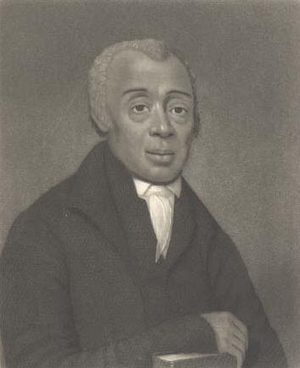

Richard Allen was born enslaved, bought his freedom, became a Methodist preacher in Philadelphia, and in 1816 became the first bishop of the African Methodist Episcopal Church. He led Black Methodists out of St. George's Methodist Church over segregated worship, and his life is the starting point of the historically Black Methodist churches. Every tradition has had to say something about the racism Black Christians met inside the churches.
| Lived | 14 February 1760, Philadelphia (born enslaved to Benjamin Chew; some sources place the birth in Delaware), to 26 March 1831, Philadelphia |
|---|---|
| Church | Methodist Episcopal Church (preacher; ordained a deacon by Bishop Francis Asbury); then the African Methodist Episcopal Church, which he helped found |
| Role | Preacher at St. George's, Philadelphia (from 1786); co-founder of the Free African Society (1787); founder of Bethel Church (dedicated 1794); first bishop of the AME Church (consecrated 11 April 1816) |
| Influenced by | Methodist preaching near Dover, Delaware (his conversion, 1777); Francis Asbury; his friend Absalom Jones |
| Influenced | Daniel Coker and Jacob Tapisco, his colleagues of 1816–17; the AME Church; the Negro convention movement |
| Writings | A Narrative of the Proceedings of the Black People, during the Late Awful Calamity (1794, with Absalom Jones); the AME Discipline (1817, with Jacob Tapisco); The Life Experience and Gospel Labors (published 1833, after his death) |
| Honored | 26 March in Holy Women, Holy Men (Episcopal Church, 2010); remembered in the AME Church as its founder |
Life
Allen was born on 14 February 1760 into the household of the Philadelphia lawyer Benjamin Chew. About 1768 Chew sold the family to Stokely Sturgis, a farmer near Dover, Delaware, and part of the family was later sold away. In 1777 Allen was converted and joined a Methodist society. In his own account, Sturgis heard a sermon against slaveholding, came to believe it applied to him, and offered Allen and his brother the chance to buy their time for sixty pounds in gold and silver, or two thousand dollars in Continental money. They did so, about 1780. Allen cut wood, drove wagons and preached in New Jersey, Pennsylvania and Maryland for about six years.
In February 1786 he came to Philadelphia to preach to Black worshipers at St. George's Methodist Church, where he "raised a society in 1786 of forty-two members." In 1787 he and Absalom Jones founded the Free African Society, a mutual aid society. Allen's account of the break with St. George's says that a trustee took hold of Jones during prayer, saying "You must get up, you must not kneel here"; Jones answered, "wait until prayer is over"; and "we all went out of the church in a body." The date is disputed (see below). Jones led his congregation into the Episcopal Church (St. Thomas's, 1794), while Allen's group remained Methodist. In the yellow fever epidemic of 1793 Allen and Jones organized Black nurses and burial crews.
Bethel Church, in a converted blacksmith's shop, was dedicated on 29 July 1794 with Bishop Asbury presiding. White Methodist elders in Philadelphia continued to claim authority over it; in 1815 they won a judgment allowing the building to be sold, and Allen bought it back for $10,125. In 1816 the Pennsylvania Supreme Court held that Bethel was an independent church. On 9 April 1816 sixteen delegates from five places met in Philadelphia and formed the African Methodist Episcopal Church; Allen was consecrated its first bishop on 11 April. In 1817 he and Jacob Tapisco published its first Discipline. Allen died on 26 March 1831 and is buried beneath Mother Bethel.
What he taught
Allen taught Methodist doctrine and did not claim a new one. In his account he wrote that he was "confident that there was no religious sect or denomination would suit the capacity of the coloured people as well as the Methodist," because "the plain and simple gospel suits best for any people." The AME Church, by its own account, separated over racial discrimination and not over doctrine, and keeps the Methodist twenty-five Articles of Religion (see the AME Church and the Methodist family).
His witness on slavery was direct. He described his own master as convicted by preaching against slaveholding, and in 1794 he and Jones answered the charge that Black nurses had profited from the epidemic with a pamphlet defending their conduct. He worked for Black self-government in church and society, opposed the American Colonization Society's plan to send free Black Americans to Africa (General Commission on Archives and History, United Methodist Church), and his campaign led to the first national Negro convention, held at Bethel in 1830. Methodists had written rules against slaveholding in 1784 and then weakened them (the Methodist record); Allen's work took place against that background.
What historians say
The date of the walkout from St. George's is the best-known dispute. The traditional date is 1787, the year of the Free African Society. In Richard Newman's Freedom's Prophet (2008) and Gary Nash's Forging Freedom, the confrontation comes in 1792, after the church's new gallery was finished, and Newman argues that until then Allen's Black congregation remained a prayer meeting inside St. George's. Other accounts give November 1786 (EBSCO) or 1791 or 1792 (Collegeville Institute); Historic St. George's gives 1794 and marks the date as disputed.
Newman presents Allen as a businessman and community leader who built institutions for free Black Philadelphians and held that his people's future lay in the United States. Alan Taylor, reviewing the book in The New Republic (2009), notes that Newman also records Allen's brief openness to colonization and later support for emigration to Haiti. Accounts also differ on how the break with the Free African Society came about: EBSCO's says that Allen wanted the move from St. George's to lead to a Black Methodist church while others wanted the Society to stay nondenominational, and that he left it within about two years.
The wrong done to Allen and his congregation is set out in Black Methodists pushed out, which describes the white connection's attempt to keep Bethel's pulpit and property, the United Methodist Church's act of repentance in 2000 and the Methodist response. Taylor also writes that during the 1793 epidemic Mathew Carey accused Black nurses of profiteering, and that Allen and Jones answered that Black Philadelphians had acted more heroically than whites.
How the churches see Allen
- Catholic:
The Catholic Church has made no statement about Richard Allen. On slavery, from which he freed himself, Vatican II's Gaudium et Spes (1965, no. 27) lists slavery among the "infamies" that poison society, and popes from Eugene IV (1435) to Gregory XVI (In supremo apostolatus, 1839) and Leo XIII (1888) condemned the slave trade (the Catholic record on slavery).
- Orthodox:
The Orthodox Church has made no statement about Richard Allen, and no Orthodox church calendar lists him.
- Lutheran:
No Lutheran confession or church body has made a statement specifically about Richard Allen that this site has found. The ELCA's Declaration to People of African Descent (27 June 2019) apologized "for its historical complicity in slavery and its enduring legacy of racism" (Lutherans and slavery). The Lutheran Samuel Schmucker, who opposed slavery, helped train Daniel Alexander Payne, a later AME bishop.
- Reformed:
No Reformed church has made a statement about Richard Allen. In 2022 the General Assembly of the Presbyterian Church (U.S.A.) apologized to African Americans "for the sin of slavery and its legacy," and in 2016 the Presbyterian Church in America voted 861 to 123 to "recognize, confess, and condemn" past and continuing racial sins (the Reformed record on slavery).
- Anglican:
The Episcopal Church's Holy Women, Holy Men (2010) listed "Richard Allen, First Bishop of the African Methodist Episcopal Church, 1831" for 26 March, with a collect, readings and a biography that includes the 1787 walkout. The 2018 edition of Lesser Feasts and Fasts keeps Absalom Jones on 13 February and has no separate entry for Allen. Jones, who joined the Episcopal Church after the walkout and became its first Black priest (1802), appears in the calendar as "Absalom Jones, Priest, 1818." In October 2008 the Episcopal Church's Presiding Bishop led a service of repentance for slavery at St. Thomas's in Philadelphia (the Anglican record on slavery). The Church of England has made no statement about Allen.
- Methodist:
The AME Church honors Allen as its founder and first bishop, and Mother Bethel in Philadelphia, where he is buried, is its oldest congregation. On 4 May 2000 the United Methodist General Conference held an Act of Repentance for Racism, recalling the departure of Black Methodists in the eighteenth and nineteenth centuries; on 30 April 2012 it approved full communion with the AME, AME Zion, CME and two other Methodist churches (Black Methodists pushed out; the United Methodist Church).
- Baptist:
No Baptist body has made a statement about Richard Allen. Black Baptists also formed their own conventions, beginning with the Foreign Mission Baptist Convention at Montgomery, Alabama, on 24 November 1880 and the National Baptist Convention of 1895 (National Baptist Convention of America). The Southern Baptist Convention's 1995 Resolution on Racial Reconciliation acknowledged that its founders "defended the right to own slaves," repudiated slavery as a "deplorable sin," and apologized to African Americans for racism (the Baptist record on slavery).
Sources
- Richard Allen, The Life Experience and Gospel Labors (1833), Documenting the American South freedom, conversion, St. George's, yellow fever, Bethel, 1816
- Encyclopedia.com, "Allen, Richard 1760-1831" birth, sale to Sturgis, 1777 conversion, 1816 court ruling
- EBSCO Research Starters, "Founding of the African Methodist Episcopal Church" Bethel dedication, April 1816, consecration, 1817 Discipline
- EBSCO Research Starters, "Free African Society"
- Historic St. George's, "The Great Walk Out" walkout dated 1794, disputed
- Historic St. George's, "Richard Allen"
- Taylor, "The Miracle at Bethel," The New Republic (3 June 2009), reviewing Newman, Freedom's Prophet (2008)
- Terpak, "Building the Black Zion," Concept (Villanova University), on the dating of the walkout
- Collegeville Institute, "Shared History: Absalom Jones and the Methodist and Episcopal Church in America"
- General Commission on Archives and History (United Methodist Church), "Richard Allen"
- National Archives, "Richard Allen and the Origins of the AME Church"
- Allen and Jones, A Narrative of the Proceedings of the Black People during the Late Awful Calamity in Philadelphia (1794)
- Standing Commission on Liturgy and Music, "March 26: Richard Allen" (Holy Women, Holy Men)
- Episcopal Church, Lesser Feasts and Fasts 2018 (13 February, Absalom Jones)
- Episcopal Church, Calendar of the Church Year
- United Methodist News Service report on the Act of Repentance for Racism (May 2000)
- UM News, "Pan-Methodist Full Communion Resolution Approved" (1 May 2012)
- Vatican II, Gaudium et Spes (1965), no. 27
- ELCA Declaration to People of African Descent (2019), Living Lutheran
- Southern Baptist Convention, Resolution on Racial Reconciliation (1995)
- Portrait of Richard Allen, Wikimedia Commons (public domain)