Francis of Assisi 1181/82–1226
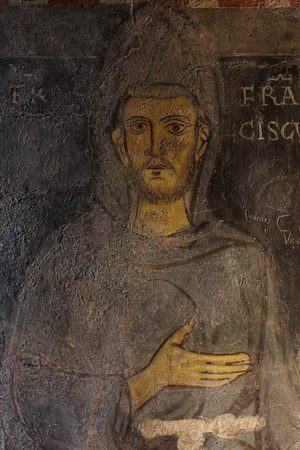

Francis of Assisi was a cloth merchant's son who gave up his inheritance to live in poverty and founded the Order of Friars Minor. He was canonized two years after his death and is honored well beyond the Catholic Church, yet his stigmata, the early biographies and the meaning of his poverty have all been disputed, and the churches that keep his day and those that do not give different reasons.
| Lived | 1181 or 1182, Assisi, to 3 October 1226, the Porziuncola chapel near Assisi |
|---|---|
| Church | Catholic; deacon; founder of the Order of Friars Minor |
| Role | Preacher and founder of the friars; his first rule was approved orally by Innocent III (1209 or 1210), his second by the bull of Honorius III (29 November 1223) |
| Influenced by | The Gospels; the crucifix at San Damiano, according to his biographers |
| Influenced | Clare of Assisi and the Poor Clares; the Franciscan orders; Bonaventure; the Anglican Society of St Francis |
| Writings | Rules (1221, disputed, and 1223); the Canticle of the Creatures (c. 1224–25); letters and Admonitions. Lives: Thomas of Celano (1229, 1247); Bonaventure's Legenda Major (c. 1263) |
| Honored | 4 October: Memorial in the Catholic General Roman Calendar; Lesser Festival in the Church of England; in the Episcopal and ELCA calendars; not in Lutheran Service Book (Missouri Synod) or on Orthodox calendars |
Life
Francis was born in Assisi in 1181 or 1182, the son of the cloth merchant Pietro di Bernardone. After a skirmish in which Assisi lost to Perugia he was held prisoner there for more than a year. In 1205, after a second illness and a dream at Spoleto, he turned back from a military expedition. At the ruined chapel of San Damiano he heard a voice from the crucifix telling him to repair the church, and sold goods from his father's shop to pay for it. Before the bishop of Assisi he returned his clothes and his inheritance, declaring that he would call God his Father (Catholic Encyclopedia).
Companions joined him, and he sought the pope's approval of their way of life. Historians date Innocent III's oral approval to 1209 or 1210; the text of that first rule is lost or uncertain, and some writers identify it with the unconfirmed Rule of 1221. In 1212 Clare, then eighteen, left her father's house on the night after Palm Sunday and joined him at the Porziuncola. On 21 June 1219 Francis sailed from Ancona for Damietta in Egypt, which the Fifth Crusade was besieging (the crusades); he crossed into the enemy camp and was received by Sultan al-Kamil. On 29 November 1223 Honorius III approved the shorter Rule of twelve chapters by the bull Solet annuere. At Christmas 1223 he arranged a nativity scene at Greccio, which tradition links to the Christmas crib.
Around 14 September 1224, at La Verna in the Tuscan Apennines, he is reported to have received the wounds of Christ after a vision of a six-winged seraph. He composed the Canticle of the Creatures in 1224–25 and added a stanza on "Sister Death" shortly before he died. He died at the Porziuncola on the evening of 3 October 1226. Gregory IX canonized him at Assisi on 16 July 1228,.
What he taught
Francis wrote no systematic theology. His writings are two rules, letters, Admonitions and the Canticle, a song of praise to God through Brother Sun, Sister Moon and the other creatures. What he taught is chiefly what he asked his brothers to live: poverty, obedience and chastity, the preaching of repentance, and the imitation of Christ. Friars Minor means "lesser brothers." Pope Francis writes in Fratelli Tutti (2020) that the saint used those words to address his brothers and sisters, and he cites the visit to the Sultan as a sign of Francis's wide, inclusive love (paras. 1, 3).
Catholics place him within the Church's teaching on the saints and the intercession of saints. Protestant writers, as the Baptist survey below shows, have more often admired his poverty, peacemaking and care for creation than any doctrine of his.
What historians say
The lives. Thomas of Celano wrote two lives of Francis, between 1229 and 1247. The 1260 chapter of the order at Narbonne asked Bonaventure to write a new one, and the chapter at Pisa in 1263 approved his Legenda Major as the standard life. A general chapter at Paris in 1266 ordered earlier legends destroyed. The Catholic Encyclopedia (1913) describes two readings of that decree: some see an effort to close the primary sources and replace the historical Francis with a constructed image; others, a practical measure to standardize the legends read in choir. Its author regrets the decree but writes that "literary vandalism" would be unjust, since both sides in the order had appealed to the older legends.
The Francis of history. In 1894 (some editions date it 1893) the French Protestant historian Paul Sabatier published Vie de S. François d'Assise. Lawrence Cunningham, a Catholic scholar, summarizes his thesis: Francis taught a lay Christianity of gospel purity and poverty, and that fraternity was "clericalized and routinized" by constraints from Rome, while members of his own order undermined his ideal of poverty. The book began the "Franciscan question"; Cunningham writes that every serious scholar since has had to reckon with it. The Catholic Encyclopedia praises Sabatier's learning but says he lacked sympathy with Francis's religious standpoint, and Cunningham notes that he wrote from liberal continental Protestantism. John Moorman and Rosalind Brooke developed modified versions of it.
The stigmata. Elias of Cortona, the order's vicar, announced the death in a circular letter dated 3 October 1226, reporting that witnesses had examined the wounds; it is the first document to call them "stigmata" (Cunningham, Christian History, 1994). Celano's first life, about two years after the death, gives the narrative of La Verna, with the six-winged figure and the wounds in hands, feet and side,. Cunningham judges the claim defensible on the historical evidence, which includes notarized statements gathered by early Franciscans, though he notes doubters in Francis's lifetime and that the 1228 canonization bull omits the wounds. He adds that scholars, including the Jesuit Herbert Thurston, almost unanimously treat such phenomena as bodily responses to intense ecstatic and psychological experience, while science cannot decide whether God caused the experience. The historian Michael Cusato argues that the seraph is Christ himself and that Francis's inward image of the Crucified marked his body (St. Anthony Messenger, 2024).
The Sultan. That Francis met al-Kamil is well documented; what was said is not. Jacques de Vitry, who was at Damietta, wrote in 1220 that Francis obtained few results, and in the later Historia occidentalis (1226) that the sultan listened to him for days and sent him back asking for prayer. Bonaventure, writing about 1260, adds an offer to enter a fire with the sultan's clerics, a story most scholars regard as legend. André Vauchez is quoted as saying it is probably futile to try to know what really happened (Connolly, Catholic World Report, 2019).
Later history. No wrong is recorded against Francis himself. Gregory IX entrusted heresy investigations to Dominican and Franciscan inquisitors (1231–33; the medieval Inquisition; the Catholic record).
How the churches see Francis
- Catholic:
Gregory IX canonized Francis on 16 July 1228, and his memorial is 4 October in the General Roman Calendar. Pius XII named him and Catherine of Siena the chief patrons of Italy (brief Licet commissa, 18 June 1939), and John Paul II, by the apostolic letter Inter Sanctos (29 November 1979), named him patron of those who promote ecology. Pope Francis took his name, and Laudato Si' (2015) calls Francis "the example par excellence of care for the vulnerable and of an integral ecology" (para. 10).
- Orthodox:
Francis lived after the 1054 separation of East and West and does not appear on Orthodox calendars; the sources consulted record no synodal statement about him. Individual Orthodox writers have addressed him, chiefly the stigmata. The Russian theologian Alexei Osipov (2010) describes Francis's prayer to share Christ's sufferings as a subtle pride, cites a psychiatric explanation of "hysterical stigmata," and offers Francis as an example of prelest, spiritual self-delusion. The Russian writer M. V. Lodyzhensky, in Light Invisible, likewise explains the stigmata partly by suggestion and holds that, because Francis stood outside the Orthodox Church, his experiences did not come from divine grace. These are the views of those authors, not an act of an Orthodox church.
- Lutheran:
The Apology of the Augsburg Confession (XXVII [XIII], 21) names Francis with Bernard among the "holy men" who used monastic exercises to discipline the body, while teaching that such observances do not merit forgiveness. The ELCA keeps 4 October for "Francis of Assisi, renewer of the church, 1226" (Living Lutheran). The Missouri Synod's Lutheran Service Book has no commemoration for him, an omission remarked on by Larry Beane on the Gottesdienst blog (2022), who notes that Bernard of Clairvaux is included.
- Reformed:
Reformed teaching has addressed the monastic life Francis founded rather than Francis himself. The Westminster Confession (22.7) calls "popish monastical vows of perpetual single life, professed poverty, and regular obedience" "superstitious and sinful snares" and denies that they are "degrees of higher perfection." Calvin (Institutes 4.13.14) says that Christ is wronged when Christians are called Benedictines, Franciscans or Dominicans, since these names take the place of a common Christian profession; he does not discuss Francis himself in that passage.
- Anglican:
The Church of England keeps 4 October as a Lesser Festival, "Francis of Assisi, Friar, Deacon, Founder of the Friars Minor, 1226," and the Episcopal Church lists "Francis of Assisi, Friar, 1226." The Society of St Francis traces itself to the Brotherhood of St Francis of Assisi, founded by Brother Giles at Hilfield, Dorset, on 17 December 1921; in 1937 it merged with the Society of the Divine Compassion, and it calls itself "an Anglican order of men and women inspired by the example of Francis of Assisi."
- Methodist:
The sources consulted show no church-wide United Methodist commemoration of Francis as such. The Book of Worship service for blessing animals (1992) suggests holding it on "the Feast Day of St. Francis of Assisi, October 4," and Discipleship Ministries has published a stewardship sermon series on him, "The Way of Poverty." No General Conference statement on Francis was found.
- Baptist:
No Baptist confession or convention statement on Francis was found. Wyman Richardson's survey of Baptist writing, drawing on Patricia Appelbaum, finds opposition (Spurgeon's Sword and Trowel, 1882; Joe Harrod, 2013, who judged him a poor guide because his thought blurred justification and sanctification), claims that he was a forerunner of the Reformation (the Baptist historian Samuel Caldwell, 1877, called him "a mediaeval Methodist"), and, most often, admiration for his peacemaking, poverty and care for creation. Timothy George of Beeson Divinity School called him "a saint for everyone" (2013).
Sources
- Catholic Encyclopedia (1913), "St. Francis of Assisi" dates of life, rules, Damietta, stigmata, Sabatier
- Catholic Encyclopedia (1913), "St. Bonaventure" Legenda Major, Narbonne 1260, decree of 1266
- Capuchin Franciscans, "Chronology of Francis, Clare and Sources" approval 1209–10, uncertain date
- Cunningham, "The Strange Stigmata," Christian History 42 (1994)
- Cunningham, "The Vitality of the Franciscan Spirit," The Christian Century (1976) Sabatier and the Franciscan question
- Franciscan Media, "The Stigmata of St. Francis: Embracing the Crucified Christ" Celano; Cusato
- Connolly, "The Crusade of Saint Francis," Catholic World Report (2019)
- Pope Francis, Fratelli Tutti (2020)
- Pope Francis, Laudato Si' (2015), para. 10
- Pius XII, brief Licet commissa (18 June 1939)
- John Paul II, Inter Sanctos (29 November 1979), Franciscan Australia page on St Francis, patron of ecology
- Osipov, "Individual Revelation and Its Indications" (OrthoChristian, 2010)
- Lodyzhensky, Light Invisible, ch. 4 (OrthoChristian)
- Apology of the Augsburg Confession, art. XXVII (XIII) (Concordia Publishing House)
- Beane, "Feast of St. Francis of Assisi," Gottesblog (2022)
- Living Lutheran, Prayer Ventures, 4 October
- Westminster Confession of Faith, ch. 22 (OPC)
- Calvin, Institutes 4.13.14 (CCEL)
- Episcopal Church, Calendar of the Church Year
- Church of England, Common Worship daily prayer collects and calendar
- Hilfield Friary, history of the Society of St Francis
- United Methodist Book of Worship, "A Service for the Blessing of Animals" (1992)
- Discipleship Ministries, "Exploring Stewardship with the Saints: Francis of Assisi"
- Richardson, "Baptist Postures Toward Francis of Assisi," Center for Baptist Renewal
- Fresco at the Sacro Speco, Subiaco, Wikimedia Commons (public domain)