Cyril and Methodius Cyril c. 826–869, Methodius c. 815–885
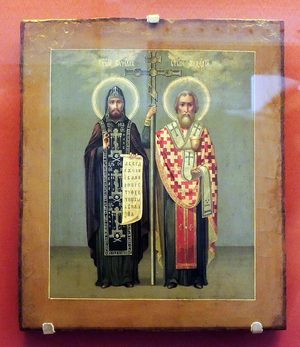

Cyril (born Constantine) and Methodius were brothers from Thessalonica who in 863 went from Constantinople to Moravia to teach in the Slavic language, devising an alphabet and translating Scripture and the services. Orthodox honor them as Equals to the Apostles and Catholics as co-patrons of Europe; both point to the fact that they were sent by the patriarch of Constantinople and approved by the pope of Rome, and both see in them the case for worship in the language of the people.
| Lived | Cyril: Thessalonica, c. 826–828, to Rome, 14 February 869. Methodius: Thessalonica, c. 815–826, to Moravia, 6 April 885 (sources differ on the birth years) |
|---|---|
| Church | The Church of the ninth century, before the Great Schism: sent by the patriarch of Constantinople, Photius, and approved by the popes Hadrian II and John VIII |
| Role | Cyril: scholar, then monk (taking the name Cyril shortly before his death). Methodius: monk, then archbishop for Pannonia and Moravia, with his title from the see of Sirmium |
| Influenced by | Emperor Michael III and the patriarch Photius, who sent them; Prince Rastislav of Moravia, who asked for them |
| Influenced | Their disciples Clement and Naum, who worked in Bulgaria; the Slavonic literature of the Orthodox Slavs |
| Writings | Slavonic translations of the Gospels, the Epistles, the Psalter and service books; Methodius added the Old Testament (except Maccabees) and a book of church law. Two Slavonic Lives, of Constantine and of Methodius, tell their story |
| Honored | 11 May in Orthodox calendars (Equals to the Apostles) and in the Missouri Synod's; 14 February in the Roman Catholic, ELCA, Church of England and Episcopal calendars; co-patrons of Europe (Catholic, 1980) |
Life
The brothers came from Thessalonica; John Paul II gives Cyril's birth as 827 or 828, and the Catholic Encyclopedia gives 827 for Cyril and 826 for Methodius. Cyril, named Constantine, became known as "the Philosopher." According to the Catholic Encyclopedia, the Khazars asked Constantinople for a Christian teacher, and Cyril was sent with his brother; John Paul II speaks of a Byzantine delegation, and Encyclopedia.com dates the mission to 860 and says about two hundred Khazars asked for baptism. In 863 Rastislav, prince of Greater Moravia, who had asked Constantinople for teachers who could preach in his people's language, received the brothers. Francis Dvornik argued that Moravia was already partly Christian, since archaeologists had found the foundations of sixteen stone churches, at least five older than the Byzantine mission, and Jennifer Hevelone-Harper writes that Rastislav looked east partly to keep the Frankish kingdom from gaining a hold on his lands.
Constantine devised an alphabet for Slavic speech (see below) and with Methodius translated the Gospel, the Epistles, the Psalter and the service books. German clergy distrusted the work, since it used Slavonic in church. At Venice in 867, according to the Orthodox Church in America (OCA), Latin clergy opposed Slavonic worship and Constantine called their position the "Three-Language Heresy." In Rome, Pope Hadrian II (867–872), who had succeeded the pope who summoned them, received them kindly and approved the Slavonic books; the Catholic Encyclopedia adds that he ordained both brothers bishops. Constantine fell ill, became a monk under the name Cyril, and died on 14 February 869, fifty days later, aged about forty-two, asking Methodius to continue.
Hadrian made Methodius archbishop for the ancient diocese of Pannonia and Moravia, with his title taken from the see of Sirmium and permission for Slavonic worship. In 870, with the help of Svatopluk of Nitra, Bishop Hermanrich had him arrested and held in a monastery in Swabia; John Paul II says the charge was that he had invaded another bishop's jurisdiction. Accounts give his imprisonment as two or three years; John VIII obtained his release in 873. In 880 John VIII's letter Industriae tuae restored the privileges Hadrian had granted, though the Catholic Encyclopedia says the pope required the Gospel to be read first in Latin and then in Slavonic. Methodius, with two pupils, translated the Old Testament except the books of Maccabees, and the Nomocanon; the German priest Wiching, whom the pope made his suffragan, challenged him and produced letters in the pope's name that the pope declared false. Methodius died on 6 April 885 and named his disciple Gorazd as successor.
What they taught and did
The brothers' principle was that the Gospel should be preached, read and sung in the people's own language, and that a translation should be as accurate as its sacred subject demands (Hevelone-Harper in Christian History). Against Latin clergy who allowed worship only in Hebrew, Greek and Latin, they held that every people may praise God in its own tongue; the Orthodox Church makes this principle its own (Liturgy in the people's language; The Bible and the people). Their works were translations and service books rather than treatises: the Slavonic Gospel, Epistles and Psalms, then Methodius's Old Testament and his Nomocanon, a book of church law. John Paul II records that when Methodius visited Constantinople, Photius was "in full communion with Rome," and the pope calls the brothers links between the Eastern and Western traditions (Slavorum Apostoli, 6 and 27).
What historians say
The alphabets. According to the OCA, Constantine devised the Glagolitic alphabet before the mission, and Cyrillic, named for Cyril and based largely on Greek letters, was most likely developed later by his disciple Constantine of Preslav; John Paul II instead places its development in Bulgaria through Clement of Ohrid (Slavorum Apostoli, 24). Christian History and Encyclopedia.com describe Cyril's own alphabet as the one that became the Cyrillic. The icon above shows a Slavonic alphabet on Cyril's scroll in the later Cyrillic style.
The Lives. Much of what is known of the missions comes from the Slavonic Life of Constantine and Life of Methodius, which John Paul II cites throughout (Slavorum Apostoli, 1985). Sources differ on details: Cyril's and Methodius's birth years, the length of Methodius's imprisonment (two years in the pope's account, two and a half or three in others), and who drove out the disciples.
What became of the Slavonic liturgy in Moravia. After Methodius died, according to Britannica, Pope Stephen V forbade the Slavonic liturgy; the OCA reports that Svatopluk arrested, exiled or enslaved many of Methodius's disciples, and another account names Wiching. Some, among them Clement and Naum, reached Bulgaria, where in 893 Slavonic became the language of church and state. After Greater Moravia fell (c. 905–906) the Latin rite replaced the Slavonic in Bohemia, but the Slavonic language lasted in the liturgy of Croatian Catholics, and the Eastern churches of the Slavs use it still (Slavorum Apostoli, 21 and 23).
How the churches see Cyril and Methodius
- Catholic:
Leo XIII extended their feast to the whole Church by the encyclical Grande Munus (30 September 1880), and the Latin Church now keeps it on 14 February. In the apostolic letter Egregiae Virtutis (31 December 1980) John Paul II proclaimed them co-patrons of Europe with Benedict, and in the encyclical Slavorum Apostoli (2 June 1985) he called them a "spiritual bridge" between the Eastern and Western traditions and said that Hadrian II approved the Slavonic liturgical books.
- Orthodox:
The Orthodox Church honors them on 11 May as "Equals of the Apostles and Teachers of the Slavs"; the troparion asks them to entreat the Master of all to strengthen all nations in Orthodoxy and unity of mind (OCA). Slavic Orthodox churches, among them the Bulgarian, use the Church Slavonic that grew from their work, and Orthodox writers cite them as the pattern for worship in each people's language.
- Lutheran:
The ELCA's worship calendar commemorates "Cyril, monk, 869, and Methodius, bishop, 885, missionaries to the Slavs" on 14 February, as the Episcopal calendar does. Lutheran Service Book of the Missouri Synod lists "Cyril and Methodius, Missionaries to the Slavs" on 11 May.
- Reformed:
No Reformed confession or church statement naming Cyril and Methodius has been found for this page. The Westminster Confession (1.8) says the Scriptures are "to be translated into the vulgar language of every nation unto which they come," the principle on which the brothers acted.
- Anglican:
The Church of England's calendar lists "Cyril and Methodius, Missionaries to the Slavs, 869 and 885" on 14 February as a Lesser Festival, and the Episcopal Church's calendar lists "Cyril, Monk, and Methodius, Bishop, Missionaries to the Slavs, 869, 885" on the same day. Article XXIV of the Thirty-Nine Articles says it is "plainly repugnant to the Word of God" to pray publicly or minister the Sacraments "in a tongue not understanded of the people."
- Methodist:
No statement by a Methodist church naming Cyril and Methodius has been found for this page. The Uniting Church in Australia, formed in 1977 by the union of the Methodist, Presbyterian and Congregational churches, includes them in its Calendar of Commemorations on 14 February, describing them as the "apostles of the Slavs."
- Baptist:
No Baptist confession or convention statement naming them has been found for this page. The Second London Confession (1677; reissued 1689), 1.8, says the Scriptures "are to be translated into the vulgar language of every Nation, unto which they come."
Sources
- Catholic Encyclopedia (1908), "Sts. Cyril and Methodius" Moravia, Hadrian II, Wiching, John VIII, Grande Munus, deaths
- John Paul II, Slavorum Apostoli (2 June 1985) Egregiae Virtutis (31 December 1980), Khazars, birth years, Sirmium, imprisonment, Industriae tuae, Photius
- OCA, "Saints Cyril and Methodius, Evangelizers of the Slavs and Equal to the Apostles" Moravia 863, Venice 867, Glagolitic, Constantine of Preslav, Bulgaria 893
- OCA, Lives of the Saints, "Equals of the Apostles and Teachers of the Slavs, Cyril and Methodius" (11 May)
- Encyclopedia.com, "Cyril and Methodius" Khazar mission c. 860, imprisonment in Swabia, Sirmium
- Britannica, "Saints Cyril and Methodius" Stephen V forbade the Slavonic liturgy
- Hevelone-Harper, "Translating the Gospel in Eastern Europe," Christian History (2008)
- Dvornik, "The Significance of the Missions of Cyril and Methodius," Slavic Review 23 (1964)
- Lutheran Service Book commemorations (Concordia Publishing House)
- ELCA Worship, prayer prompts for 12 February 2023 (14 February commemoration)
- Episcopal Church, Calendar of the Church Year
- Church of England, Morning Prayer for 14 February 2025 (Lesser Festival)
- Church of England, Articles of Religion, Article XXIV
- Uniting Church in Australia, Calendar of Commemorations (14 February, as reproduced by the Congregation of Mark the Evangelist)
- Westminster Confession of Faith, ch. 1
- Second London Baptist Confession (1689), ch. 1
- Icon of Saints Cyril and Methodius, Wikimedia Commons (CC BY-SA 4.0)