Thomas Cranmer 1489–1556
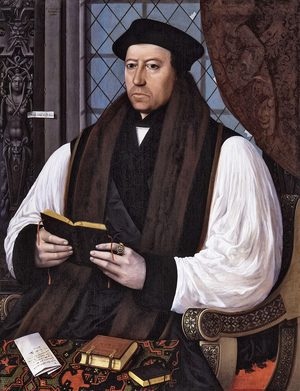

Thomas Cranmer was a Cambridge scholar who, as Archbishop of Canterbury from 1533, helped Henry VIII end his first marriage and then, under Edward VI, wrote the first two English Books of Common Prayer and the articles of religion behind the Thirty-nine Articles. Mary I's government burned him for heresy in 1556. Anglicans honor him as the architect of their liturgy and a martyr; the other traditions judge his work and his recantations differently.
| Lived | 2 July 1489, Aslockton, Nottinghamshire, to 21 March 1556, Oxford |
|---|---|
| Church | Priest of the Church of England; Archbishop of Canterbury from 1533 until his death |
| Role | Fellow of Jesus College, Cambridge; Doctor of Divinity (1526); adviser on Henry VIII's annulment; principal compiler of the prayer books of Edward VI |
| Influenced by | The Nuremberg reformer Andreas Osiander; Continental reformers whom he invited to England, Martin Bucer and Peter Martyr Vermigli |
| Influenced | The Book of Common Prayer; the Thirty-nine Articles (1563), which descend from his Forty-two |
| Writings | Preface to the Great Bible (1540); Exhortation and Litany (1544); Catechism (1548); Books of Common Prayer (1549, 1552); Defence of the True and Catholic Doctrine of the Sacrament (1550); Forty-two Articles (1553) |
| Honored | 21 March, Lesser Festival in the Church of England; 21 March in the Episcopal Church; 16 October for Latimer and Ridley, burned together in 1555 |
Life
Cranmer came from a Nottinghamshire gentry family, studied at Jesus College, Cambridge, became a fellow and took orders; he received his doctorate in divinity in 1526. In 1529 he suggested that Henry VIII ask the universities of Europe whether his marriage to Catherine of Aragon was valid. On an embassy to Germany in 1532 he married a niece of the Nuremberg reformer Andreas Osiander (some accounts say of Osiander's wife) and later brought her to England in secret. When Archbishop Warham died that August, Henry named him successor; he was consecrated on 30 March 1533 with papal bulls from Clement VII, and on 23 May 1533 he pronounced the king's marriage to Catherine void.
He shared church policy with Thomas Cromwell and contributed to the Bishops' Book (1537). In 1539 he opposed the Act of Six Articles, which forced him to send his wife away. The second edition of the Great Bible (April 1540) carried his preface, and the English Litany appeared in 1544. Under Edward VI he oversaw the Book of Homilies (1547), welcomed Vermigli (Oxford, 1548) and Bucer (Cambridge, 1549), and issued the Prayer Books of 1549 and 1552, the Ordinal (1550) and the Forty-two Articles (1553). The 1549 book provoked the western rebellion that year.
He went along uneasily with Edward's plan to pass the crown to Lady Jane Grey. Under Mary I he was condemned for treason in 1553, disputed at Oxford in April 1554, and was tried for heresy. In early 1556 he signed a series of recantations accepting Catholic doctrine. On 21 March 1556, at Oxford, he withdrew them and rejected the pope; John Foxe reports that he thrust his right hand, which had signed, into the fire first, and died saying "Lord Jesus, receive my spirit."
What he taught
On justification Cranmer held that sinners are accounted righteous by faith in Christ's merit. The Homily of Salvation in the 1547 book is attributed to him, and Article XI says: "We are accounted righteous before God, only for the merit of our Lord and Saviour Jesus Christ by Faith." His Great Bible preface urged ordinary people to read Scripture (Scripture alone), and the Prayer Book put Scripture and the daily offices into English for the whole church. He held that the king governs the church in England, and he stayed loyal to the crown through four reigns; at the stake he denounced the pope.
His teaching on the Lord's Supper changed. He began, in the historian William Tighe's account, with loosely Lutheran views, affirming Christ's presence while rejecting the philosophy of transubstantiation, and by about 1546–47 had moved to a symbolic view closer to Heinrich Bullinger's than to Calvin's. His 1550 Defence attacked transubstantiation and the sacrifice of the Mass. The 1552 book changed the words at communion, and the Privy Council added the "Black Rubric" denying a bodily presence in October 1552 (the rubric). The Articles descended from his Forty-two say that Christ's body is "given, taken, and eaten, in the Supper, only after an heavenly and spiritual manner" (XXVIII), and that infant baptism "is in any wise to be retained" (XXVII).
What historians say
Diarmaid MacCulloch's Thomas Cranmer: A Life (1996) shows a conservative Cambridge don who became a Protestant by stages, and, as Tighe reports, stresses that Cranmer would have rejected any middle way between truth and Antichrist, so he was not the founder of a "via media" later Anglicans imagined. Euan Cameron's Oxford Companion entry answers the charge of timidity by pointing to a "curiously biddable humility," loyalty to the crown and a taste for gradual change, and ranks him below the Protestant theologians who came to England in 1549–53. The Catholic Encyclopedia quotes Macaulay's verdict, "a supple, timid, interested courtier." Historians also disagree about his Eucharistic view: Tighe calls it Zwinglian-leaning, while Ashley Null argues that he built a Reformed doctrine from Cyril of Alexandria, a reading Brian Douglas disputes (Journal of Anglican Studies).
Several acts are criticized. He pronounced Henry's marriages to Catherine of Aragon (1533) and Anne Boleyn void and ended the one to Anne of Cleves (Henry and the church). With Ridley and Coverdale he condemned the Anabaptist Joan Bocher (burned May 1550) and the Dutch surgeon George van Parris (April 1551); in Foxe's account he pressed a reluctant Edward VI to sign the first warrant, and Anglican writers answer that the deaths were sentences under the heresy law of his age (executions of reformers; the Anglican record). His own death is the best known: Eamon Duffy, as Lucy Beckett reports, thinks Cardinal Pole probably tried to dissuade Mary from burning a man already reconciled to the Church.
How the churches see Cranmer
- Catholic:
Rome has made no judgment on Cranmer himself. Leo XIII's letter Apostolicae Curae (1896), after examining the Ordinal introduced under Edward VI (it does not name Cranmer), declared Anglican ordinations "absolutely null and utterly void"; the Archbishops of Canterbury and York answered in Saepius Officio (1897) (the exchange). The Catholic Encyclopedia (1909) credits him with the chief part in the first Prayer Book and the Forty-two Articles, and calls his execution "doubtless impolitic" but says it "can hardly be deemed unjust if his career be carefully considered." Duffy's Fires of Faith (2009) treats the burning of Cranmer as a possible exception to Mary's following Pole's lead.
- Orthodox:
The Orthodox Church has made no statement about Cranmer. He took "A Prayer of St. Chrysostom" from the Byzantine liturgies into his Litany (John Chrysostom). The Synod of Jerusalem (1672) uses the word transubstantiation of the Eucharist, which Article XXVIII, descended from Cranmer's Articles, rejects (the Synod's text).
- Lutheran:
The Lutheran confessions do not mention Cranmer. His ties ran through Nuremberg: he married there in 1532, and his 1548 Catechism is an English adaptation of the Nuremberg Lutheran Kinderpredigt (1533), probably through Justus Jonas's Latin version, though scholars doubt that Jonas made such a version. On the Supper he left the Lutheran position; Tighe dates the move to about 1546–47.
- Reformed:
Cranmer brought Vermigli to Oxford (1548) and Bucer to Cambridge (1549) and in 1552 invited Calvin, Bullinger and Melanchthon to a council of Protestant churches; Calvin declined. In a letter of that year Calvin told him that "the eyes of many are fixed upon you," and urged further reform. Tighe finds Cranmer's later view of the Supper closer to Bullinger's than to Calvin's. No Reformed church has issued a statement about him.
- Anglican:
The Church of England's calendar keeps 21 March as a Lesser Festival, "Thomas Cranmer, Archbishop of Canterbury, Reformation Martyr, 1556"; its collect thanks God that through him "you renewed the life and worship of your Church." The Episcopal Church also keeps 21 March, and Latimer and Ridley, burned together on 16 October 1555, share a separate commemoration on that day. Canon A 5 finds the Church's doctrine in the Articles, the Prayer Book and the Ordinal, all in his line (the Articles).
- Methodist:
John Wesley's Sunday Service of the Methodists in North America (1784) is an abridgment of the Prayer Book, whose preface says no liturgy breathes "more of a solid, scriptural, rational piety than the Common Prayer of the Church of England." Wesley also shortened the Thirty-nine Articles to twenty-five for American Methodists. The Methodist churches have issued no statement about Cranmer.
- Baptist:
Baptist churches have made no statement about Cranmer. His Articles keep infant baptism (XXVII); the Second London Confession (1677; 1689) says baptism is for those who "actually profess" repentance and faith (29.2), so Baptists decline what the Articles require (from the Reformation to the Baptists).
Sources
- Euan Cameron, "Cranmer, Thomas," The Oxford Companion to British History (via Encyclopedia.com) career dates, Osiander marriage, historians' views
- Anne Boleyn Files, 30 March 1533: Cranmer consecrated archbishop
- Anne Boleyn Files, 23 May 1533: sentence of the Dunstable court
- Cambridge University Library, The Great Bible April 1540 edition with Cranmer's preface
- Books of Homilies (Biblical Training) 1547 Homilies and Cranmer's share
- Catholic Encyclopedia, "England (Since the Reformation)"
- Tighe, review of MacCulloch, Thomas Cranmer: A Life, New Oxford Review (December 1998)
- Null, "Thomas Cranmer's appropriation of the eucharistic theology of Cyril of Alexandria," Journal of Anglican Studies
- Beckett, review of Duffy, Fires of Faith, The Spectator (June 2009)
- Graves, "Cranmer Insisted on Burning van Pare," Christian History Institute Joan Bocher and George van Parris
- Reimer, "The archbishop's hand," Christian History 160
- Foxe, Acts and Monuments, "Thomas Cranmer" (transcription)
- Church of England, Articles of Religion (XI, XXVII, XXVIII)
- Church of England, 21 March: Thomas Cranmer (Oremus)
- Leo XIII, Apostolicae Curae (1896)
- Wedgeworth, "Calvin on the Church of England, Part 2," Ad Fontes Calvin's 1552 letter to Cranmer
- Peter Martyr Vermigli, Britannica Oxford 1548
- Wesley, Sunday Service of the Methodists (1784), preface quoted in Beebe, Pastoral Office
- Second London Baptist Confession (1689), ch. 29
- Gerlach Flicke portrait, Wikimedia Commons (public domain)