Luther Bible 1522–1545
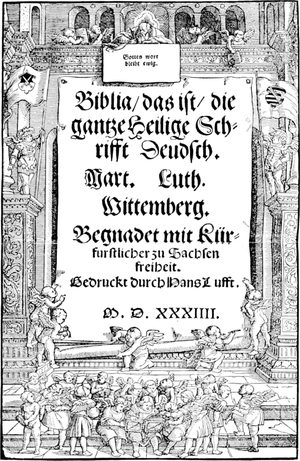

Luther's German Bible began with the New Testament of September 1522, appeared complete in 1534 and was last revised by Luther in 1545. It printed the Apocrypha in a separate section, set four New Testament books apart, and added "alone" to Romans 3:28, so every tradition has had to say what it makes of it. It is still revised for the German Protestant churches; the latest revision went on sale in 2016.
| Published | New Testament, September 1522; Old Testament in parts, 1523–1532; complete Bible, 1534 (Hans Lufft, Wittenberg); last edition revised by Luther, 1545 |
|---|---|
| Translators | Martin Luther, with a Wittenberg circle including Philipp Melanchthon, Matthäus Aurogallus, Caspar Cruciger, Johannes Bugenhagen, Justus Jonas and the proofreader Georg Rörer |
| Language | German |
| Old Testament from | Hebrew Masoretic text (Brescia, 1494), with the Septuagint, the Vulgate and Latin versions consulted |
| New Testament from | Erasmus's Greek text, second edition (1519) |
| Books | 39 Old Testament books of the Hebrew canon, then the Apocrypha (among them Judith, Wisdom, Tobit, Sirach, Baruch, 1–2 Maccabees and additions to Esther and Daniel) between the Testaments, then 27 New Testament books, with Hebrews, James, Jude and Revelation last |
| Approach | Idiomatic: between word-for-word and thought-for-thought |
| Copyright | Luther's 1545 text is public domain; Luther 2017 is held by the Evangelical Church in Germany (EKD) and published by the Deutsche Bibelgesellschaft |
| Used by | Lutheran and other Protestant churches in German-speaking lands; Luther 2017 is the EKD's recommended text |
How it was made
Luther began the New Testament at the Wartburg after the Edict of Worms and finished it at Wittenberg; it appeared in September 1522. The first printing of 3,000 to 5,000 copies sold out within weeks and a revised edition followed in December (Howard Jones, Oxford). The Old Testament came out in parts: the Pentateuch in 1523, the Psalter in 1524, the Prophets in 1532, and the whole Bible, printed with woodcuts by Hans Lufft, in 1534. Philip Schaff describes a weekly Bible circle at Luther's house, with Melanchthon for the Greek, Cruciger for the Hebrew and Aramaic, Bugenhagen for the Vulgate and Rörer as proofreader, and notes that Jewish rabbis were consulted. Luther kept revising the text, and the last edition in his lifetime is that of 1545.
Luther prefaced the books. The Preface to the New Testament (1522) ranks John, Paul's letters and 1 Peter above Hebrews, James, Jude and Revelation, which are placed last, and calls James "an epistle of straw" by comparison (Luther's Works 35:362); the remark was dropped from the complete Bible. Lutheran writers answer that the prefaces are Luther's opinion, not confession (the debate page).
How it translates
Luther worked from the original languages. The New Testament follows Erasmus's Greek of 1519, with some use of an older German version; the Old Testament follows the Masoretic text printed at Brescia in 1494, with Pagnino's Latin version, the Septuagint, the Vulgate and Lyra's commentary consulted (Schaff). In On Translating: An Open Letter (written at Coburg, 8 September 1530) he said one must "ask the mother in the home, the children on the street, the common man in the marketplace" and translate as they speak.
Two choices drew most comment. In Romans 3:28 he added "allein" ("alone"): "It is a fact that the letters sola are not there," he wrote, but German idiom and Paul's meaning require it (Luther's Works 35:188–189). Catholic critics reply that the word turns Paul's contrast of law and grace into one of faith and love (the debate page). For Luke 1:28 he wrote "du holdselige" ("you gracious one") rather than "full of grace," which Emser criticized.
The Apocrypha stand between the Testaments under the heading "not held to be equal to Holy Scripture, but useful and good to read" (the canon).
Reception and revisions
The Catholic Encyclopedia calls the translation "thoroughly idiomatic" though "not free from errors." Jerome Emser's 1523 critique counted "1,400 heretical errors and lies"; his own New Testament (1527) kept Luther's text largely, and Johann Dietenberger's complete Catholic Bible (Mainz, 1534) became, in later revisions, "the Catholic Bible." In Zürich, Luther's parts were adopted, and a Reformed Bible followed in 1530.
Church-authorized revisions followed: 1892 (the Kirchenkonferenz), 1912, the New Testament in 1956 and 1984, the Old Testament in 1964 and the Apocrypha in 1970. In 2006 the Deutsche Bibelgesellschaft asked the EKD Council to review the 1984 text; a steering committee formed in 2010, some 70 scholars worked on it, and it went on sale on 19 October 2016, for the 500th anniversary of the Reformation. Its Apocrypha were heavily revised.
Where each church stands on the Luther Bible
- Catholic:
The Council of Trent (Session IV, 8 April 1546) listed the Old Testament books Luther set apart and anathematized anyone who does not receive them as sacred and canonical. Dei Verbum 22 (1965) asks for "suitable and correct translations" from the original texts and, with Church approval, for translations made with "the separated brethren." The German Catholic liturgical Bible is the Einheitsübersetzung (1979, revised and presented 20 September 2016); at Romans 3:28 it reads "durch Glauben, unabhängig von Werken des Gesetzes," without "allein."
- Orthodox:
The Orthodox Church has made no statement on Luther's Bible. Its Old Testament follows the Septuagint, not the Hebrew text Luther used. The Synod of Jerusalem (1672) called Wisdom, Judith, Tobit, Maccabees and Sirach "genuine parts of Scripture," and Patriarch Jeremias II's reply to the Lutheran theologians of Tübingen (to 1581) turned on the Fathers' place in reading Scripture.
- Lutheran:
The Formula of Concord (Rule and Norm) names the prophetic and apostolic writings as the norm but lists no books. The EKD Council recommends Luther 2017 and holds its rights. Lutheran defenders of "allein" cite Luther's Open Letter (the Wisconsin Synod's FAQ quotes it) and the Apology of the Augsburg Confession, IV.73–74, and hold that the prefaces are Luther's opinion, not confession.
- Reformed:
The Zürich Bible (1530; revised 1531), published by Froschauer, grew from Luther's New Testament adapted to Swiss usage in 1524; Conrad Pellican and Leo Jud prepared the Prophets and Apocrypha (Schaff). A new Zürcher Bibel was presented on 24 June 2007. The Westminster Confession (1.3) says the Apocrypha, "not being of divine inspiration," are no part of the canon. R. Scott Clark argues that the Belgic Confession's "by faith alone" (art. 22) probably came from Luther's rendering.
- Anglican:
The Church of England has made no statement on Luther's Bible. Article VI says of the Apocrypha that "the Church doth read" them "for example of life and instruction of manners" but does not use them to establish doctrine. Tyndale's prologue to Romans is largely a translation of Luther's 1522 preface (Tyndale), and Coverdale's 1535 Bible was "based on the Latin and the German versions" (Catholic Encyclopedia).
- Methodist:
Methodism has made no statement on Luther's Bible. Wesley's Journal for 24 May 1738 records that Luther's Preface to Romans was being read when his heart was "strangely warmed." Wesley's abridged Articles of Religion (1784) omit the Anglican paragraph on the Apocrypha, so Methodist doctrine says nothing about them.
- Baptist:
Baptists have made no statement on Luther's Bible. The Second London Confession (1689), 1.3, says the Apocrypha, "not being of divine inspiration," are no part of the canon. Baptist questioners who hold the Bible inerrant also object to Luther's ranking of Hebrews, James, Jude and Revelation (the debate page).
Sources
- Philip Schaff, History of the Christian Church, vol. 7 (1910), Luther's translation of the Bible texts used, translation circle, parts and dates
- Luther, An Open Letter on Translating (1530), tr. Michael D. Marlowe sola, Luke 1:28, Emser; Weimar edition 30 II, 632–646
- Howard Jones, "Sendbrief vom Dolmetschen 2: The Translation Controversy," History of the Book, University of Oxford print run; Emser's gloss on Romans 3:28
- Carol Regulski, "Emser on Luther's Bible Translation," History of the Book, University of Oxford Emser's 1523 critique
- Catholic Encyclopedia, "Versions of the Bible" Emser, Dietenberger, Zürich Bible, Coverdale
- Catholic Encyclopedia, "Martin Luther"
- Philip Schaff, History of the Christian Church, vol. 8, on Zwingli's Bible Zürich Bible
- evangelisch.de, "Die Lutherbibel 2017: Fragen und Antworten" (19 September 2016) revision history, 2006 request, 2010 committee, 19 October 2016, rights
- Sonntagsblatt, "Wie die Lutherbibel überarbeitet wurde" (2016) 70 scholars; Apocrypha revised
- Römer 3,28 in the Lutherbibel 2017, bibleserver.com
- Römer 3,28 in the Einheitsübersetzung 2016, bibleserver.com
- evangelisch.de, "Revision der katholischen Bibelübersetzung ist fertig" (20 September 2016)
- Dei Verbum (1965), art. 22, vatican.va
- Wisconsin Evangelical Lutheran Synod, "Romans 3:28 and Martin Luther" quotes Luther's Works 35:188–189
- R. Scott Clark, "The Reformed Churches Confess Luther's Translation of Romans 3:28: Allein," Heidelblog (2020)
- Theologischer Verlag Zürich, Zürcher Bibel 2007 launch materials
- Thomas Wengert, Word & World 35:3 (2015), on Luther's prefaces to the New Testament, James and Jude (Luther's Works 35:362, 395–397)