John Wesley 1703–1791
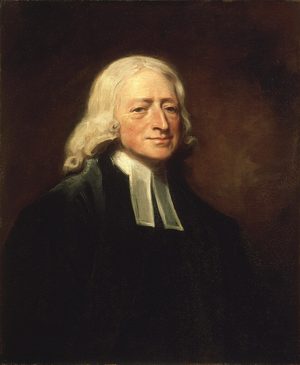

John Wesley was a priest of the Church of England and a fellow of Lincoln College, Oxford, who led the eighteenth-century revival that became Methodism. He taught that God's grace reaches every person, that believers may know their sins forgiven, and that they are called to perfect love. He lived and died an Anglican priest, yet his 1784 ordinations for America began a separate church, and every tradition has had to say what it makes of him.
| Lived | 17 June 1703 (Old Style), Epworth, Lincolnshire, to 2 March 1791, London |
|---|---|
| Church | Church of England: deacon (1725), priest (1728); fellow of Lincoln College, Oxford (1726) |
| Role | Leader of the Methodist societies and of their annual Conference; set apart Thomas Coke as superintendent for America (1784) |
| Influenced by | The Book of Common Prayer and the Articles; Luther's Preface to Romans, read at Aldersgate Street; the Spiritual Homilies attributed to Macarius; Lord King's account of the primitive church |
| Influenced | Charles Wesley and George Whitefield, his companions in the Oxford club; Thomas Coke and Francis Asbury; the Methodist and Holiness churches |
| Writings | Journal; the Standard Sermons; Explanatory Notes Upon the New Testament; A Plain Account of Christian Perfection; A Letter to a Roman Catholic (1749); Thoughts upon Slavery (1774); The Sunday Service of the Methodists (1784) |
| Honored | 24 May in the Church of England calendar (Lesser Festival, with Charles); 3 March in the Episcopal Church calendar; 24 May kept by Methodists as Aldersgate Day |
Life
Wesley was born at Epworth rectory, Lincolnshire, the son of the rector Samuel Wesley and Susanna Wesley. On the night of 9 February 1709 the rectory burned and the five-year-old John was rescued last; he later called himself "a brand plucked from the burning." He entered Oxford in 1720, was ordained deacon in 1725, was elected a fellow of Lincoln College in 1726, and was ordained priest on 22 September 1728. In 1729 he took the lead of a student group that included Charles Wesley and George Whitefield, nicknamed "Methodists" for their methodical devotion: weekly Communion, fasting, and visits to the poor, the sick and prisoners. In 1735 he sailed to Georgia with General Oglethorpe. He left Savannah on 2 December 1737 and reached England on 1 February 1738; on 24 January he had written in his Journal, "I went to America to convert the Indians; but oh! who shall convert me?"
On 24 May 1738, at a society in Aldersgate Street, London, where Luther's Preface to Romans was being read, he wrote, "I felt my heart strangely warmed. I felt I did trust in Christ, Christ alone, for salvation." In 1739, following Whitefield, he began preaching in the open air, first at Bristol; a London group asked him to lead a society, and the Foundry at Moorfields became the center of the work until 1778. He separated from the Moravians in 1740. The first annual Conference of preachers met at the Foundry in 1744. Wesley argued against leaving the Church of England in Reasons against a Separation from the Church of England (1760) and Farther Thoughts on Separation from the Church (1789).
On 28 February 1784 he executed the Deed of Declaration, which made the Conference of one hundred preachers (the "Legal Hundred") the body that held the chapels; the Global Council on Archives and History calls it "the charter of British Methodists." On 1 September 1784 he ordained Richard Whatcoat and Thomas Vasey, and on 2 September, according to his Diary, Thomas Coke "as a superintendent, by the imposition of my hands, and prayer," for the Americans left without clergy by the Revolution. Francis Asbury was ordained and set apart at Baltimore on 25–27 December. Wesley sent a revision of the Prayer Book, The Sunday Service of the Methodists, and an abridgment of the Thirty-nine Articles to twenty-four. He explained that Lord King's account of the primitive church had convinced him that bishops and presbyters are of one order, and that in America "my scruples are at an end." He died on 2 March 1791; British Methodism separated from the Church of England soon afterward.
What he taught
Wesley held that grace comes to every person before any response. He called it "preventing" grace: "no man sins because he has not grace, but because he does not use the grace which he hath" (Sermon 85). He preached against unconditional election: grace "is free for ALL, as well as IN ALL," and "the doctrine of predestination is not a doctrine of God" (Sermon 128, "Free Grace"; predestination). With the Articles he taught justification by faith, and he taught that the Holy Spirit gives believers assurance of it.
His distinctive teaching was Christian perfection, which he defined as "that love of God and our neighbour, which implies deliverance from all sin" and "pure love reigning alone in the heart and life." He avoided the phrase "sinless perfection," since a person filled with love remains "liable to these involuntary transgressions," and he wrote that "there is indeed an instantaneous, as well as a gradual, work of God" (A Plain Account of Christian Perfection). Early Methodists prayed the Daily Office, and his Sunday Service provided for Communion every Lord's Day (see Infant baptism for the Methodist position on baptism). His Sermons and Notes became the doctrinal standards of the churches that followed him.
What historians say
Henry Rack's Reasonable Enthusiast (Epworth Press, 1989), the standard biography, examines closely the nature of the Aldersgate "conversion." Nineteenth-century writers asked whether it could be a conversion at all, since Wesley's earlier devotion suggested he was already a Christian; defenders answered that he passed from trusting his own righteousness to trusting Christ. Ben Witherington III argues that Rack sometimes overstresses natural causes of the experience, and reviewers describe Rack's Wesley as "reasonable" but, in the end, not truly an "enthusiast."
The 1784 ordinations are read two ways: the Christian History Institute's timeline sums them up as "ordination is separation," an act that eventually and unintentionally broke the link with the Church of England, while Wesley's own tracts show him arguing against separation to the end. Charles Wesley gave the proceeding no countenance. On slavery, Wesley's Thoughts upon Slavery (1774) pleaded, "Give liberty to whom liberty is due," and in a letter of 24 February 1791 he urged Wilberforce against "that execrable villainy"; the American church's later retreat from the rules of 1784 is set out in the Methodist record.
How the churches see Wesley
- Catholic:
The Catholic Church has no calendar entry or condemnation for Wesley. His Letter to a Roman Catholic (Dublin, 18 July 1749) set out what he called Protestant belief, asked whether it differed from Catholic belief on any point, and proposed, "Let the points wherein we differ stand aside." The Houston report (2016) of the Joint Commission of the Roman Catholic Church and the World Methodist Council says that "Catholics and Methodists affirm in their respective ways that perfection in love is possible before death" (§76); it adds that Catholic theology "generally does not refer to Christian perfection or entire sanctification as such" (§75), and that Catholics place the final state of perfection after death, in purgatory, which Methodists do not accept (§77). In 2006 the World Methodist Council associated itself with the Joint Declaration on Justification.
- Orthodox:
The Orthodox Church has made no statement about Wesley. The Orthodox scholar Hieromonk Alexander (Golitzin) of Marquette University writes that at the Oxford club the Wesleys "picked up and read Macarius, and loved him in spite of the gulf of time and space." Wesley placed a selection from the Spiritual Homilies of Macarius in the first volume of his Christian Library (1749). Scholars differ on whether his doctrine of perfection is a form of theosis: Michael Christensen calls it a reformulation of that teaching, while Albert Outler held that Wesley's chief patristic influence was Gregory of Nyssa.
- Lutheran:
The Lutheran confessions (1530–1580) predate Wesley and do not mention him. The contact on record is Luther's: Wesley's Journal for 24 May 1738 names Luther's Preface to Romans as the text being read at Aldersgate, yet on 15 June 1741 he wrote that he was "utterly ashamed" of having esteemed Luther's commentary on Galatians, finding it "deeply tinctured with mysticism throughout and hence often dangerously wrong" (Martin Luther). The Lutheran World Federation and the World Methodist Council held an international dialogue from 1979 to 1984, The Church: Community of Grace, and in July 2006 the World Methodist Council affirmed the 1999 Joint Declaration on Justification, which the Lutheran World Federation had signed.
- Reformed:
The Reformed churches have no official act on Wesley; the record is his quarrel with Whitefield and the Calvinistic Methodists. Wesley's sermon "Free Grace" (1739) rejected unconditional election. Whitefield's reply, dated 24 December 1740, answered, "I frankly acknowledge that I believe the Doctrine of Reprobation in this view," and criticized Wesley for "pleading so vehemently for a sinless perfection." Whitefield died in September 1770; Wesley preached his funeral sermon on 18 November, in the year his Conference Minutes on faith and works were taken by Calvinists to teach justification by works. The Reformed case is set out in Predestination and free will.
- Anglican:
The Church of England's calendar keeps 24 May as a Lesser Festival, "John and Charles Wesley, Evangelists, Hymn Writers, 1791 and 1788," and the Episcopal Church's calendar keeps 3 March for "John and Charles Wesley, Priests, 1791, 1788." Wesley remained a priest of the Church of England until his death. On 1 November 2003 the Church of England and the Methodist Church of Great Britain signed the Anglican-Methodist Covenant at Methodist Central Hall, Westminster, after both the Methodist Conference and the General Synod had approved it; the Methodist account of the Covenant notes that the churches separated in the 1790s, after Wesley's death.
- Methodist:
Wesley's Sermons and Notes are doctrinal standards in British Methodism (the first four volumes of sermons, the Forty-four Sermons, and the Notes) and among the standards of the United Methodist Church; the Articles of Religion are his abridgment of the Thirty-nine Articles, to which the Christmas Conference of 1784 added what is now Article 23. Methodists keep 24 May as Aldersgate Day and use the Covenant Service he drew up in 1755. The Holiness churches teach entire sanctification as a definite "second work of grace"; Phoebe Palmer's "shorter way" contrasted with Wesley's gradual approach, and Nathan Bangs criticized it (the Methodist chapter).
- Baptist:
No Baptist confession names Wesley; the Second London Confession (1677; reissued 1689) was written before his birth. It teaches that "some men and Angels, are predestinated, or fore-ordained to Eternal Life" (3.3), the doctrine his sermon "Free Grace" rejected, and it reserves baptism for those who "actually profess" repentance and faith (29.2), where Methodist churches hold that infants are to be baptized (Infant baptism).
Sources
- Wesley, Journal, 24 May 1738 (quoted by Discipleship Ministries)
- Wesley, Journal, 24 January 1738 ("who shall convert me")
- Wesley, Journal, September 1784 (Wesley Center Online) ordinations of 1 and 2 September 1784; Sunday Service
- Wesley, Journal, 15 June 1741 (CCEL)
- Global Council on Archives and History, John Wesley
- Christian History Institute, Timeline: John Wesley and the 18th Century World
- Christian History Institute, Timeline: The Wesleys
- Dictionary of National Biography, "Wesley, John" (1885–1900) Savannah and the voyage home
- Epworth Old Rectory, John Wesley birth and the fire of 1709
- Wesley Center Online, John Wesley the Evangelist, ch. 11 (1784)
- Wesley Center Online, chronology of Wesley's letters, vol. 7 (Deed of Declaration; ordinations)
- Wesley, Reasons against a Separation from the Church of England (1760)
- Wesley, A Plain Account of Christian Perfection
- Wesley, Sermon 85, On Working Out Our Own Salvation
- Wesley, Sermon 128, Free Grace
- Wesley Corpus, A Letter to a Roman Catholic (Dublin, 18 July 1749)
- Whitefield, letter to Wesley in answer to "Free Grace" (24 December 1740)
- Wesley Scholar, The Minutes Controversy 1770–1777
- Witherington, "Wesley on the Rack: Rack on Wesley," Ashland Theological Journal 23 (1991)
- Rack, Reasonable Enthusiast (Epworth Press, 1989), review in Journal of Ecclesiastical History
- Joint Commission, The Call to Holiness: From Glory to Glory (Houston, 2016)
- World Methodist Council, Statement of Association with the Joint Declaration (2006)
- Golitzin, "A Testimony to Christianity as Transfiguration: The Macarian Homilies and Orthodox Spirituality"
- Christensen, Theosis and Sanctification: John Wesley's Reformulation of the Doctrine of Perfection
- GCAH, The First Step Toward Grace: John Wesley's Use of the Spiritual Homilies of Macarius the Great
- Prounione, The Lutheran-Methodist Dialogue (The Church: Community of Grace, 1979–1984)
- Methodist Church in Britain, Joint Declaration on the Doctrine of Justification (2017 update)
- Church of England, Lesser Festivals (24 May)
- Church of England, The Calendar
- Episcopal Church, Calendar of the Church Year
- Methodist Church in Britain, How Methodists and Anglicans reached the point of signing a Covenant
- Methodist Church in Britain, Church of England and Methodist Church Covenant turns 21
- Church of England, Mission and Ministry in Covenant (2014)
- Second London Baptist Confession (1689), ch. 3
- Second London Baptist Confession (1689), chs. 11 and 29
- Portrait by George Romney, Wikimedia Commons (public domain)