The Russian Synodal Bible 1876
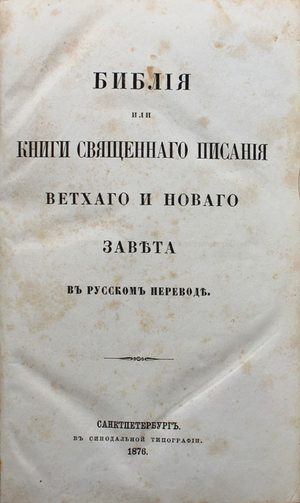

The Synodal Bible is the Russian translation made under the Holy Synod of the Russian Orthodox Church and published complete in 1876, after the Russian Bible Society's work had been stopped in 1826. The Orthodox Church reads it at home and in teaching, while worship keeps the Church Slavonic Bible, and it is also the Bible of Russian evangelical Protestants. It is the only Russian translation prepared and published with the Synod's authority.
| Published | Gospels 1860; rest of the New Testament 1862; Old Testament in four parts, 1868 to 1875; complete Bible, St. Petersburg, 1876 |
|---|---|
| Commissioned by | The Holy Synod of the Russian Orthodox Church (resolution of 1858, approved by Alexander II), which gave the work to the theological academies of St. Petersburg, Moscow, Kiev and Kazan |
| Translators | Scholars of the four academies, building on earlier Russian versions; directed by Metropolitan Philaret of Moscow until his death in 1867, then completed under the Synod |
| Language | Russian of the 1800s, with Church Slavonic vocabulary and constructions |
| Old Testament from | The Hebrew Masoretic Text, with some Septuagint additions, often in square brackets |
| New Testament from | The Greek textus receptus (Moscow edition of 1811), compared with the Slavonic Bible |
| Books | 27 New Testament books and the 39 Hebrew Old Testament books, with eleven "non-canonical" books in Orthodox editions (the Apocrypha), set among the canonical books, and the Greek additions to Daniel and Esther, Psalm 151 and the Prayer of Manasseh |
| Approach | Close to the originals, in a literary Russian that keeps Slavonic wording |
| Copyright | The 1876 text is in the public domain; later editions may carry their publishers' rights in notes and layout |
| Used by | The Russian Orthodox Church for private reading and teaching; Russian Baptists and other evangelical Protestants as their Bible |
How it was made
Russian Christians had a complete Slavonic Bible from 1499 (the Gennadi Bible), and Prince Constantine of Ostrog sponsored the first printed one in 1581. Its revision, issued in 1751 under Empress Elizabeth after ukases of 1721 and 1744, is the Elizabeth Bible, still the base of the Church Slavonic Bible of the Russian Church (Bryner). Slavonic had grown hard to follow, and in 1815 Alexander I asked the Synod to let Russians read Scripture in their own language.
The Petersburg Bible Society was founded on 6 December 1812 with the Tsar's approval and renamed the Russian Bible Society in 1814, with Prince Alexander Golitsyn as president. Archimandrite Philaret (Drozdov), rector of the St. Petersburg Academy, oversaw the translation: the Gospels appeared in 1818 in parallel Slavonic and Russian columns, the New Testament in 1821, the Psalter in 1822. The Pentateuch, Joshua, Judges and Ruth were translated from the Hebrew under the Hebraist Gerasim Pavsky in 1824 and 1825 (de Regt). Golitsyn was dismissed in 1824 and Nicholas I closed the Society in 1826; opponents had called it a mixed, mystical body that circulated Scripture without Orthodox explanation, and about 9,000 printed copies of the Pentateuch and the next three books were burned in late 1825 (Bryner; Metropolitan Hilarion).
Pavsky went on translating the prophetic and poetic books for his students in 1839 and 1841, was reprimanded as a "new Marcion" and lost his chair; the missionary Archimandrite Makary (Glukharev) translated the whole Old Testament on his own (Bryner). On 10 September 1856 the Synod, moved by Philaret, resolved to resume translating from the Hebrew and Greek; in 1858 it sanctioned the work, and Alexander II approved. The Synod meant the Russian text for private reading, not for worship. The Gospels were issued in 1860, the rest of the New Testament in 1862, and the Old Testament in parts from 1868. Philaret died in 1867; the complete Bible came out in 1876, "with the blessing of the Holy Synod" (de Regt).
How it translates
Philaret drew up the principles in 1845 and presented them to the Synod in 1858. Count Protasov, the chief procurator, had tried to have the Greek Septuagint declared inviolable; Philaret treated the Hebrew and the Greek Old Testament as both authoritative. The Old Testament therefore follows the Masoretic Text, with passages found in the Septuagint and the Slavonic Bible added in square brackets, among them Deuteronomy 32:43, Psalm 151 and the end of Job. Jeremiah keeps the Hebrew order. Not every Septuagint addition is rendered (de Regt).
The eleven "non-canonical" books (1 Esdras, Tobit, Judith, Wisdom, Sirach, the Letter of Jeremiah, Baruch, 1 to 3 Maccabees and 3 Ezra) stand among the historical, poetic and prophetic books, marked by an asterisk and a note. They were translated from the Greek, 3 Ezra from the Latin. Daniel and Esther carry their longer Greek forms, with the added passages in brackets (de Regt).
For the New Testament the translators used the textus receptus and the Slavonic Bible, as the Bible Society's version had. Nikolai Glubokovsky questioned that base before the Revolution (de Regt). The style keeps Slavonic constructions, which critics call dated: I. E. Evseev described its language as "pre-Pushkin," while Metropolitan Hilarion calls it readable and poetic. Hilarion also lists faults, among them Acts 19:35 (KJV: "the image which fell down from Jupiter"), where the Greek word diopetes, "fallen from heaven," was taken for a proper name, Diopet.
Reception and revisions
Opposition to a Russian Bible did not end in 1858: some argued that the Slavonic text was inspired and that Russian could not carry Scripture's weight (Bryner). The Church has never declared one text or translation canonical, Hilarion notes. From the middle of the twentieth century most Orthodox publications quoted Scripture from the Synodal text instead of the Slavonic. The Moscow Patriarchate reprinted it in 1956 and 1968, while Soviet authorities restricted Bibles (the Orthodox record). In the same decades the Church debated a modern translation, after Bishop Cassian Bezobrazov's Nestle-based Gospel of Matthew (Paris, 1953) met criticism in Moscow (Bryner).
Patriarch Kirill said on 2 December 2013 that the Synodal text had faults to correct but that the Church should "by no means create a new version." On 4 October 2016, at the 140th anniversary, Hilarion proposed an edited Synodal edition correcting plain errors and called the text "the Bible of the New Martyrs." Newer Russian versions exist, among them the Bible Society in Russia's Contemporary Russian Version (2015), which omits the non-canonical books (de Regt).
Russian evangelical Protestants have long taken the Synodal text as theirs. Igor Mikeshin, who studies Russian Baptists, writes that evangelicals "admire this translation," that most believers read no other, and that it is, in his view, "considerably far from being accurate" (2015).
Where each church stands on the the Synodal Bible
- Catholic:
The Catholic Church has made no statement about the Synodal Bible. Trent (Session IV, 1546) held the Latin Vulgate "authentic" for teaching, and Dei Verbum 22 says the Church "has always given a place of honor to other Eastern translations" beside the Septuagint and Latin versions, while asking for new translations "especially from the original texts." Orthodox editions of the Synodal Bible print all the Old Testament deuterocanonical books of the Catholic canon, along with 1 Esdras, 3 Maccabees and 3 Ezra.
- Orthodox:
The Holy Synod approved the translation in 1858 and the complete Bible in 1876, as an aid to private reading, and the Church Slavonic Elizabeth Bible remains the base of the Church's liturgical text. Metropolitan Hilarion (2016) calls the Synodal Translation "our precious heritage" and says the Church has never canonized any single text or translation. Orthodox editions hold the non-canonical books, in line with the Greek Old Testament the Church reads (see which Old Testament Orthodoxy holds; Russian Orthodox Church).
- Lutheran:
The Lutheran confessions name no translation, and no Lutheran church has made a statement about the Synodal Bible. Luther's 1534 Bible printed the Apocrypha in a separate section, as books not held equal to Scripture but useful and good to read.
- Reformed:
The Westminster Confession (1.3) says the Apocrypha, "not being of divine inspiration, are no part of the canon of the Scripture," and (1.8) calls the Hebrew Old Testament and Greek New Testament "authentical" and requires translation into each nation's language. No Reformed body has made a statement about the Synodal Bible, whose Old Testament follows the Hebrew.
- Anglican:
Article VI of the Thirty-Nine Articles says the Church reads the other books "for example of life and instruction of manners" but does not use them to establish doctrine. The Church of England has made no statement about the Synodal Bible.
- Methodist:
Article V of the United Methodist Articles of Religion lists the Old Testament books from Genesis to the Twelve Prophets and receives all New Testament books "as they are commonly received." No Methodist body has made a statement about the Synodal Bible.
- Baptist:
The Second London Confession (1677; 1689), which many Baptists hold, calls the Hebrew Old Testament and Greek New Testament "authentical" (1.8) and requires translation into every nation's language. Russian Baptists use the Synodal text as their Bible, according to Mikeshin. No Baptist body has made an official statement about it.
Sources
- Erich Bryner, "Bible Translations in Russia," The Bible Translator 25 (1974), 318-331 Slavonic Bibles, Bible Society, Pavsky, 1856 and 1858, 1876, Moscow Patriarchate reprints
- Lenart J. de Regt, "Canon and Biblical Text in the Slavonic Tradition in Russia," The Bible Translator 67 (2016), 223-239 textual base, non-canonical books, Philaret's principles
- Metropolitan Hilarion of Volokolamsk, report on the 140th anniversary of the Synodal Translation (Moscow, 4 October 2016), Russian Orthodox Church Department for External Church Relations in Russian
- Interfax report, Patriarch Kirill on the Synodal Translation, 2 December 2013 (Pravmir)
- Stephen K. Batalden, "Which text? Whose job? What language?", Christian History 146
- Translating the Russian Bible, East-West Church and Ministry Report Slavonic style; criticism of its language
- Igor Mikeshin, "Russian Evangelicalism Glocalized" (University of Edinburgh New Directions, 2015)
- Second Vatican Council, Dei Verbum 22
- Westminster Confession of Faith, ch. 1
- Articles of Religion of the Methodist Church (UMC)
- Title page of the Synodal Bible (1876), Wikimedia Commons (public domain)