Our Lady of Guadalupe 1531
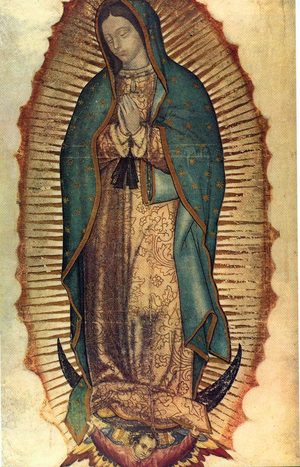

Catholics honor Our Lady of Guadalupe as the Virgin Mary who, according to tradition, appeared in December 1531 to a Nahua man, Juan Diego, on the hill of Tepeyac near Mexico City and left her image on his cloak. Historians, scientists and churches disagree about the early sources, the image and the apparition, and each tradition has its own view of devotion to Mary and of claimed miracles.
| Date | 9 and 12 December 1531 (feast: 12 December) |
|---|---|
| Place | Tepeyac hill, northwest of Mexico City; the Basilica of Guadalupe |
| Claimed by | The Catholic Church in Mexico, on the witness of Juan Diego (canonized 2002) to Bishop Juan de Zumárraga |
| Type | Marian apparition and an image on a cloak said not to be of human making |
| Official status | Mass and Office of 12 December approved by Benedict XIV (1754); Juan Diego canonized by John Paul II (31 July 2002); private revelation does not belong to the deposit of faith (CCC 67) |
| Investigations | Church inquiries of 1556, 1666 and 1723; examination of the tilma by Philip Callahan (1979); restorer's report by José Sol Rosales (1982); historical studies for the canonization cause |
What is claimed
According to the tradition summarized in the New Catholic Encyclopedia, on 9 December 1531 Juan Diego, a man over fifty, saw the Virgin Mary at Tepeyac and was told to ask the bishop to build a church there. Three days later she told him to gather flowers and carry them to the bishop. When he unfolded his cloak (the tilma) before Bishop Juan de Zumárraga, the flowers fell out and the image of the Lady appeared on the cloth. John Paul II, in the canonization homily of 31 July 2002, spoke of roses given as a sign and of the image imprinted on the tilma. The cloth, woven of agave fiber, is kept in the Basilica of Guadalupe.
The fullest account is the Nahuatl narrative Nican Mopohua, first published in 1649 in Luis Laso de la Vega's Huei tlamahuiçoltica. Many Mexican scholars attribute it to the Nahua scholar Antonio Valeriano; others hold that Laso de la Vega wrote or edited it, and the question is still debated. A Spanish account by the priest Miguel Sánchez had appeared in 1648; it read the Lady as the woman "clothed with the sun" of Revelation 12:1 (KJV).
History and devotion
The New Catholic Encyclopedia reports a first sanctuary at Tepeyac around 1533, a second church begun in 1556 under Archbishop Alonso de Montúfar, and a new sanctuary dedicated in 1709. Mexico City chose her as patroness in 1737, and in 1754 Benedict XIV approved the patronage and a Mass and Office for 12 December. Pius XII in 1945 called her "Queen of Mexico and Empress of the Americas." In Ecclesia in America (22 January 1999) John Paul II invoked her as "Patroness of all America" and welcomed the proposal that her feast be kept across the continent on 12 December. Juan Diego was beatified at the basilica on 6 May 1990 and canonized there on 31 July 2002; John Paul II called him the first Indigenous saint of the Americas.
Investigations
The written record. The New Catholic Encyclopedia states that no report by Zumárraga survives and that probably none was written, and calls the evidence of the 1666 church inquiry, held 135 years after the event, "vague and rather weak" on the early events. It points to Juan de Tovar's Nahuatl summary and the Valeriano relation (1560–1570), which it says agree in their facts. Stafford Poole, a Catholic priest and historian, argues in Our Lady of Guadalupe: The Origins and Sources of a Mexican National Symbol (1995) that no documentary evidence from the 1530s and 1540s supports Juan Diego or the apparition; a reviewer in the Hispanic American Historical Review says he agrees here with Joaquín García Icazbalceta and Edmundo O'Gorman. Eduardo Chávez, postulator of Juan Diego's cause, defends the historical evidence in Our Lady of Guadalupe and Saint Juan Diego (2006).
Archbishop Montúfar opened an inquiry in 1556 after a sermon criticizing the crowds at the new shrine. According to the testimony taken, the Franciscan Francisco de Bustamante preached on 8 September 1556 that the image had been painted by an Indian named Marcos. Skeptical readers take this as evidence that no apparition story was yet told; defenders answer that the surviving record is incomplete. The Franciscan Bernardino de Sahagún complained in the later sixteenth century that pilgrims at Tepeyac called the Virgin by the name of the Nahua mother goddess Tonantzin; Chávez says the name means only "our venerable mother."
The cloth. Philip Callahan, an infrared specialist, examined the tilma in 1979 and published in 1981 that he found no preliminary sketch, though he thought the angel and tunic might be seventeenth-century additions. A study by Richard Kuhn in the 1930s is said to have found no coloring matter in sample fibers, but the details of his analysis are unknown. Beginning with Carlos Salinas Chávez (1951), researchers have reported tiny human figures reflected in the Virgin's eyes. Joe Nickell reads the evidence differently: infrared photographs show altered hands and underdrawing, and the figures in the eyes are chance shapes. José Sol Rosales, a restorer commissioned in 1982 by the basilica's abbot, concluded that the cloth was primed with a calcium-based ground and painted in tempera with sixteenth-century pigments. His report was not made public until quoted in Proceso in 2002, and Callahan had disputed his claim of a primer. The tilma has not been examined with the full range of modern methods, since any study needs the custodians' consent.
The canonization. In 1996 Guillermo Schulenburg, abbot of the basilica, said that Juan Diego was a symbol and not a historical person, and he resigned that year. The Congregation for the Causes of Saints went ahead, and Juan Diego was canonized in 2002.
Popular claims and what the record shows
Devotional literature repeats many claims about the tilma. They fall into three groups.
Documented events. According to the basilica's own account, as given by Eduardo Chávez, on 14 November 1921 a man hid a bomb among flowers placed near the altar of the old basilica. The blast damaged the altar steps and candlesticks and bent a crucifix, now called the "Santo Cristo del Atentado," while the glass over the image was not broken. Church writers read the image's survival as protection. The account comes from church-affiliated sources, and the report consulted for this page cites no police or press record from 1921.
Real studies whose meaning is disputed. The infrared study by Philip Callahan and Jody Brant Smith is real (the examination was in 1979, the report published in 1981). Callahan was a University of Florida biophysicist, and PolitiFact reported in 2024 that his study did not claim a supernatural origin.
Claims with no published source. A "NASA study" is said to have found the image "living." A NASA spokesperson told PolitiFact that the claim was untrue, and the story has circulated since at least 2012. Popular accounts also give the cloth a steady temperature near that of the body and a heartbeat heard at the waist; Chávez himself says the image, on agave fiber, does not have a body's temperature, and none of the sources listed here cites a published measurement or medical report for either claim. Skeptics such as Nickell read the image as painted by human hands, while defenders such as Chávez rest the case on the documented record and the image itself; the Church does not require belief in any of them (CCC 67).
Official status
The Catholic Church has approved the devotion in its liturgy (the Mass and Office of 12 December, 1754) and has canonized Juan Diego (2002). The Catechism says that private revelations "do not belong to the deposit of faith" (CCC 67), though the Church has approved some, so belief in the apparition is not an article of Catholic faith. The Dicastery for the Doctrine of the Faith's norms of 2024 say that, as a rule, no declaration of supernatural origin is now made for such phenomena, even when a nihil obstat is granted.
Where each church stands
- Catholic:
The Catholic Church honors Our Lady of Guadalupe in its liturgy (Benedict XIV, 1754), invoked her as Patroness of all America (John Paul II, Ecclesia in America, 1999) and canonized Juan Diego (2002). Catholic scholars differ over the early sources: Chávez defends them, the New Catholic Encyclopedia admits gaps, and Poole, a priest, doubts them. On images and relics see Statues, icons and relics.
- Orthodox:
No Orthodox church has issued a statement on Guadalupe. Orthodox teaching honors the Mother of God and the veneration of icons (Second Council of Nicaea, 787; see icons), and the Confession of Dositheus (1672) affirms asking the saints for their prayers, but none of this addresses the apparition of 1531 or the tilma.
- Lutheran:
No Lutheran confession mentions Guadalupe. The Augsburg Confession (art. XXI, 1530) commends remembering the saints to imitate their faith, but not invoking them, since Christ alone is mediator; the Smalcald Articles (II.2.25–28) call invocation idolatry. Lutheran worship therefore does not include this devotion.
- Reformed:
The Westminster Confession (21.2) says worship is due to God alone, "not to angels, saints, or any other creature," and the Heidelberg Catechism (Q 94) condemns trust in saints. B. B. Warfield's Counterfeit Miracles (1918) argues that miracles ceased with the apostolic age and that later claims, including Roman Catholic ones, are not genuine. Neither the confessions nor Warfield examines Guadalupe in particular.
- Anglican:
Article XXII of the Thirty-Nine Articles calls the "Romish Doctrine" of invocation of saints "a fond thing, vainly invented." Practice varies: many Anglo-Catholics ask Mary and the saints to pray for them. The 2005 ARCIC II report Mary: Grace and Hope in Christ (a commission text not adopted by either church) says devotion arising from private revelation may be acceptable but is never required, and that its test is whether it points to Christ.
- Methodist:
Article XIV of Wesley's Articles of Religion (1784) rejects "the Romish doctrine" of worship of images and relics and of invocation of saints. Wesley himself held that miracles did not end with the apostles: his Letter to Dr Conyers Middleton (4 January 1749) defended miracles in the early church. No Methodist body has made a statement about Guadalupe.
- Baptist:
The Second London Confession (1689, 22.2) says worship is given to God alone, "not to angels, saints, or any other creature," and treats God's former ways of revealing himself as "now ceased" (1.1). No Baptist confession or convention has made a statement about Guadalupe; Baptist teaching on images and relics holds that venerating them is idolatry.
Sources
- New Catholic Encyclopedia, "Guadalupe, Our Lady of" the traditional account, sanctuary, patronage dates, inquiries
- John Paul II, homily at the canonization of Juan Diego, 31 July 2002
- John Paul II, Ecclesia in America (22 January 1999), no. 11
- Catechism of the Catholic Church, no. 67
- Dicastery for the Doctrine of the Faith, Norms for proceeding in the discernment of alleged supernatural phenomena (17 May 2024)
- EWTN Library, "Guadalupe, Shrine of" (Montúfar's inquiry of 1556)
- Historiography of the Apparition of Guadalupe, Part VIII (the 1556 inquiry)
- Stafford Poole, Our Lady of Guadalupe: The Origins and Sources of a Mexican National Symbol, 1531–1797 (University of Arizona Press, 1995) reviewed in Hispanic American Historical Review 76:4 (1996)
- Stafford Poole, "History versus Juan Diego," The Americas 62:1 (2005)
- Eduardo Chávez, Our Lady of Guadalupe and Saint Juan Diego: The Historical Evidence (Rowman & Littlefield, 2006)
- Digital Sindonological Lexicon, "The Tilma of Guadalupe" studies of the cloth: Kuhn, Callahan, Salinas, Rosales
- Joe Nickell, "'Miraculous' Image of Guadalupe," Skeptical Briefs 12.2 (June 2002)
- Eduardo Chávez interview, "Fact or fiction? Nine popular myths about Our Lady of Guadalupe," Catholic World Report (2025) on Tonantzin and on the temperature claim
- Philip Callahan, The Tilma under Infra-Red Radiation (CARA Studies on Popular Devotion, 1981) the infrared study; as summarized in the Digital Sindonological Lexicon entry above
- PolitiFact, "La NASA no dijo que la imagen de la Virgen de Guadalupe está 'viva'" (4 April 2024) on the "NASA study" and Callahan
- EWTN News (formerly Catholic News Agency), "Our Lady of Guadalupe bomb attack" (1921), citing Eduardo Chávez
- ARCIC II, Mary: Grace and Hope in Christ (2005)
- John Wesley, Letter to Dr Conyers Middleton (4 January 1749)