Our Lady of La Salette 1846
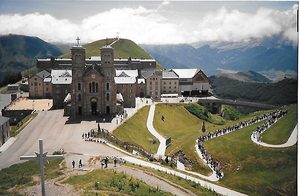

On 19 September 1846 two poor children, Mélanie Calvat and Maximin Giraud, said that a weeping Lady had spoken to them on a mountain pasture above the village of La Salette-Fallavaux in the French Alps. Their account was investigated by the Catholic diocese of Grenoble and approved by its bishop in 1851, but it was also disputed from the start, and the later "secrets" attributed to the Lady have been contested ever since.
| Date | 19 September 1846, about 3 p.m. |
|---|---|
| Place | Mont Planeau, above La Salette-Fallavaux, diocese of Grenoble, France |
| Claimed by | Catholic Church; Mélanie Calvat (almost 15) and Maximin Giraud (11), cowherds from Corps |
| Type | Marian apparition: a weeping Lady with a public message and a private secret for each child |
| Official status | Approved by the local bishop, Philibert de Bruillard of Grenoble (pastoral letter, 19 September 1851); devotion to Our Lady of La Salette authorized. Mélanie's 1879 text of her secret was placed on the Index (1923). |
| Investigations | A diocesan inquiry and commission; the 1848 report of Canon Rousselot; opposition from critics in Grenoble and Lyons, who disputed the children's account and the identity of the Lady |
What is claimed
According to Mélanie Calvat and Maximin Giraud, who were minding their herds on Mont Planeau, they saw on 19 September 1846 a globe of light in a hollow, and in it a woman seated with her elbows on her knees and her face in her hands. The Missionaries of La Salette, the religious order that serves the shrine, give the children's account as follows. The woman rose and said, "Come closer, my children; don't be afraid." She was tall and radiant, dressed as the local women dressed, with a large crucifix, and she wept as she spoke. She told them that if her people would not submit, she could no longer hold back her Son's arm. She spoke of work on Sunday and of blasphemous swearing, and warned of a poor harvest and famine, and of the death of children under seven. She asked whether they prayed well, and they answered that they hardly ever did. She repeated her warning in the local dialect when Mélanie did not understand the French word for potatoes. She told each child a secret, told them to make her message known to all her people, then climbed toward the Collet, rose into the air and "melted into light."
Mélanie's longer account (written 1878, published 1879) has the Lady say of Sunday work and swearing, "This is what weighs down the arm of my Son so much," and describes a crown of roses. According to Miracle Hunter, a spring was found at the place of the apparition, and twenty-three cures were attributed to it in the first year.
History and devotion
Cures were reported on the mountain and pilgrimages began (Catholic Encyclopedia). Bishop de Bruillard of Grenoble had the event investigated, and in August 1848 Canon Pierre-Joseph Rousselot, the diocese's reporter, wrote The Truth about the Event of La Salette and addressed it to Pius IX. On 3 July 1851 the children set down their secrets before Church officials, and the documents were sent to the pope on 18 July. On 19 September 1851, the fifth anniversary, the bishop issued the pastoral letter that approved the apparition (see below). The first stone of a church on the site was laid on 25 May 1852, and in the same year the bishop founded the Missionaries of Our Lady of La Salette to serve the shrine. The basilica was consecrated and the statue crowned on 20 and 21 April 1879, and Rome approved the institute on 18 August 1879. Persecuting laws drove the missionaries into exile in 1891; the bishop recalled them to the shrine in 1943.
The children's later lives were hard. Maximin Giraud, born in 1835, entered the seminary but was never ordained, and died at Corps on 1 March 1875. Mélanie Calvat, born in 1831, became a nun, was forbidden by her bishop in 1860 to speak of the apparition in public, and died at Altamura, Italy, on 15 December 1904. John Paul II wrote to the bishop of Grenoble on 6 May 1996 for the 150th anniversary, calling La Salette "a message of hope."
Investigations
The diocesan inquiry. The commission appointed by Bishop de Bruillard concluded, in the words of the Catholic Encyclopedia, that "the reality of the apparition should be admitted." The bishop's letter of 1851 states that the apparition "bears within itself all the characteristics of truth," and that the faithful "have grounds for believing it indubitable and certain." The Catholic Encyclopedia gives 16 November 1851 for the declaration and the authorization of the cult.
Opposition. The Catholic Encyclopedia reports strong opposition in Grenoble and Lyons, increased by what it calls "the incident of Ars." In September 1850 Maximin had visited the Curé of Ars, John Vianney, who afterward was reported to have said that the boy had retracted; Maximin denied that he had. Opposition continued after Bishop Ginoulhiac succeeded de Bruillard in 1852, and the Encyclopedia reports that critics claimed that the "beautiful lady" was a young woman named Lamerlière, which led to a widely advertised slander suit. The sociologist Michael P. Carroll has proposed psychological accounts of Marian visions (The Cult of the Virgin, 1992).
The secrets. The children's secrets were sent to Pius IX in 1851. Maximin's was never published. Mélanie published hers at Lecce on 15 November 1879, much expanded, with the imprimatur of Bishop Salvatore Luigi Zola; Miracle Hunter says it foretold apostasy in Rome. In 1880 Bishop Pierre-Louis-Marie Cortet of Troyes denounced it to the Holy Office. The Catholic Encyclopedia says Rome gave no ruling at that time, that some prudent observers thought the 1879 text largely imaginative, and that bishops censured many who defended it. In 1923 the book was placed on the Index of Forbidden Books (Miracle Hunter).
Official status
The approval is the bishop's. His 1851 letter judges the apparition of 19 September 1846 credible and authorizes devotion to Our Lady of La Salette; it does not extend to Mélanie's later text. The sources used for this page record no separate judgment of the apparition by the Holy See, though popes have spoken of it (see below). Catholic teaching holds that private revelations, even those recognized by the Church, "do not belong, however, to the deposit of faith" (Catechism 67), so belief in La Salette is not required of Catholics. New norms of the Dicastery for the Doctrine of the Faith (17 May 2024) say that, as a rule, neither a bishop nor the Dicastery will declare such a phenomenon supernatural, and they leave existing classifications unchanged (Vatican News).
Where each church stands
- Catholic:
Bishop de Bruillard's pastoral letter of 19 September 1851 approved the apparition and authorized the devotion. John Paul II (letter of 6 May 1996) called La Salette "a message of hope" and said the Missionaries "have never ceased plumbing the depths" of its message. At the Angelus on 19 September 2021 Pope Francis recalled the apparition of the Madonna "in tears to two children" on its 175th anniversary. Catholics are not required to believe in it (Catechism 67).
- Orthodox:
The Orthodox Church has made no statement about La Salette. Some Orthodox writers, such as Monk Gorazd on the independent Orthodox Christian Information Center site, argue that Western apparitions must be tested by their agreement with Orthodox teaching, and counsel caution toward visions; these are individual views, not the position of a church body.
- Lutheran:
The Lutheran churches have made no statement about La Salette. The Smalcald Articles (III.8.3) say that "God grants His Spirit or grace to no one, except through or with the preceding outward Word," a principle the Lutheran confessions state against claims to the Spirit apart from the Word and sacraments.
- Reformed:
The Reformed churches have made no statement about La Salette. The Westminster Confession (1.1, 1.6) says that the "former ways of God's revealing his will unto his people" are "now ceased" and that nothing is to be added to Scripture "by new revelations of the Spirit." The confession does not mention apparitions; this is the general Reformed teaching on Scripture alone that would apply.
- Anglican:
The Church of England has made no statement about La Salette. Its Articles of Religion say that "Holy Scripture containeth all things necessary to salvation" (VI). Article XXII calls "the Romish Doctrine concerning Purgatory, Pardons, Worshipping, and Adoration" "a fond thing vainly invented." The Articles do not mention apparitions.
- Methodist:
The Methodist churches have made no statement about La Salette. The Articles of Religion of the United Methodist Church say that "The Holy Scripture containeth all things necessary to salvation" (V) and call the Roman doctrine of purgatory, pardons and invocation of saints "a fond thing, vainly invented" (XIV).
- Baptist:
Baptist bodies have made no statement about La Salette. The Second London Confession (1677; 1689), which many Baptists hold, says in chapter 1 that God's "former ways" of revealing his will are "now ceased" and that nothing is to be added to Scripture "by new Revelation of the Spirit."
Sources
- Catholic Encyclopedia (1910), "La Salette" the approval, opposition, secrets, the Lamerlière suit; gives 16 November 1851
- Missionaries of La Salette, "The Apparition" the children's account; the 19 September 1851 letter
- Missionaries of La Salette, "History of the Congregation" foundation, approval of the institute (1879), the basilica, recall of 1943
- Miracle Hunter, "Our Lady of La Salette" dates of the inquiry, the secrets, Mélanie's 1879 text, the Index (1923), the spring
- Miracle Hunter, Bishop de Bruillard's pastoral letter of 19 September 1851
- Mélanie Calvat, account of the apparition (1878; Lecce, 1879), Fordham Internet Modern History Sourcebook
- John Paul II, letter to Bishop Louis Dufaux of Grenoble, 6 May 1996 (French)
- Pope Francis, Angelus, 19 September 2021
- Catechism of the Catholic Church, para. 67
- Vatican News, new norms for discerning alleged supernatural phenomena (17 May 2024)
- Orthodox Christian Information Center, "The Marian Apparitions: Divine Intervention or Delusion?"
- Smalcald Articles, Part III, Article 8 (Book of Concord)
- Westminster Confession of Faith, chapter 1 (OPC)
- Church of England, Articles of Religion
- United Methodist Church, Articles of Religion
- Second London Baptist Confession (1689), chapter 1
- Carroll, The Cult of the Virgin: Psychological Origins (Princeton, 1992)
- Notre Dame de La Salette en 1994, Wikimedia Commons (CC BY-SA 4.0)