Gregory Palamas 1296–1359
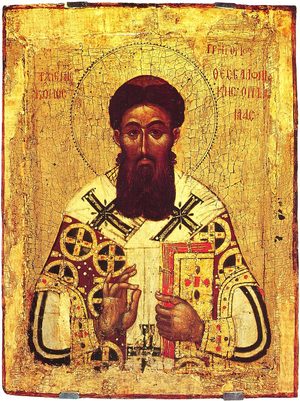

Gregory Palamas was a monk of Mount Athos who, in the 1330s and 1340s, defended the prayer of the hesychasts against the scholar Barlaam of Calabria and later became archbishop of Thessalonica. His distinction between God's unknowable essence and his uncreated energies, confirmed by councils at Constantinople, is for the Orthodox Church the way creatures are united to God; Catholic and Reformed critics have questioned it as a division in God.
| Lived | 1296, Constantinople, to 14 November 1359, Thessalonica |
|---|---|
| Church | Byzantine (Eastern Orthodox) Church; monk, priest (ordained 1326) and archbishop |
| Role | Monk on Mount Athos; abbot of Esphigmenou (1333); archbishop of Thessalonica (consecrated 1347, took up his see in 1350); chief defender of the hesychasts |
| Influenced by | The hesychast tradition of Athos; the Greek Fathers, among them Basil the Great |
| Influenced | Later Orthodox theology; in the twentieth century Vladimir Lossky and John Meyendorff |
| Writings | Letters to Barlaam (1330s); Triads in Defence of the Holy Hesychasts (from c. 1338); Hagiorite Tome (c. 1340–41, issued by the Athonite monks); One Hundred and Fifty Chapters (c. 1347–51); homilies |
| Honored | Orthodox: 14 November, and the Second Sunday of Great Lent (since his canonization in 1368); also observed on that Sunday in some Eastern Catholic parishes |
Life
Gregory was born in Constantinople in 1296 and, after his father's death, was brought up with the help of the emperor Andronicus II. In his early twenties he went with his two younger brothers to Mount Athos (c. 1316–18 in the sources) and began the practice of hesychasm, a way of prayer in inner stillness. Turkish raids drove him to Thessalonica, where he was ordained priest in 1326; he returned to Athos in 1331 and became abbot of Esphigmenou in 1333.
The monk Barlaam of Calabria, who had come to Constantinople in 1330, mocked the hesychasts' claim to experience God in prayer and argued that the light of Tabor was created. Palamas answered first in letters and then, from about 1338, in the Triads in Defence of the Holy Hesychasts. The Athonite monks issued the Hagiorite Tome (c. 1340–41), and a council at Constantinople in 1341 upheld Palamas and condemned Barlaam, who returned to Calabria. His disciple Akindynos carried on the opposition, and in 1344 a synod condemned and excommunicated Palamas; the Orthodox Church in America's life says that he was imprisoned for four years. The dispute ran alongside the Byzantine civil war, and John VI Kantakouzenos restored his standing. In 1347 he was consecrated archbishop of Thessalonica, though he could not take up his see until 1350. Councils in 1347 and in 1351 (Blachernae) reaffirmed his teaching.
In 1354, sailing to Constantinople, Palamas was captured by the Turks and taken to the court of the emir Orhan, where he took part in religious discussions with his captors; he was ransomed in 1355 and wrote a letter to his flock from captivity, which historians use as a source for early Ottoman Anatolia. He died in Thessalonica on 14 November 1359 and was canonized in 1368 at a council under Patriarch Philotheos Kokkinos, who wrote his Life and services.
What he taught
Palamas defended the hesychasts' claim that the saints, in prayer, see the uncreated light that shone from Christ on Mount Tabor (Matthew 17:2: "his face did shine as the sun, and his raiment was white as the light"). To explain how creatures can share in God without becoming God by nature, he distinguished God's essence, which no creature can know or share, from his energies or operations, which are uncreated and fully divine and are given to creatures in grace. The Orthodox Church in America summarizes this as the teaching that "the actions, operations, or Energies of God" are "uncreated and fully divine" and open to human experience. On this view the light of Tabor is an energy of God, neither the divine essence nor a created thing. The Orthodox cite Basil's letter 234 for the pattern, and read 2 Peter 1:4 ("partakers of the divine nature") as the goal: this is theosis, or deification (the essence–energies question; theosis in Scripture).
He also stressed that the whole person, body and soul, is graced, and that the body has a part in prayer (New Catholic Encyclopedia). His teaching is closely tied to the Orthodox understanding of the Fathers and of tradition: the Orthodox hold that the councils of 1341, 1347 and 1351 defined nothing new but defended the Fathers' faith in new words (Palamas and development).
What historians say
The Assumptionist Martin Jugie, whose article on Palamas appeared in the Dictionnaire de théologie catholique (vol. 11.2, cols. 1735–76), presented "Palamism" as a novelty, a system invented in defence of the hesychasts. Norman Russell reports that Jugie judged Palamas by reason, the Fathers and papal authority, and wrote with the aim of encouraging conversions from Orthodoxy, and that most Western scholars followed his framework for decades. In 1959 John Meyendorff published Introduction à l'étude de Grégoire Palamas (English translation A Study of Gregory Palamas, 1964) as a reply, arguing that Palamas stands in continuity with the Greek Fathers. Russell adds that critics on both sides have since questioned Meyendorff's reading and that his version has fared less well than Jugie's since the 1970s.
The New Catholic Encyclopedia records three objections of Western critics (Pétau, Jugie, Candal): that distinguishing essence and operation in God "destroys the simplicity of God's nature"; that Palamas's claim that the blessed see God's energy and not his essence conflicts with Benedict XII's definition of the vision of the divine essence (Benedictus Deus, 1336); and that his teaching on the visible, divine light of Tabor has been a major obstacle to Western acceptance. Orthodox writers answer that the energies are God himself acting, not a part or a third thing, and Catholic Thomists in turn hold that God has no real distinctions. Some Western scholars, such as Irénée Hausherr, have valued his stress on the whole person in prayer, and the Dominican Jacques Lison studies him with little use of the term "Palamism" (Russell).
How the churches see Palamas
- Catholic:
Catholic judgments of Palamas have varied. M. Jugie, D. Pétau and E. Candal held that his teaching on essence and operation conflicts with Western doctrine (New Catholic Encyclopedia); Russell writes that "Jugie's proselytizing approach is now officially superseded," and Catholic attitudes have shifted since Vatican II. Hausherr and Lison, cited above, are among Catholic scholars who have treated him sympathetically. Some Eastern Catholic churches keep his day: at St. George Melkite Greek Catholic Church in Milwaukee (Eparchy of Newton) the Second Sunday of Great Lent is the "Sunday of St. Gregory Palamas." The objection from Benedictus Deus is set out above, and the Orthodox answer is in the essence–energies question.
- Orthodox:
Palamas is a saint, glorified in 1368 under Patriarch Philotheos. The Orthodox Church commemorates him on 14 November and again on the Second Sunday of Great Lent, appointed as a second "Triumph of Orthodoxy" after his glorification. The Orthodox Church in America says that from the councils of his time the distinction between God's essence and energies "became an official part of the doctrine of the Orthodox Church." He is counted among the later Fathers (the Fathers; the Orthodox Church).
- Lutheran:
The Lutheran confessions treat God's presence in the believer under justification, not by naming Palamas. The Solid Declaration of the Formula of Concord (art. III) rejects the view that Christ is our righteousness "according to His divine nature alone" (para. 59) and says that "this indwelling of God is not the righteousness of faith" (para. 54); it also rejects the claim that "not God dwells in the believers, but only the gifts of God" (para. 65). Tuomo Mannermaa and the Helsinki school, which grew out of dialogue between the Finnish Lutheran and Russian Orthodox churches, argue that Christ's indwelling in Luther corresponds to Orthodox theosis, as Veli-Matti Kärkkäinen reports; other Lutherans dispute this (theosis or a courtroom verdict).
- Reformed:
The Westminster Confession (2.1) calls God "without body, parts, or passions" and "incomprehensible," and Reformed critics of Palamas appeal to such statements. The Reformed theologian Robert Letham, in Through Western Eyes: Eastern Orthodoxy: A Reformed Perspective (2007, pp. 233–34, 283–84), argues that the essence–energies distinction "drives a wedge between the inner life of God and his saving activity in history" and "introduces into God a division, not a distinction."
- Anglican:
The Church of England's Thirty-Nine Articles do not mention Palamas. Article I says God is "without body, parts, or passions,". A. M. Allchin argued in Participation in God (1988) that the patristic idea of divinization is less foreign to Anglicanism than is commonly assumed (as reported by reviewers).
- Methodist:
Randy Maddox concludes that Wesley had little direct contact with or knowledge of the Eastern Orthodox churches of his own era. In "John Wesley and Eastern Orthodoxy: Influences, Convergences, and Differences" (Asbury Theological Journal 45.2, 1990, pp. 29–53) he names deification and sanctification as the closest point of resemblance between Wesley and Orthodoxy (entire sanctification).
- Baptist:
No Baptist confession consulted for this page mentions Palamas. The Second London Confession (1689), which many Baptists hold, says that God's "Essence cannot be comprehended by any but himself," and that he is "without body, parts, or passions" (2.1).
Sources
- Orthodox Church in America, Life of Saint Gregory Palamas, 14 November life, councils, canonization, feast
- Orthodox Church in America, The Orthodox Faith, vol. 3, "Saint Gregory Palamas"
- Orthodox Church in America, 2nd Sunday of Great Lent: St Gregory Palamas
- OrthodoxWiki, "Gregory Palamas" (chronology)
- H. D. Hunter, "Palamas, Gregory," New Catholic Encyclopedia (via Encyclopedia.com)
- Norman Russell, "Inventing Palamism," Analogia
- Meyendorff, Introduction à l'étude de Grégoire Palamas (1959); A Study of Gregory Palamas, tr. G. Lawrence (London, 1964) bibliographic details
- Jugie, "Palamas (Grégoire)," Dictionnaire de théologie catholique 11.2, cols. 1735–76 (Paris); Wikisource text of the companion article "Palamite (Controverse)"
- St. George Melkite–Greek Catholic Church, Milwaukee, Sunday of St. Gregory Palamas (2024)
- Solid Declaration of the Formula of Concord, art. III (Book of Concord)
- "Theosis in Luther: Analysis of the New Finnish Luther Research" (on the Finnish school and Kärkkäinen's One with God)
- Westminster Confession of Faith, ch. 2 (OPC)
- Letham, Through Western Eyes (Mentor, 2007), pp. 233–34, 283–84 (as quoted)
- Church of England, Articles of Religion (Article I)
- Review of A. M. Allchin, Participation in God (1988), Clarion Journal
- Maddox, "John Wesley and Eastern Orthodoxy," Asbury Theological Journal 45.2 (1990)
- Second London Baptist Confession (1689), ch. 2
- Icon of Gregory Palamas, Wikimedia Commons (public domain)