Wycliffe Bible c. 1382–1395
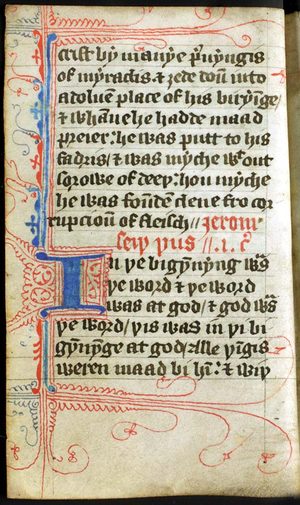

The Wycliffe Bible is the first complete English Bible, translated from Jerome's Latin Vulgate by followers of the Oxford theologian John Wycliffe in the last decades of the fourteenth century. It circulated only in handwritten copies. Archbishop Arundel's Constitutions (1409) forbade unauthorized new translations and the use of this one, and the churches have since read its story differently: as a suppressed Bible, as a Bible of doubtful origin, or as a forerunner of the Reformation. The wider story is told in the Bible and the people.
| Published | Early Version begun c. 1382; Later Version c. 1388 to the early 1390s; in manuscript only until the first complete printing in 1850 |
|---|---|
| Translators | A group of Oxford followers of John Wycliffe (died 31 December 1384); the Early Version's Old Testament is linked to Nicholas of Hereford; the Later Version is traditionally credited to John Purvey |
| Language | Middle English |
| Old Testament from | Latin Vulgate |
| New Testament from | Latin Vulgate |
| Books | The Vulgate's books, including those Protestants call the Apocrypha; the translators disagreed over whether to include 3 Ezra |
| Approach | Early Version: very literal, keeping Latin word order. Later Version: more idiomatic, aiming at sense for sense |
| Copyright | Public domain |
| Used by | No church uses it in worship today; studied by scholars through manuscripts and the 1850 edition. In the 1400s it was owned by kings, religious houses and wealthy lay readers |
How it was made
John Wycliffe held that Scripture was the law of God and that literate laypeople should be able to read it for themselves, which meant translating the Latin Bible into English. The project took some twenty years, with changing personnel and limited resources, and Wycliffe died at Lutterworth on 31 December 1384 (Mary Dove, British Academy Review, 2007). The Catholic Encyclopedia (1913) says "It is quite uncertain what part Wyclif himself took."
The translation survives in two forms. The Early Version (c. 1382) is a rigid, literal rendering. The Catholic Encyclopedia reports that its Old Testament manuscripts break off at Baruch 3 with a note naming Nicholas of Hereford, but that the copy was written in at least five hands, so Hereford's share rests on "very slender evidence." The Later Version (from c. 1388) is a thorough revision with a long General Prologue. John Purvey is generally assumed to have led it; Anne Hudson notes that the link first appears in a guess made in 1729 and has no medieval support.
Archbishop Thomas Arundel's Constitutions were drafted at Oxford in 1407 and promulgated in 1409. They required that no new translation be made without approval by a bishop or provincial council, and, according to Hudson, that existing English copies be confiscated unless the bishop approved text and owner. In 1411 Arundel wrote to Pope John XXIII that Wycliffe had tried to attack the faith by many means, among them a new translation of Scripture (Dove; Brand). The Council of Constance condemned Wycliffe's teaching in 1415 and ordered his remains removed from consecrated ground, which was done in 1428 (Catholic Encyclopedia).
More than 250 manuscripts survive, the most of any medieval English text (Dove; Hudson). Owners included Henry VI, whose copy went to the London Charterhouse. The whole Bible was first printed in 1850, in four volumes from Oxford University Press, edited by Josiah Forshall and Frederic Madden as The Holy Bible ... in the earliest English versions made from the Latin Vulgate by John Wycliffe and his followers.
How it translates
The translators worked from the Vulgate alone, without Hebrew or Greek; Brand notes that Greek was not taught in English universities in Wycliffe's day and calls the result a translation from a translation. Dove, who has edited and studied the text, adds that the translators knew the Latin Bible had accumulated copying errors: where many late Latin copies had Jacob ask Laban why he had brought Leah to him secretly (Genesis 29:25), they restored the better reading, "Whi hast thou disseyved me?"
The Early Version kept Latin word order and is hard to follow without the Latin beside it (Hudson). The Later Version recasts it in English idiom. Its Prologue argues that sense for sense is better than word for word, and three of its chapters give rules for telling literal from figurative meanings, drawing on Augustine's De Doctrina Christiana (Dove). She adds that, contrary to what is commonly supposed, the translators did not hold to "scripture alone" (compare Scripture alone).
The Bible includes the books the Vulgate carries and Protestants call the Apocrypha (Hudson); the translators first included and later dropped 3 Ezra, a point on which they disagreed (Dove). The canon question is set out in the canon of Scripture.
Reception and revisions
The ban did not stop copying, but it made owning a copy risky. Dove cites a Kent layman, William Harry, who in 1428 confessed to having read books of Scripture in English and was imprisoned; Dove argues that the readers were predominantly devout and orthodox, and that Church authorities were wrong to suppose the translators had inserted heresy; opponents, including Thomas More, assumed that Wycliffe had corrupted the text.
A Catholic dispute followed. In The Old English Bible (1897) Abbot Francis Gasquet argued that the medieval English Bible was not Wycliffe's but an earlier, approved translation, and the Catholic Encyclopedia names More, Cranmer and Foxe among those who said a whole English Bible existed before Wycliffe. Dove judges Gasquet's argument unsustainable, since the surviving medieval English Bible is the translation described in the Wycliffite Prologue and no other complete one exists. Later English Bibles were made from the original languages (Tyndale). For the restrictions on vernacular Bibles in general, see the question of Bibles restricted from laypeople.
Where each church stands on the Wycliffe Bible
- Catholic:
The Council of Constance (1415) condemned Wycliffe's teaching, and his remains were removed from consecrated ground in 1428 (Catholic Encyclopedia). Arundel's Constitutions were legislation for the Province of Canterbury, reported by Arundel to Pope John XXIII in 1411; Dove writes that the English Church had made no formal pronouncement on Bible translation before 1409. Thomas More, in the Dialogue Concerning Heresies (1529), held that Wycliffe had corrupted Scripture and that earlier English Bibles had been read with approval (Dove; Catholic Encyclopedia). The 1913 Catholic Encyclopedia judged Wycliffe's own share in the work uncertain and Gasquet's thesis disputed. Vatican II, in Dei Verbum 22, says "Easy access to Sacred Scripture should be provided for all the Christian faithful" and asks for accurate translations, ideally from the original texts.
- Orthodox:
The Orthodox Church has made no statement about the Wycliffe Bible or about Wycliffe. Its general teaching is that Scripture is heard above all in the liturgy and read within the Church's tradition; the Synod of Jerusalem (1672) allowed every Orthodox Christian to hear it but forbade the unprepared to read some parts, especially of the Old Testament. Orthodox Christians point to Cyril and Methodius, who translated Scripture into Slavonic in 863, as a precedent for Scripture in the people's language (the Bible and the people).
- Lutheran:
No Lutheran confession mentions Wycliffe or his Bible. The Augsburg Confession (XXIV) holds that ceremonies exist to teach the unlearned and speaks of "a language understood by the people." Luther's own New Testament (1522) and Bible (1534) were made from the original languages rather than the Vulgate, which the Wycliffite translators used.
- Reformed:
The Westminster Confession (1.8) holds that because God's people are commanded to search the Scriptures, they are to be "translated into the vulgar language of every nation." Stephen Nichols of Ligonier Ministries, a Reformed teaching ministry, calls Wycliffe "the Morning Star of the Reformation" and says Jan Hus and Martin Luther acknowledged their debt to him. No Reformed confession names the Wycliffe Bible.
- Anglican:
The Church of England's calendar, as printed in cathedral lectionaries, lists "John Wyclif, reformer, 1384" on 31 December. The Episcopal Church's A Great Cloud of Witnesses keeps "John Wyclif, Priest and Prophetic Witness, 1384" on 30 October, describing him as "a forerunner of the Protestant Reformation" and praying that his remembrance may help heal the divisions of Christ's Body. Article XXIV of the Thirty-nine Articles holds public prayer in an unknown tongue repugnant to the Word of God. Neither church has made a statement on the Wycliffite translation itself.
- Methodist:
No Methodist body has made a statement about the Wycliffe Bible. The Articles of Religion (V, XV) hold that Scripture contains all things necessary to salvation and that worship must be in a language the people understand. John Wesley wrote his Explanatory Notes upon the New Testament (1754) chiefly for "plain unlettered men, who understand only their mother tongue."
- Baptist:
The Second London Confession (1677; 1689), which many Baptists hold, says (1.8) that because the Old Testament was written in Hebrew and the New in Greek, Scripture is "to be translated into the vulgar language of every Nation." Chad Brand, in the Southern Baptist Journal of Theology (Southern Baptist Theological Seminary), headed his account of Wycliffe "the Morning Star," called any English Bible "a good thing," and listed the limits of this one: it was a translation from the Vulgate and existed only in manuscript. No Baptist convention has made a statement about the translation.
Sources
- Mary Dove, "The First English Bible: A Lost Opportunity," British Academy Review 10 (2007) dates, manuscripts, Constitutions, Gasquet, More, Genesis 29:25
- Anne Hudson, "The First Complete English Bible," Tyndale Society Journal 2 Early and Later Versions, Purvey, Hereford, Constitutions of 1409
- Catholic Encyclopedia (1913), "Versions of the Bible" Early and Later Versions; Hereford at Baruch 3; pre-Wycliffite translations; More, Cranmer
- Catholic Encyclopedia (1913), "John Wyclif" death, Constance, 1428, Gasquet and Matthew
- Chad O. Brand, "The English Bible before Tyndale," Southern Baptist Journal of Theology 15.4
- Josiah Forshall and Frederic Madden, eds., The Holy Bible ... in the earliest English versions made from the Latin Vulgate by John Wycliffe and his followers (Oxford University Press, 1850), 4 vols. catalogue record
- Vatican II, Dei Verbum, para. 22
- Augsburg Confession, Article XXIV (Book of Concord)
- Westminster Confession of Faith 1.8
- Stephen Nichols, "The Morning Star of the Reformation," Ligonier Ministries (2023)
- Episcopal Church, A Great Cloud of Witnesses: A Calendar of Commemorations John Wyclif, 30 October
- Chichester Cathedral, Lectionary November 2020 to February 2021 (Church of England calendar, 31 December)
- Second London Baptist Confession (1689), ch. 1
- Thirty-nine Articles, XXIV; United Methodist Articles of Religion V, XV; Wesley, Preface to Explanatory Notes upon the New Testament (1754) as cited on the Bible and the people chapter
- Glasgow University Library MS Hunter 191, folio 2v, on Wikimedia Commons (public domain)