Knock, County Mayo 1879
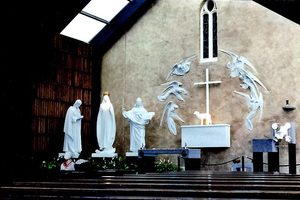

On the evening of 21 August 1879, fifteen villagers at Knock, County Mayo, said they saw Mary, Saint Joseph, Saint John the Evangelist and a lamb on an altar, all silent, on the gable of their parish church for about two hours in heavy rain. Two archdiocesan commissions found the witnesses trustworthy, popes have visited and honored the shrine, and sceptics have proposed that the figures were a projected image. The churches differ on Mary and the saints and on how claims of this kind are to be weighed.
| Date | 21 August 1879, about 8 p.m. |
|---|---|
| Place | South gable of the parish church, Knock, County Mayo, Ireland (Archdiocese of Tuam) |
| Claimed by | Fifteen named witnesses from Knock; the Catholic Church in the Archdiocese of Tuam |
| Type | Silent apparition of Mary, Saint Joseph, Saint John the Evangelist and a lamb on an altar with a cross |
| Official status | Witnesses found "trustworthy and satisfactory" by archdiocesan commissions (1879, 1936); shrine raised to International Shrine of Special Eucharistic and Marian Devotion, 19 March 2021 |
| Investigations | Commission, 8 October 1879; physicist's tests (as reported); second commission, 1935–36; sceptical studies by Berman (1979) and Harris (2000); healing recognized 2019 |
What is claimed
According to the depositions of October 1879, as summarized by the shrine and by The Irish Times, the first to see the scene at about 8 p.m. were Mary McLoughlin, housekeeper to the parish priest, Archdeacon Bartholomew Cavanagh, and Mary Byrne (also written Beirne). Others joined them, and fifteen became the official witnesses, among them John Curry, aged five, and the elderly Bridget Trench.
On the south gable they described a light and three figures. Mary wore a white cloak and a bright crown, her hands and eyes raised in prayer. Saint Joseph stood on her right, head bowed. Saint John, on her left, was dressed as a bishop, with a book and one hand raised as if preaching. Beside them stood a plain altar with a lamb facing west and a cross behind it, with angels about the lamb (mayo-ireland.ie). No word was spoken. The witnesses said the Rosary in the rain for about two hours, and Bridget Trench went up to the gable and tried to kiss Mary's feet.
The depositions differ on details. Mary Byrne said she took the third figure to be Saint John from a statue at Lecanvey, but called this "only an opinion"; Mary McLoughlin first supposed that the Archdeacon had put statues there (The Irish Times, 2019).
History and devotion
Newspaper reports drew sick pilgrims within days. The Irish Times reports that the first cure was recorded twelve days after the event and that Archdeacon Cavanagh had noted 637 cures by October 1880; the sources consulted give no medical verification of these. Mother Teresa visited in 1993.
Pope John Paul II came on 30 September 1979 for the centenary, before a crowd reported at about 450,000. He said, "I am here then as a pilgrim, a sign of the pilgrim Church throughout the world," gave a Golden Rose, and announced that the new church would be called the Basilica of Our Lady, Queen of Ireland (vatican.va). Pope Francis visited in August 2018. On 19 March 2021 he sent a video message elevating the National Shrine of Our Lady of Knock to an International Shrine of Special Eucharistic and Marian Devotion. Of the apparition, in which "the Virgin does not say a word," he said: "The message from Knock is the great value of silence for faith." The shrine's rector, Fr. Richard Gibbons, has pointed to the Eucharistic character of the apparition, in which a lamb appeared on an altar before a cross.
Investigations
Commission of 1879. Archbishop John MacHale of Tuam appointed a commission of priests, including Archdeacon Cavanagh, which began taking depositions at Knock on 8 October 1879. It examined all fifteen witnesses and reported their testimony as a whole "trustworthy and satisfactory"; according to The Irish Times it set fraud aside as a likely explanation.
Tests, 1879. Melvin Harris writes that a fortnight later a church team led by Francis Lennon, professor of physics at Maynooth, tested whether a magic lantern could have thrown the images, rejected that idea, and favored the possibility that the figures had been painted on the gable with phosphorescent substances (Free Inquiry, 2000).
Commission of 1935–36. Archbishop Thomas Gilmartin appointed a second commission, which examined the surviving witnesses, Mary O'Connell (Mary Byrne, then 86) and Patrick Byrne, while the Archbishop of New York arranged for John Curry, who lived there, to be questioned. All confirmed their earlier statements; Mary O'Connell testified on oath from her deathbed: "I am quite clear about everything I have said." The report called the witnesses upright and their evidence satisfactory (The Irish Times; mayo-ireland.ie).
Sceptical explanations. In 1979 the philosopher David Berman argued that the figures, which neither moved nor spoke, were probably "the projection of a magic lantern slide," and found contradictions in the statements; he cited a letter in the Tuam diocesan archive claiming a policeman had used a lantern, which he acknowledged to be hearsay (The Irish Times). Melvin Harris, a television investigator, held that a lantern could have been run from the sacristy behind the altar and cast through the gable window by a mirror, and reported reproducing the effect on a replica gable; citing Berman, he suggested a motive in a mass meeting at Knock on 1 June 1879 that protested against Archdeacon Cavanagh's pro-government views (Free Inquiry, 2000). Eugene Hynes, in Knock: The Virgin's Apparition in Nineteenth-Century Ireland (2008), sets the event in the Land War and argues that tensions between priests and tenants shaped how clergy identified the figures; Paul Carpenter (New Hibernia Review, 2011) holds that the witnesses' own descriptions count against the lantern theory.
A healing. In September 2019 Bishop Francis Duffy of Ardagh announced the Church's recognition of the 1989 healing at Knock of Marion Carroll, who had multiple sclerosis, after a medical bureau led by Dr. Diarmuid Murray took about thirty years over the case. Duffy called it "a healing for which there is no medical explanation at present" (America, 2019).
Official status
The apparition was examined locally, by two commissions of the Archdiocese of Tuam, each reporting on the witnesses' reliability. The papal acts reported in the sources consulted concern the shrine and its devotion (the 1979 visit and basilica, the 2021 elevation); none is reported as a separate decree on the apparition's supernatural character. The Catholic Church holds that approved private revelations "do not belong, however, to the deposit of faith" (Catechism 67), so no Catholic is required to believe in Knock. The Dicastery for the Doctrine of the Faith's norms of 17 May 2024, under which a diocesan bishop proposes one of six verdicts to the Dicastery, say that such phenomena do not become objects of faith and that the faithful may adhere to an approved one prudently; the text does not say whether it applies to cases decided earlier.
Where each church stands
- Catholic:
Two commissions of the Archdiocese of Tuam (1879, 1936) found the witnesses trustworthy; John Paul II made a pilgrimage to Knock in 1979, and Francis raised it to an International Shrine of Special Eucharistic and Marian Devotion in 2021. Approved private revelations "do not belong, however, to the deposit of faith" (Catechism 67), so belief in Knock is permitted, not required. See praying to Mary and the saints.
- Orthodox:
The Orthodox Church has made no statement about Knock. Its own calendar keeps, on 1 October, the Protection of the Theotokos, which commemorates a vision of the Mother of God seen at the Blachernae church in Constantinople by Saint Andrew the Fool, who died in 936 (Orthodox Church in America).
- Lutheran:
The Lutheran Church has made no statement about Knock. The Augsburg Confession (Art. XXI) allows that "the memory of saints may be set before us" for imitation, but says "the Scripture teaches not the invocation of saints." The Smalcald Articles (III.8.3) reject "spirits who boast that they have the Spirit without and before the Word," holding that God deals with people through the spoken Word and the sacraments (III.8.10).
- Reformed:
The Reformed churches have made no statement about Knock. The Westminster Confession (1.1) says that "those former ways of God's revealing his will unto his people" are "now ceased," and (1.6) that nothing is to be added to Scripture "by new revelations of the Spirit." Reformed teaching therefore holds that Scripture is complete and does not look to new apparitions for doctrine.
- Anglican:
The Church of England has made no statement about Knock. Article XXII of the Thirty-Nine Articles calls "the Romish Doctrine" of images, relics and the invocation of saints "a fond thing vainly invented, and grounded upon no warrant of Scripture." Practice varies widely: Evangelical parishes keep churches plain, while Anglo-Catholics use statues, icons and relics as aids to devotion.
- Methodist:
The Methodist churches have made no statement about Knock. Article XIV of the Articles of Religion calls the "Romish doctrine" of worshiping and adoring images and relics and of the invocation of saints "a fond thing, vainly invented, and grounded upon no warrant of Scripture, but repugnant to the Word of God."
- Baptist:
Baptists have made no statement about Knock. The Second London Confession (1677; reissued 1689), which many Baptists hold, says that "those former ways of God's revealing his will" are "now ceased" (1.1) and that worship is to be given to God alone, "not to Angels, Saints, or any other Creatures" (22.2). Baptists have no body that approves or rejects apparitions.
Sources
- Knock history page, "Apparition of 1879" (mayo-ireland.ie) the account of the figures; the 1936 findings; John Paul II's visit
- "An apparition or a magic lantern: What happened at Knock 140 years ago?" The Irish Times, 2019 witnesses, both commissions, cures, Berman's argument
- Harris, "The 'Miracle' at Knock: The Anatomy of a Hoax," Free Inquiry, spring 2000 Lennon's tests; the lantern reconstruction; the motive suggested
- Carpenter, "Mimesis, Memory, and the Magic Lantern: What Did the Knock Witnesses See?" New Hibernia Review 15.2 (2011), including its account of Hynes summary of its argument read second-hand; the article itself could not be opened
- The Miracle Hunter, "Our Lady of Knock" (devotional reference) date of the 1879 commission; attendance in 1979
- John Paul II, homily at the Shrine of Knock, 30 September 1979
- Pope Francis, video message on the elevation of the National Shrine of Our Lady of Knock, 19 March 2021 (Holy See Press Office)
- "Church recognizes 1989 healing at Knock shrine," America, 3 September 2019
- Catechism of the Catholic Church, no. 67
- Dicastery for the Doctrine of the Faith, Norms for proceeding in the discernment of alleged supernatural phenomena (17 May 2024)
- Orthodox Church in America, "The Protection of Our Most Holy Lady the Mother of God and Ever-Virgin Mary" (1 October)
- Augsburg Confession, Article XXI (Book of Concord)
- Smalcald Articles, Part III, Article VIII (Book of Concord)
- Westminster Confession of Faith, ch. 1
- Church of England, Articles of Religion, Article XXII
- United Methodist Church, Articles of Religion, Article XIV
- Second London Baptist Confession (1689), chs. 1 and 22
- Photograph of the apparition gable chapel, Wikimedia Commons (CC BY-SA 2.0)