Nicodemus the Hagiorite 1749–1809
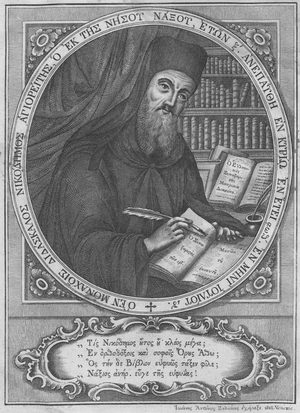

Nicodemus the Hagiorite ("of the Holy Mountain") was a Greek monk of Mount Athos who edited, translated and wrote works that shaped Orthodox spiritual life and church law after 1800: the Philokalia, the canon-law commentary called the Rudder, and an adaptation of a Catholic manual published as Unseen Warfare. The Orthodox honor him as a saint; his handling of baptism outside the Orthodox Church and his use of Western books are still debated.
| Lived | 1749 (some sources give 1748), Naxos, to 14 July 1809, Mount Athos |
|---|---|
| Church | Orthodox Church (Ecumenical Patriarchate); monk, baptized Nicholas, who began monastic life at Dionysiou on Mount Athos |
| Role | Monk, editor, translator and author |
| Influenced by | Macarius of Corinth, who set him on the monastic path; the Kollyvades monks; the Greek Fathers and Gregory Palamas; Catholic spiritual writers of the sixteenth and seventeenth centuries |
| Influenced | Orthodox spirituality and canon law since 1800; Theophan the Recluse, who reworked Unseen Warfare for Russian readers (1885) |
| Writings | Philokalia (Venice, 1782, with Macarius); Exomologetarion (1794); Unseen Warfare (Venice, 1796); New Martyrology (1799); Rudder (Leipzig, 1800, with Agapios); Handbook of Spiritual Counsel (1801) |
| Honored | Glorified (canonized) by the Ecumenical Patriarchate on 31 May 1955; inscribed by the Russian Church in 1956; feast on 14 July |
Life
Nicholas was born on Naxos and educated there and at the Evangelical School of Smyrna, finishing in 1770. Back on Naxos he worked as secretary to the bishop and met Macarius, a former metropolitan of Corinth, who inspired him to become a monk (Russell). On Mount Athos he was tonsured and took the name Nicodemus. Macarius belonged to the Kollyvades, monks who had been in dispute since 1754 over whether memorial services should be held on Sundays; the movement grew into a call to return to strict monastic observance, the canons and the Greek Fathers, and to renew the spiritual life of lay people as well (Russell).
Nicodemus spent the rest of his life editing, translating and writing, moving about in search of manuscripts and collaborators (Erickson). He died on Mount Athos on 14 July 1809 (Britannica; Orthodox Church in America). The Ecumenical Patriarch Athenagoras I canonized him on 31 May 1955, and the Church of Russia added him to its calendar of saints in 1956 (Russell).
What he taught
The Philokalia. With Macarius he compiled the Philokalia (Venice, 1782), an anthology of fourth- to fifteenth-century texts on watchfulness and the prayer of the heart, the repetition of the Jesus Prayer. The original edition did not name the compilers (Andrew Louth), and Nicodemus's introduction addresses it to "all Orthodox Christians, married as well as monastic." It was translated into Russian in the nineteenth century; an English selection by E. Kadloubovsky and G. E. H. Palmer appeared in 1951, and the complete English text by Palmer, Philip Sherrard and Kallistos Ware ran from 1979 to 2023. With Macarius he also prepared the Evergetinos, an anthology of monastic sayings, first printed in 1783. See Gregory Palamas for the hesychast tradition behind the collection.
Frequent communion. Nicodemus held that the faithful should receive Communion often, indeed continually, and pressed the point in his notes to the canons (Erickson). Macarius's essays on the Eucharist were at first criticized as doctrinally mistaken; the Synod of Constantinople in 1819 vindicated them (Britannica). See the Lord's Supper.
Spiritual handbooks from Western sources. Unseen Warfare (Venice, 1796) follows The Spiritual Combat by the Theatine Lorenzo Scupoli, with added quotations from Basil, Isaac the Syrian, Maximus the Confessor and Palamas; the title page names only "a certain wise man." He likewise adapted Pinamonti's version of the Spiritual Exercises of Ignatius Loyola (Gymnasmata pneumatika, 1800), and Segneri's manuals for confessors and penitents (Exomologetarion, 1794). He worked from Modern Greek translations already made on Patmos and valued the books for their practical and psychological guidance for lay readers (Russell).
The Rudder. The Pedalion (Leipzig, 1800), edited with the hieromonk Agapios, prints the apostolic, conciliar and patristic canons with a paraphrase, a "harmony" of related canons and notes. It holds the canons to be a harmonious whole, binding everywhere and at all times, on laity as well as clergy (Erickson). On baptism it argues that the Apostolic Canons and Cyprian of Carthage state the rule of the ancient Church: baptism by heretics is not baptism. The ecumenical councils that accepted some heretics' baptism did so by oikonomia (relaxation of the strict rule, akribeia) for the sake of winning them back. He judged the Latins to be heretics who also do not baptize by three immersions, so that their baptism was unacceptable by strictness, and that the economy once used in receiving Latins by chrismation had run its course. He fully supported the 1755 decree of Patriarch Cyril V requiring that converts from the Latins be baptized (Erickson; Cyprian). He also wrote that the Orthodox should not reject a practice only because Latins hold it: "if they have anything sound and confirmed by the canons of the holy synods, this we must not hate" (Heortodromion, quoted by Erickson).
What historians say
Use of Catholic books. Norman Russell notes that Nicodemus was hostile to the Roman Catholic Church yet borrowed heavily from its writers and did not name Scupoli or say that the books were of Catholic origin, since that would have hindered their reception. Russell adds that the Russian reviser Theophan the Recluse judged it necessary to rewrite passages of Unseen Warfare on Eucharistic doctrine, spiritual communion and perpetual prayer, while Nicodemus's own version has stayed popular in Greece, its latest reprint noted by Russell being that of 1965. Christos Yannaras counts Nicodemus's teaching on repentance, which speaks of satisfying divine justice, as part of a Western captivity of Greek theology, and cites Nicodemus's 1806 request to the patriarchate about an indulgence for a fellow monk. Russell replies that rigorism has a long history in Orthodox teaching, and that Nicodemus joined Orthodox canonical and ascetical tradition to Western psychological insight to meet the needs of his time. John Erickson writes that Nicodemus accepted Latin sacramental vocabulary even in opposing a Latin form of absolution.
The Rudder and baptism. Britannica says the Rudder's bias against the Latin church is partly due to interpolations by another editor. Erickson calls the work's legacy "mixed": his scholarship on the canons needs correction (the Apostolic Canons are not the work of the apostles), and setting akribeia against oikonomia hides the older sense of economy as pastoral stewardship; yet Nicodemus remains "unsurpassed among Orthodox interpreters of the canons" in breadth of vision. The Orthodox theologian George Dragas answers that the two principles are not opposed, that the Church applies one or the other through its lawful authorities, and that the Ecumenical Patriarchate has sanctioned both Nicodemus and the Rudder. The 1755 decree is not regarded as binding on the Orthodox Church as a whole, and earlier practice received Catholic converts by chrismation (Russell; see the Orthodox record).
How the churches see Nicodemus
- Catholic:
The Catholic Church has made no statement about Nicodemus. The Second Vatican Council's decree Unitatis Redintegratio (1964, para. 15) says the Eastern churches "possess true sacraments," above all by apostolic succession, the priesthood and the Eucharist, which it says link them closely with the Catholic Church. In 1999 the North American Orthodox-Catholic Theological Consultation, a body of theologians from both churches and not an act of either church, called the Rudder's theory of sacramental economy "an eighteenth-century innovation" and asked the Ecumenical Patriarchate to withdraw the 1755 decree; some Orthodox commentators reject its conclusions. The authors he adapted were Catholic: Scupoli was a Theatine, and Ignatius Loyola, Pinamonti and Segneri were Jesuits.
- Orthodox:
The Ecumenical Patriarchate glorified him on 31 May 1955, and the Orthodox Church in America lists his feast on 14 July. His Rudder is widely treated as authoritative, especially in Greek usage, but Orthodox opinion differs on its strictness toward non-Orthodox baptism. The Ecumenical Patriarchate and the Greek Orthodox Archdiocese of America receive those baptized with water in the name of the Trinity within a church that confesses the Trinity by chrismation, while Russell notes that some "scrupulous" Orthodox still observe the 1755 decree. Erickson sees in the Rudder a turning point in the idea of economy, and the 1999 consultation calls it an innovation; Dragas and others defend it. Yannaras criticizes his Western borrowings; others call him a great teacher of the inner life (Russell). See The Orthodox perspective.
- Lutheran:
No Lutheran church has made a statement about Nicodemus. The Augsburg Confession (art. XXI) teaches that the memory of saints may be kept as an example of faith, but that Scripture does not teach invoking saints or asking their help, since it sets before us Christ as the one Mediator.
- Reformed:
No Reformed church has made a statement about Nicodemus. The Westminster Confession (21.2) says religious worship is to be given to the Father, Son and Holy Spirit "and to him alone," "not to angels, saints, or any other creature."
- Anglican:
The Church of England has made no statement about Nicodemus. Article XXII of the Thirty-Nine Articles rejects the "Romish doctrine" of invocation of saints. In Looking East in Winter (2021) the former Archbishop of Canterbury Rowan Williams introduces Eastern Christian spiritual practice, including the Jesus Prayer, to Western readers, and has said that "looking east can free us a bit from our anxiety" (Christian Century, 2022).
- Methodist:
No Methodist church has made a statement about Nicodemus or the Philokalia. Article XIV of the Methodist Articles of Religion calls the Roman doctrine of purgatory, relics and "invocation of saints" "a fond thing, vainly invented" and "grounded upon no warrant of Scripture."
- Baptist:
No Baptist body has made a statement about Nicodemus. The Second London Confession (22.2), which many Baptists hold, says religious worship is to be given to God alone, "not to Angels, Saints," or other creatures, and (29.2) that baptism is for those who actually profess repentance and faith, so Baptists do not practice infant baptism.
Sources
- Britannica, "Saint Nicodemus the Hagiorite"
- Norman Russell, "St Nikodemos the Hagiorite and the Spirituality of the Catholic Reformation," The Way 56/4 (2017)
- John H. Erickson, "On the Cusp of Modernity: The Canonical Hermeneutic of St Nikodemos the Haghiorite," St Vladimir's Theological Quarterly 42/1 (1998)
- George Dragas, "The Manner of Reception of Roman Catholic Converts into the Orthodox Church" (paper read to the Orthodox-Roman Catholic Dialogue, USA, 1998)
- Andrew Louth on volume five of the Philokalia, Fortnightly Review (2023)
- Orthodox Church in America, "Repose of the Venerable Nicodemus the Hagiorite" (14 July)
- Holy Trinity Greek Orthodox Cathedral, Portland, "Reception of Adults by Baptism or Chrismation" (practice of the Ecumenical Patriarchate and the Greek Orthodox Archdiocese)
- North American Orthodox-Catholic Theological Consultation, "Baptism and Sacramental Economy" (3 June 1999)
- Second Vatican Council, Unitatis Redintegratio (1964), para. 15
- Augsburg Confession, Article XXI (Book of Concord)
- Westminster Confession of Faith, ch. 21 (OPC)
- Church of England, Articles of Religion, Article XXII
- Timothy Jones, interview with Rowan Williams, The Christian Century (4 May 2022)
- United Methodist Church, Articles of Religion, Article XIV
- Second London Baptist Confession (1689), ch. 22
- The Evergetinos, book 1 (St. Nicodemos's first publication, 1783), STM Press
- Engraving of Nicodemus the Hagiorite, Venice 1818, Wikimedia Commons (public domain)