Thomas Aquinas c. 1225–1274
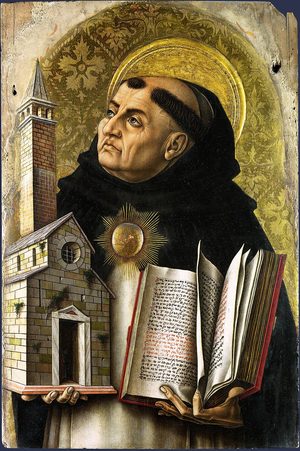

Thomas Aquinas was a Dominican friar and teacher at Paris and Naples whose Summa Theologiae the Catholic Church has held up as a model of theology since Leo XIII's 1879 encyclical. He explained transubstantiation in the terms of Aristotle and argued that reason and grace work together, so every tradition has had to say what it makes of his method as well as his conclusions.
| Lived | c. 1225, Roccasecca, near Naples, to 7 March 1274, Fossanova Abbey |
|---|---|
| Church | Catholic; Dominican friar (habit received April 1244) and priest |
| Role | Master of theology at Paris (1256; regent master again 1268–72); teacher at Naples, Orvieto and Rome |
| Influenced by | Albert the Great, his teacher; Aristotle; Augustine; Peter Lombard's Sentences |
| Influenced | Later Thomists such as Cajetan; the neo-Thomist revival after 1879; Richard Hooker; Reformed scholastics such as Peter Martyr Vermigli and Girolamo Zanchi |
| Writings | Summa contra Gentiles (early 1260s); Summa Theologiae (begun 1265–68, unfinished at his death) |
| Honored | Canonized 18 July 1323 by John XXII; Doctor of the Church 1567 (Pius V); 28 January in the Catholic, Episcopal and Church of England calendars |
Life
Thomas was born at Roccasecca, near Naples, between 1224 and 1226, the youngest of four sons. He studied at the Benedictine abbey of Monte Cassino and from 1239 at the University of Naples, where he read Aristotle. In April 1244 he received the Dominican habit; his family held him for about a year to dissuade him, but he returned to the order. He studied under Albert the Great at Paris and Cologne, lectured at Paris on Peter Lombard's Sentences from 1252, and became a master of theology in 1256. He then taught at Naples, Orvieto and Rome, where he began the Summa Theologiae (1265–68), and again at Paris (1268–72) and Naples (1272–73). The Catholic Encyclopedia dates the Summa contra Gentiles to 1261–64.
On 6 December 1273, according to the Catholic Encyclopedia, he stopped writing after a long ecstasy at Mass and told his companion Reginald of Piperno that what he had written appeared of little value beside what had been revealed to him; the Stanford Encyclopedia gives the words as, "All that I have written seems to me like straw." The third part of the Summa breaks off in the treatise on penance. Summoned to the Second Council of Lyon, he died at Fossanova on 7 March 1274. John XXII canonized him on 18 July 1323, and Pius V named him a Doctor of the Church in 1567.
What he taught
Aquinas held that theology (sacra doctrina) rests on revelation and does not replace reason: "grace does not do away with nature but completes it" (Summa Theologiae I, q. 1, a. 8, as quoted by Shawn Wright). In I, q. 2, a. 3 he sets out the Five Ways, short arguments from motion, causation, contingency, degrees of perfection and the order of things to a first mover and cause, "this we understand to be God." He taught that God is simple and pure act, and that natural law is the share of rational creatures in God's eternal law (I–II, qq. 90–97).
On justification he taught that God infuses grace, which moves the will to faith and to turn from sin, and that works done in grace merit eternal life (I–II, qq. 109–114). In the Eucharist he held that the whole substance of the bread and wine is changed into Christ's body and blood while the appearances remain (III, q. 75), an account that Trent later endorsed when it called "transubstantiation" the fitting term (the Lord's Supper). He also questioned the Immaculate Conception, and with Duns Scotus he held that unbaptized infants feel no pain and enjoy a natural happiness, the idea later called limbo (International Theological Commission, 2007, original sin).
What historians say
Aquinas was not accepted at once. Of the 219 articles condemned at Paris in 1277, three years to the day after his death, a significant number seem to touch his teaching, and Archbishop Robert Kilwardby condemned theses at Oxford that month, including two Thomist doctrines: that a thing has a single substantial form, and that prime matter is pure potentiality (Stanford Encyclopedia). Two years after the canonization the bishop of Paris ruled that the 1277 condemnations should not be applied to Aquinas.
Leo XIII's 1879 encyclical Aeterni Patris states that the Fathers of Trent laid the Summa on the altar with Scripture and the papal decrees (para. 22). The sources consulted give this only on papal authority, with Pius XI repeating it in Studiorum Ducem; no record by the council's own participants appears in them. The same encyclical began the neo-Thomist revival, which produced twentieth-century Thomists such as Jacques Maritain and Étienne Gilson and, in the Stanford Encyclopedia's account, rival "Thomisms." Historians also note that Luther and Thomas Hobbes rejected scholasticism. How far later Protestant and Orthodox thinkers drew on Aquinas, and how far they departed from him, is still discussed (see below).
How the churches see Aquinas
- Catholic:
Aquinas was canonized in 1323 and made a Doctor of the Church in 1567. Aeterni Patris (1879) urged bishops "to restore the golden wisdom of St. Thomas, and to spread it far and wide" (para. 31). The 1917 Code (canon 1366 §2) told professors to teach philosophy and theology according to "the system, teaching, and principles of the Angelic Doctor" (as translated in one secondary source). Vatican II's decree Optatam Totius (16) asks students to examine doctrine "under the guidance of St. Thomas," and the 1983 Code (canon 252 §3) asks that dogmatic theology be taught "especially with St. Thomas as a teacher." John Paul II's Fides et Ratio (1998, para. 43) says the Church has been justified in proposing him "as a master of thought." His feast is 28 January.
- Orthodox:
The Orthodox Church has made no declaration about Aquinas. In the fourteenth century Demetrios Kydones translated the Summa contra Gentiles and parts of the Summa Theologiae into Greek; he and his brother Prochoros opposed Gregory Palamas's teaching on God's essence and energies, which councils at Constantinople had upheld (essence and energies). Marcus Plested argues that many late Byzantines, among them Palamite and anti-unionist writers, admired Aquinas, and that Gennadios Scholarios claimed none admired him more. He adds that modern Orthodox writing has mostly treated Aquinas as a symbol of the West: Vladimir Lossky objected to his Trinitarian theology and Georges Florovsky to Orthodox "scholasticism." The Synod of Jerusalem (1672) used the Latin-derived term for the change of the elements (Decree 17).
- Lutheran:
Luther's Disputation Against Scholastic Theology (1517), thesis 50, says "the whole Aristotle is to theology as darkness is to light"; the Lutheran writer Jordan Cooper adds that Luther's objections to Aquinas concerned Aristotle's ethics and the limits of syllogism, and that Luther "may never be vindicated" as a Thomist. The Smalcald Articles (III.6) say of transubstantiation, "we care nothing about the sophistical subtlety" (why not transubstantiation). In the seventeenth century Johann Gerhard's Loci Theologici used the scholastic form "in a moderate degree," in Luthardt's phrase quoted by Schmid.
- Reformed:
Reformed scholastics used Aquinas. Peter Martyr Vermigli drew on Thomist arguments against Stephen Gardiner on transubstantiation, and Girolamo Zanchi against Domingo de Soto and Trent, in what Matthew Barrett calls "critical appropriation." R. Scott Clark of Westminster Seminary California writes that he was "surprised to see how favorable" the orthodox Reformed writers were to Thomas, having first been taught to see in him a "nature-grace dualism." The Reformed reading of the Supper differs from Aquinas's (the Lord's Supper).
- Anglican:
Richard Hooker's Laws of Ecclesiastical Polity (Books I–IV, 1593) takes its account of law from Aquinas: one reference work calls Book I "a readable sixteenth-century compendium of Thomistic philosophy," and Hooker cites Summa Theologiae I–II, q. 94. Article XXVIII of the Thirty-Nine Articles holds that transubstantiation "overthroweth the nature of a Sacrament." The Episcopal calendar lists "Thomas Aquinas, Priest and Friar, 1274" on 28 January, and the Church of England's Common Worship lists him on that date as a Lesser Festival.
- Methodist:
The Methodist Articles of Religion do not mention Aquinas; Article XVIII rejects transubstantiation. No statement by Wesley assessing Aquinas has been found. The Methodist scholar Edgardo Colón-Emeric of Duke Divinity School argues in Wesley, Aquinas, and Christian Perfection (Baylor, 2009) that the two theologians' teaching on perfection is largely complementary.
- Baptist:
The Baptist Faith and Message (2000, art. VII) calls the Lord's Supper a "symbolic act" and does not mention Aquinas. Shawn D. Wright of The Southern Baptist Theological Seminary writes in the Southern Baptist Journal of Theology (30.1, 2026) that Calvin cited Thomas only four times and that "Thomas's doctrine of salvation is synergistic," while noting that Craig Carter and Matthew Barrett make Thomas the hero of their recent books.
Sources
- Catholic Encyclopedia (1913), "St. Thomas Aquinas" dates of life and works; December 1273; canonization 1323; Doctor 1567
- Internet Encyclopedia of Philosophy, "Thomas Aquinas" career dates, Fossanova and Lyon
- Stanford Encyclopedia of Philosophy, "Thomas Aquinas" the 1277 condemnations; later reception
- Leo XIII, Aeterni Patris (1879), paras. 17, 22, 31
- Code of Canon Law (1983), canon 252
- "St Thomas Aquinas and the Church: His Extrinsic Authority" (quoting 1917 canon 1366 §2)
- Vatican II, Optatam Totius (1965), para. 16
- John Paul II, Fides et Ratio (1998), paras. 43-44
- Plested, Orthodox Readings of Aquinas (Oxford University Press, 2012)
- Review of Plested, Orthodox Readings of Aquinas (Ancient Faith)
- Encyclopedia.com, "Cydones, Demetrius"
- Smalcald Articles, Part III, Article VI (Book of Concord)
- Cooper, "Luther contra Scholasticos," Modern Reformation
- Schmid, Doctrinal Theology of the Evangelical Lutheran Church, Appendix I (on Gerhard)
- Barrett, "First Principles: Reformed Scholasticism," Credo Magazine (2023)
- Clark, "Why I Changed My Mind about Thomas Aquinas," Heidelblog (2022)
- Encyclopedia.com, "Hooker, Richard (1553-1600)"
- Episcopal Church, Calendar of the Church Year
- Church of England, Common Worship: Lesser Festivals
- Colón-Emeric, Wesley, Aquinas, and Christian Perfection (Baylor University Press, 2009)
- Wright, "The Reformation, Baptists, and Biblical Retrieval Theology," Southern Baptist Journal of Theology 30.1 (2026)
- Crivelli, Saint Thomas Aquinas, National Gallery, London
- Crivelli portrait, Wikimedia Commons (public domain)