Robert Bellarmine 1542–1621
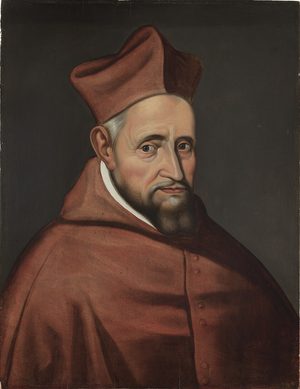

Robert Bellarmine was a Jesuit theologian and cardinal whose Disputationes de controversiis (Controversies) set out the Catholic case against the Protestants point by point, so that Reformed, Lutheran and Anglican writers answered him for generations. He took part in the Holy Office's cases against Giordano Bruno and Galileo, and held that the pope has an indirect power over temporal rulers, a view that brought him into dispute with King James I of England and, for a time, with Pope Sixtus V.
| Lived | 4 October 1542, Montepulciano, to 17 September 1621, Rome |
|---|---|
| Church | Catholic; Jesuit from 20 September 1560, priest, cardinal (1599) |
| Role | Professor of controversies at the Roman College (from 1576); cardinal (3 March 1599); Archbishop of Capua (1602–1605); took part in the Holy Office's handling of Bruno and Galileo |
| Influenced by | Thomas Aquinas and the Church Fathers, whom he studied at Louvain |
| Influenced | Catholic controversial theology and ecclesiology; the Protestant writers who answered him, among them William Whitaker, Amandus Polanus and Johann Gerhard |
| Writings | Disputationes de controversiis christianae fidei (Ingolstadt, 1586–93); preface to the Clementine Vulgate (1592); Dottrina cristiana breve and Dichiarazione più copiosa (1597–98); Responsio Matthaei Torti (1608); Tractatus de potestate Summi Pontificis in rebus temporalibus (1610) |
| Honored | Beatified 1923; canonized 1930; Doctor of the Church 1931; optional memorial on 17 September in the General Roman Calendar |
Life
Bellarmine was born at Montepulciano in Tuscany. He entered the Society of Jesus on 20 September 1560, studied philosophy at the Roman College, began theology at Padua in 1567 and finished it at Louvain, where he was ordained in 1570 and taught for several years. In 1576 he was given the new chair of controversies at the Roman College; his lectures there became the Disputationes de controversiis christianae fidei, published at Ingolstadt from 1586. About 1590 Pope Sixtus V proposed to put the first volume on the Index of Forbidden Books because it gave the papacy only an indirect power over temporal affairs; Sixtus died before acting, and the work was not condemned. In 1592 Clement VIII issued the revised Vulgate; Bellarmine wrote its preface, which presents the text as continuing Sixtus V's work.
Clement VIII made him a cardinal on 3 March 1599. In March 1602 he was named Archbishop of Capua and was consecrated in April; he held the see for about three years, and when Paul V kept him in Rome he asked to be released from it. He wrote catechisms (Dottrina cristiana breve and the fuller Dichiarazione, 1597–98) that were used widely, and a commentary on the creed for priests (1604). In 1608–10 he wrote against the oath of allegiance imposed on English Catholics and against William Barclay's denial of papal power. He died in Rome on 17 September 1621. Pius XI beatified him in 1923, canonized him in 1930 and proclaimed him a Doctor of the Church in 1931.
What he taught
The Controversies take the disputed articles in order: the Word of God, Christ, the pope, councils, the Church, the sacraments, and grace, free will and justification. Bellarmine argued from Scripture, the Fathers and councils, and held that the Church is a visible society under the pope (the papacy). Benedict XVI said the work stressed the Church's institutional side against the errors of the time, while Bellarmine also described her invisible reality as the Mystical Body of Christ. On justification he denied that a believer can be certain by divine faith, without special revelation, that his sins are forgiven, while allowing confidence grounded in God's promise and a conjectural security from one's own dispositions (De iustificatione III.2).
On the pope's relation to rulers he took a middle course, called the indirect power: the pope has no direct temporal dominion over princes, but may judge temporal matters so far as they touch the salvation of souls. Papalists such as Sixtus V thought this gave the papacy too little; regalists such as Barclay, who denied that the pope may depose kings, thought it gave too much. In the oath of allegiance dispute the Holy See forbade English Catholics the oath, whose text called the deposing power "impious and heretical," and Bellarmine defended that ruling in his reply to King James.
What historians say
Bruno. According to the Stanford Encyclopedia of Philosophy, Bellarmine and the Dominican Alberto Tragagliolo compiled the eight propositions that the Holy Office approved on 14 January 1599 as heretical, working from the trial records and Bruno's books. Bruno refused to recant, and on 17 February 1600 he was burned in the Campo de' Fiori. The site's record chapter on the Roman Inquisition, Bruno and Galileo gives the Catholic account that he was condemned chiefly for theological heresies rather than for his cosmology, and the Vatican's regret in 2000.
Galileo. In April 1615 Bellarmine wrote to the Carmelite Paolo Foscarini that it was prudent to present the earth's motion as a hypothesis; if a real proof were shown, Scripture would have to be re-read with care, but he doubted that any proof existed, since none had been shown to him. In February 1616, after an internal Holy Office commission had reportedly judged the Copernican view heretical, Galileo was called to Bellarmine's residence and told to abandon it. Historians dispute what was said: the Stanford Encyclopedia notes that a "charitable admonition" may or may not have been followed by a formal injunction not to hold, teach or defend the doctrine in any way, and that when the record surfaced in 1633 it made Galileo appear to have broken it. On 26 May 1616 Bellarmine gave Galileo a certificate stating that he had not abjured or been given a penance, but had been notified that the doctrine could not be defended or held. In 1992 John Paul II acknowledged the Church's error in Galileo's case.
The oath and the pope's power. English Catholics were required from 1606 to swear that the pope could not depose the king. The Holy See forbade the oath; King James I defended it in Triplici nodo, triplex cuneus (1608); Bellarmine answered under the name Matthaeus Tortus (1608), and Lancelot Andrewes replied for the king in Tortura Torti (1609). Bellarmine's 1610 treatise answered Barclay.
How the churches see Bellarmine
- Catholic:
Pius XI beatified Bellarmine in 1923, canonized him in 1930 and proclaimed him a Doctor of the Church in 1931. His day, 17 September, is an optional memorial in the General Roman Calendar. Benedict XVI, in a general audience on 23 February 2011, said the Controversies won "instant renown" and remain a valid reference for Catholic ecclesiology, and that Bellarmine avoided polemics against the Reformation.
- Orthodox:
The Orthodox Church has made no statement about Bellarmine. The Orthodox reject the universal jurisdiction of the pope that his Controversies defend; the Encyclical of the Eastern Patriarchs (1848), in paragraphs 11–12, sets out that rejection (see the Orthodox claim).
- Lutheran:
The Lutheran theologian Johann Gerhard answered Bellarmine in his Confessio catholica (1634–37), whose last three parts take the disputed articles in Bellarmine's order, and which argues from Catholic writers, Bellarmine among them, that Lutheran doctrine is catholic. The Book of Concord (1580) predates the Controversies and does not name him; its Smalcald Articles (II.4) call the papacy "Antichrist."
- Reformed:
Reformed theologians answered the Controversies at length. Amandus Polanus of Basel published a 1600 collection of theses aimed chiefly at Bellarmine's disputations and, in his Syntagma theologiae (1610), a long reply to him on Scripture; Francis Junius wrote Animadversions on him (1600–08) and William Ames Bellarminus enervatus (1630s). The Westminster Confession (25.6) holds that the pope is not head of the Church "in any sense." Reformed churches have made no formal statement about Bellarmine himself.
- Anglican:
William Whitaker, Regius Professor of Divinity at Cambridge from 1580, wrote Disputatio de sacra scriptura (1588) against Bellarmine and Thomas Stapleton. When Bellarmine, as Matthaeus Tortus, answered King James I's defense of the oath of allegiance, Lancelot Andrewes replied with Tortura Torti (1609) and later a further Responsio. Article XXXVII states that "The Bishop of Rome hath no jurisdiction in this Realm of England." In ARCIC's The Gift of Authority (1999), Anglican and Catholic theologians agreed that a universal primacy could be "offered and received"; Anglicans differ on this.
- Methodist:
No Methodist church has made a statement about Bellarmine. The Methodist–Roman Catholic commission's report Towards a Statement on the Church (1986) judged Rome's claim of primacy not established from Scripture apart from tradition, while not ruling out its acceptance in a restored unity.
- Baptist:
No Baptist body has made a statement about Bellarmine. The Second London Confession (1689), which many Baptists hold, says of the church (26.4) that "neither can the Pope of Rome in any sense be head thereof," and names Christ as its head.
Sources
- Catholic Encyclopedia, "St. Robert Francis Romulus Bellarmine" dates of life, Controversies, Index, Vulgate preface, catechisms, oath, canonization
- Benedict XVI, general audience, 23 February 2011
- Catholic Culture, liturgical calendar for 17 September
- Stanford Encyclopedia of Philosophy, "Giordano Bruno"
- Stanford Encyclopedia of Philosophy, "Galileo Galilei"
- Bellarmine to Foscarini, April 1615 (Famous Trials)
- Bellarmine's certificate to Galileo, 26 May 1616 (Famous Trials)
- Finocchiaro, "Galileo's First Confrontation with the Inquisition (1616)"
- Museum of the Bible, Clementine Vulgate (1592)
- Regensburg Forum, on Bellarmine's De iustificatione III.1-3
- Schaff-Herzog Encyclopedia, "Gerhard, Johann" (Confessio catholica)
- Schaff-Herzog Encyclopedia, "Whitaker, William"
- Reformed Books Online, works against Bellarmine (Polanus, Junius, Ames, Whitaker)
- Whitaker, A Disputation on Holy Scripture, against the Papists, especially Bellarmine and Stapleton (Parker Society, 1849)
- Dictionary of National Biography, "Andrewes, Lancelot" (Tortura Torti, 1609)
- Second London Baptist Confession (1689), ch. 26
- Church of England, Articles of Religion
- Portrait, Wikimedia Commons (Museum Plantin-Moretus, Antwerp)
- Encyclical of the Eastern Patriarchs (1848), paras. 11-12 as cited in the site chapter on the papacy
- Westminster Confession of Faith (1646), 25.6 as cited in the site chapter on the papacy
- ARCIC II, The Gift of Authority (1999) as cited in the site chapter on the papacy
- Methodist–Roman Catholic International Commission, Towards a Statement on the Church (1986) as cited in the site chapter on the papacy