Heinrich Bullinger 1504–1575
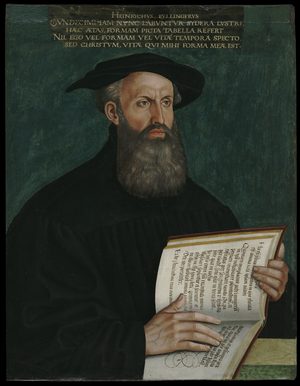

Heinrich Bullinger was the chief pastor of Zurich for more than forty years after Zwingli's death, the author of the Second Helvetic Confession, and a correspondent of reformers and rulers across Europe. His confession shaped the Reformed churches of Switzerland, Scotland and Hungary, and he stands at the center of two modern debates: the origins of Reformed covenant theology, and how Zurich treated the Anabaptists.
| Lived | 18 July 1504, Bremgarten, to 17 September 1575, Zurich |
|---|---|
| Church | Son of a priest, Catholic by birth; Reformed pastor; chief pastor of the Zurich church |
| Role | Teacher at the Cappel monastery school; pastor of Bremgarten (1529–31); chief pastor of Zurich from December 1531 until his death |
| Influenced by | Zwingli; Augustine and Chrysostom, whom he read at Cologne; Luther and Melanchthon |
| Influenced | Reformed churches in Switzerland, Scotland and Hungary through his confession; the English bishops and exiles who wrote to him; his successor Rudolf Gwalther |
| Writings | De testamento on the one covenant (1534); First Helvetic Confession (1536, with others); Consensus Tigurinus with Calvin (1549); the Decades, fifty sermons (1549–51); Second Helvetic Confession (written 1562, published 1566); about 12,000 letters |
| Honored | No feast or commemoration is known in the calendars of the seven traditions; his Second Helvetic Confession is still a confessional standard in Reformed churches |
Life
Bullinger was born at Bremgarten, in what is now the canton of Aargau, the son of the town's dean, a priest, and Anna Wiederkehr. He studied at Emmerich and Cologne, where reading Augustine and Chrysostom, then Luther and Melanchthon, turned him to Scripture. He taught at the Cappel monastery school, heard Zwingli at Zurich in 1527, and in 1528 went with him to the disputation at Bern. In 1529 he became pastor of Bremgarten and married Anna Adlischweiler, a former nun; they had eleven children.
After the Swiss Protestants were defeated at Kappel on 11 October 1531 and Zwingli was killed, Bullinger left Bremgarten for Zurich. On 9 December 1531 he was chosen to succeed Zwingli, and he held the post until his death. In 1536 he helped draft the First Helvetic Confession. In May 1549 he and Calvin agreed on the Consensus Tigurinus on the Lord's Supper, published in 1551. Between 1549 and 1551 he published the Decades, and in 1562 he wrote the confession that became the Second Helvetic Confession; Frederick III, Elector Palatine, had it published in 1566. About 12,000 of his letters survive.
Bullinger took in English Protestant fugitives in 1539 and again under Mary I (1553–58), and after Elizabeth's accession English bishops including Grindal, Jewel and Sandys wrote to him. He died at Zurich on 17 September 1575, and Rudolf Gwalther succeeded him.
What he taught
The Second Helvetic Confession, his best-known work, begins with Scripture: when the Word is lawfully preached, "the very Word of God is proclaimed, and received by the faithful" (ch. 1; Scripture alone). It defines the church as "an assembly of the faithful called or gathered out of the world" (ch. 17; the visible church), and says ministers "may now be called bishops, elders, pastors, and teachers" (ch. 18). On predestination it directs readers to Christ: "Let Christ, therefore be the looking glass, in whom we may contemplate our predestination" (ch. 10). It says that magistracy "is instituted by God himself" (ch. 30).
On the Lord's Supper the Confession says the body of Christ "is in heaven at the right hand of the Father" and that "there is also a spiritual eating of Christ's body" (ch. 21); it rejects the teaching that Christ's body is hidden corporeally under the bread. The Consensus Tigurinus (1549) says the Supper is not an empty symbol but a testimony and seal of grace, with spiritual communion with Christ (the symbolic view). On infant baptism the Confession says: "We condemn the Anabaptists, who deny that newborn infants of the faithful are to be baptized" (ch. 20).
In De testamento seu foedere Dei unico et aeterno (October 1534), "On the one and eternal covenant of God," he argued that God's covenant with his people is single and lasting. Lyle Bierma calls it the first treatise in the Reformed tradition devoted wholly to the covenant, and it has been much studied since (see below).
What historians say
The chief scholarly dispute concerns the covenant. J. Wayne Baker, in Heinrich Bullinger and the Covenant: The Other Reformed Tradition (1980), argued that the covenant was the organizing idea of Bullinger's theology, that he understood it as bilateral and conditional, and that he founded a covenantal stream in the Reformed churches distinct from Calvin's; with Charles McCoy he called De testamento the fountainhead of federal theology (Fountainhead of Federalism, 1991). Edward Dowey (1990) judged this "premature." Richard Muller (1994) agreed that Bullinger is a source of federal theology but called the claim that his whole system rested on a conditional covenant "a great overstatement." Bierma (1996) held that the covenant never became an organizing principle of his theology. Baker replied in 1998 that Bullinger "was not a covenant theologian in the same way that later thinkers were." Isaias Ochoa (2024) calls him the forerunner, not the father, of federal theology. Bruce Gordon and Emidio Campi's Architect of Reformation (2004) was the first broad introduction to his life and theology in English.
The Zurich authorities put Anabaptists to death between 1527 and 1614, and Bullinger led the Zurich church from 1531. He wrote against the Anabaptists and, according to Campi, published On the Origin of Anabaptism in 1560; the Second Helvetic Confession condemns them by name. Mennonite and other Anabaptist historians, and many Reformed historians since, hold that a city that reformed its church from Scripture killed fellow Protestants for reading Scripture differently on baptism; the Reformed answer at the time was that the sentences punished sedition and defiance of the magistrate. The Swiss Reformed church apologized in 1983 and again at a reconciliation conference at the Grossmünster on 26 June 2004 (the Reformed record).
How the churches see Bullinger
- Catholic:
The Catholic Church has made no statement about Bullinger. On the Supper, the Council of Trent's thirteenth session (11 October 1551, canon 1) anathematized anyone who denies that the Eucharist contains Christ "truly, really, and substantially," or who says he is there only as a sign, figure or power.
- Orthodox:
The Orthodox Church has made no statement about Bullinger. The Synod of Jerusalem (1672, Confession of Dositheus) addressed Calvinist teaching generally: it rejected unconditional predestination (decree 3) and taught that Christ's body and blood are present "truly and really" in the Eucharist (decree 17).
- Lutheran:
In his 1544 Short Confession on the Supper Luther attacked the Swiss, and Bullinger answered for the Zurich ministers in 1545 (True Confession). In 1552 Joachim Westphal wrote against the Zurich Consensus and called Bullinger "the bull of Zürich." The Formula of Concord (1577, Solid Declaration VII) rejects the "Sacramentarian" teaching on the Supper and names Theodore Beza, but not Bullinger. The Leuenberg Agreement (1973) declares the old Lutheran and Reformed condemnations inapplicable to the churches that sign it.
- Reformed:
The Second Helvetic Confession was approved by the Scottish General Assembly in 1566 (though, Philip Schaff notes, no subscription to it was ever required) and adopted at the Debrecen synod of the Hungarian Reformed on 24–26 February 1567; France (1571) and Poland (1578) adopted it too. Bishop Károly Fekete of the Reformed Church in Hungary calls it "a theological pillar to which we can always return," and the Protestant Church in Switzerland draws on it. The Consensus Tigurinus became the first bond uniting the Swiss Reformed, though it never became a formal confession.
- Anglican:
English bishops consulted him: Grindal wrote to him on 27 August 1566 during the vestments dispute, and Bullinger and his colleagues answered on 6 September (Zurich Letters, Parker Society, 1842–45). In December 1586 Archbishop Whitgift ordered ministers with a cure who held no degree above bachelor and had no license to preach to obtain a Bible and Bullinger's Decades, in Latin or English, and to read one sermon from it each week. Article XXVIII of the Thirty-Nine Articles says that the body of Christ "is given, taken, and eaten, in the Supper, only after an heavenly and spiritual manner."
- Methodist:
The Methodist churches have made no statement about Bullinger. Article XVIII of the United Methodist Articles of Religion has nearly the same wording as the Anglican article: the body of Christ "is given, taken, and eaten in the Supper, only after a heavenly and spiritual manner."
- Baptist:
The Baptist churches have made no statement about Bullinger. The Second Helvetic Confession condemns those who deny infant baptism (ch. 20), and the 1689 Second London Confession, which many Baptists hold, reserves baptism for those who "actually profess" repentance and faith (29.2). On the Supper it says Christ's body and blood are "spiritually present to the faith of Believers" (30.7), and that the bread and wine remain bread and wine (30.5).
Sources
- Encyclopaedia Britannica, 11th ed. (1911), "Bullinger, Heinrich" life and dates
- Christian History Institute, "Henry Bullinger"
- Second Helvetic Confession (1566), chs. 1, 10, 17, 18, 20, 21, 30
- Schaff, "Consensus Tigurinus," New Schaff-Herzog Encyclopedia
- Schaff, History of the Christian Church, vol. 7, on Luther's Short Confession (1544)
- Schaff, History of the Christian Church, vol. 8, on the Zurich Consensus and Westphal
- Schaff, Creeds of Christendom, on the Scottish General Assembly and the Second Helvetic Confession
- Schaff, Creeds of Christendom, on Hungary and the Second Helvetic Confession
- Reformed Church in Hungary, "The Significance of 450 Years' Heritage"
- Ochoa, "Regarding the Centrality of the Covenant Motif in Heinrich Bullinger's Theological Thought," Fides Reformata 29:2 (2024) surveys and quotes Baker, Dowey, Muller, Bierma
- Gordon and Campi, eds., Architect of Reformation: An Introduction to Heinrich Bullinger, 1504-1575 (Baker Academic, 2004)
- The Zurich Letters, ed. Hastings Robinson (Parker Society, 1842, 1845)
- Whitgift's 1586 order on the Decades, from The Works of John Whitgift (Parker Society, 1843), as quoted
- Church of England, Articles of Religion (art. XXVIII)
- United Methodist Church, Articles of Religion (art. XVIII)
- Council of Trent, Session 13 (Waterworth translation)
- Schaff, Creeds of Christendom, on the Synod of Jerusalem (1672)
- Solid Declaration of the Formula of Concord, art. VII (Book of Concord)
- Leuenberg Agreement (1973)
- Second London Baptist Confession (1689), chs. 29 and 30
- Hans Asper, Heinrich Bullinger, Wikimedia Commons (public domain)