Fátima 1917
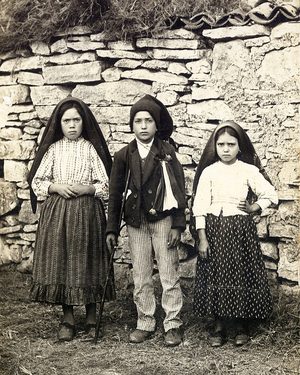

Between 13 May and 13 October 1917 three shepherd children near Fátima, Portugal, reported six appearances of a Lady who asked for the Rosary, penance and, later, the consecration of Russia. Thousands said they saw the sun move on the last day. The Catholic Church judged the visions worthy of belief in 1930 and has canonized two of the children; the other traditions have no act about Fátima, but each teaches about miraculous gifts and private revelation.
| Date | 13 May to 13 October 1917 (on the 13th of each month, except August, when the vision came on 19 August) |
|---|---|
| Place | Cova da Iria, parish of Fátima, central Portugal (19 August: Valinhos, nearby); Diocese of Leiria |
| Claimed by | The Catholic Church, on the testimony of Lúcia dos Santos (1907–2005) and her cousins Francisco (1908–1919) and Jacinta Marto (1910–1920) |
| Type | Marian apparition with messages (the "secret" in three parts); a reported solar phenomenon, the "miracle of the sun" (13 October) |
| Official status | Visions declared "worthy of credence" and the cult permitted by Bishop José Alves Correia da Silva of Leiria, 13 October 1930; Francisco and Jacinta beatified 13 May 2000 and canonized 13 May 2017; belief not required |
| Investigations | Diocesan committee (appointed 1922); press reports of October 1917; sceptical studies by Auguste Meessen (2003) and Benjamin Radford (2019); Stanley Jaki (1999, 2002) |
What is claimed
According to Lúcia's memoirs, an Angel of Peace appeared to the three children in 1916 and asked for prayer and sacrifice in reparation for sin. On 13 May 1917 at the Cova da Iria, they said, a Lady who was "from Heaven" asked them to come on the 13th for six months and to pray the Rosary daily "to obtain peace for the world." On 13 July, in Lúcia's account, she showed them a vision of hell, asked for devotion to her Immaculate Heart, and said she would come "to ask for the consecration of Russia" to it. Lúcia wrote down these two parts of the "secret" in 1941 and the third, a vision of a bishop in white killed by soldiers at the foot of a cross, on 3 January 1944. On 19 August, at Valinhos, the Lady promised a miracle in October.
On 13 October, asked her name, she answered "I am the Lady of the Rosary," and asked for a chapel. Lúcia reports that as the Lady rose, the children saw St. Joseph with the Child Jesus, then Our Lord and Our Lady. The Shrine of Fátima gives the crowd as 50,000 to 70,000. In O Século of 15 October the Lisbon journalist Avelino de Almeida wrote that most present described the sun as trembling and "dancing," in the peasants' phrase: a dull silver disc that could be looked at without strain. Some said it spun like a wheel, changed color, or seemed to fall toward the earth. He left it to "competent" people to judge.
History and devotion
A chapel was begun at the site in 1919. Francisco died in 1919 and Jacinta on 20 February 1920; Lúcia later became a Carmelite nun and died in 2005. The Cova da Iria became a pilgrimage site with a sanctuary and basilica.
The envelope with the third part went to the archives of the Holy Office on 4 April 1957; John XXIII and Paul VI chose not to publish it. After the attempt on his life on 13 May 1981, John Paul II asked for it, and said in 1994 that "a mother's hand" guided the bullet's path. On 13 May 2000, at Fátima, Cardinal Sodano announced that the vision concerned "the war waged by atheistic systems against the Church and Christians" and that the "Bishop clothed in white" was the pope; the text appeared on 26 June 2000 with a commentary by Cardinal Ratzinger. Lúcia had said "it was not for me to interpret it, but for the Pope" (27 April 2000).
Consecrations: Pius XII consecrated the world on 31 October 1942 and the peoples of Russia on 7 July 1952; John Paul II consecrated the world on 25 March 1984 in union with the bishops. Lúcia wrote on 8 November 1989 that it "has been done just as Our Lady asked." Some devotees argue that the consecration of Russia was never properly done, because John Paul II did not name Russia in his prayer and the part of the bishops differed from what they say was requested. Pope Francis consecrated Russia and Ukraine on 25 March 2022, with a matching act at Fátima.
Investigations
Bishop Correia da Silva appointed a committee of priests on 6 May 1922; its report preceded his pastoral letter of 13 October 1930. The letter reasons that, since "no observatory has registered" the solar phenomenon, it was not natural, and that it was not a collective illusion, since witnesses of every rank and belief, including journalists, saw it, some from far away. Almeida wrote that estimates of 30,000 to 40,000 in the crowd came from people not swayed by mystical influences.
Sceptical writers offer natural accounts. The physicist Auguste Meessen (2003), after looking at the sun himself, argued that the grey disc, colors and apparent motion are retinal after-images and effects of staring, and that the seers are "honestly experiencing what they report" (Apparitions and Miracles of the Sun). Benjamin Radford (Skeptical Inquirer, 2019), citing Joe Nickell's Looking for a Miracle (1993), describes a rainy day with the sun seen through thin clouds; he writes that accounts varied, that thousands saw nothing unusual, that the story of rain-soaked clothes and ground drying suddenly was not widely reported at the time, and that the event had "strong elements of mass suggestion."
Catholic writers answer from the witnesses. The Benedictine priest and physicist Stanley Jaki (1999) regarded the event as meteorological, the sun seen through thin clouds with light refracted by ice crystals, yet wrote: "Clearly, the 'miracle' of the sun was not a mere meteorological phenomenon, however rare" (A Mind's Matter, 2002).
Official status
The 1930 decision of the local bishop declares the visions worthy of credence and permits the devotion; it does not make belief a duty. The Catechism (par. 67) says approved private revelations do not belong to the deposit of faith and are not meant to "improve or complete" Christ's revelation. Cardinal Ratzinger's 2000 commentary cites Benedict XIV: "An assent of Catholic faith is not due to revelations approved in this way." Catholics are therefore free to hold the secrets and the miracle of the sun as devotion or to set them aside.
Where each church stands
- Catholic:
Acts of the Church tied to Fátima include the 1930 decision, Pius XII's consecrations (1942, 1952), John Paul II's beatification of Francisco and Jacinta (13 May 2000) and Francis's canonization of them (13 May 2017; feast 20 February). Ratzinger's commentary calls private revelation "a help which is offered, but which one is not obliged to use."
- Orthodox:
The Orthodox Church has made no official statement about Fátima. Individual Orthodox writers have judged it: Fr. Lawrence Farley wrote on OrthoChristian (2024) that he could not recall "a single Orthodox priest who believed in the legitimacy and truth of the Marian apparitions," argued that the saints' visions of the Theotokos followed long preparation, unlike these, and questioned the claim that Russia's conversion was promised unconditionally.
- Lutheran:
The Lutheran Confessions do not mention Fátima. Augsburg Confession XXI says saints are remembered so that "we may follow their faith and good works," but that "the Scripture teaches not the invocation of saints or to ask help of saints," and sets Christ forth as the one Mediator.
- Reformed:
The Westminster Confession does not name Fátima. It says that God's "former ways" of revealing his will are "now ceased" (1.1), and that nothing "is to be added, whether by new revelations of the Spirit, or traditions of men" (1.6).
- Anglican:
The Thirty-Nine Articles do not name Fátima. Article VI says Scripture "containeth all things necessary to salvation," and Article XXII calls "Invocation of Saints" "a fond thing vainly invented." The Anglican-Roman Catholic commission (ARCIC, 2005, par. 73) says "There is need for careful discernment in assessing the spiritual value of any alleged apparition."
- Methodist:
The Articles of Religion do not name Fátima; Article XIV calls "invocation of saints" "a fond thing, vainly invented." Wesley (Sermon 89, "The More Excellent Way," section 2) denied that the extraordinary gifts ceased because they were no longer needed, and blamed the church's decline in love.
- Baptist:
The Second London Confession (1.1, 1.6) uses the Westminster wording: God's former ways of revealing his will are "now ceased," and nothing is "to be added, whether by new Revelation of the Spirit, or traditions of men." No Baptist confession names Fátima.
Sources
- Shrine of Fátima, "Narrative of the Apparitions" (from Lúcia's memoirs)
- Congregation for the Doctrine of the Faith, The Message of Fatima (26 June 2000), with Ratzinger's Theological Commentary
- Bishop of Leiria, pastoral letter "Divine Providence" (13 October 1930), English text
- Shrine of Fátima, "Little shepherds were canonised 5 years ago"
- Avelino de Almeida, O Século, 15 October 1917 (Documentação Crítica de Fátima, doc. 87)
- Avelino de Almeida, O Século, 15 October 1917 (English translation, Living Fatima)
- Meessen, "Apparitions and Miracles of the Sun," International Forum in Porto, 2003
- Radford, "Fatima Miracle Claims All Wet," Skeptical Inquirer 43:3 (2019)
- Trasancos, "Fr. Stanley Jaki on the Fátima Miracle," Catholic Stand (2013)
- Pius XII, Sacro vergente anno (7 July 1952)
- Vatican News, "Pope Francis to consecrate Russia and Ukraine" (15 March 2022), with the earlier consecrations
- Catholic Weekly, "Papal consecration of Russia, Ukraine has history of controversy behind it"
- Catechism of the Catholic Church, par. 67
- ARCIC, Mary: Grace and Hope in Christ (2005), par. 73
- Farley, "Marian Devotion, Orthodox and Roman Catholic," OrthoChristian (2024)
- Augsburg Confession, Article XXI (Book of Concord)
- Westminster Confession of Faith, chapter 1 (OPC)
- Second London Baptist Confession (1689), chapter 1
- Church of England, Articles of Religion
- Articles of Religion of the United Methodist Church
- Wesley, Sermon 89, "The More Excellent Way" (Wesley Center Online)
- Photograph of the seers, Wikimedia Commons (public domain)