Jonathan Edwards 1703–1758
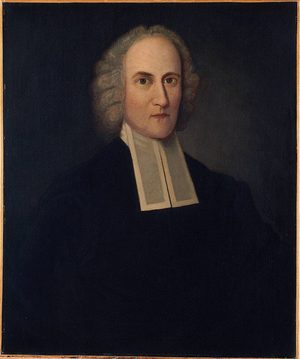

Jonathan Edwards was the Congregational pastor of Northampton, Massachusetts, whose preaching and writing in the revivals of the 1730s and 1740s made him the best-known theologian of colonial America. He defended Calvinist teaching on predestination and original sin and wrote on how true religious experience can be told from false. Every tradition has read him, some as a teacher and some with sharp disagreement, and he is also remembered as a man who owned enslaved people.
| Lived | 5 October 1703, East Windsor, Connecticut, to 22 March 1758, Princeton, New Jersey |
|---|---|
| Church | Congregational minister in New England |
| Role | Pastor at Northampton, Massachusetts (1726–1750; sole pastor from 1729); pastor at Stockbridge and missionary to the Mahican (1751–1757); president of the College of New Jersey (1758) |
| Influenced by | His grandfather and predecessor Solomon Stoddard; the Puritan tradition; Locke and Newton, whom he read at Yale |
| Influenced | The Edwardseans, among them Samuel Hopkins; the Baptist Andrew Fuller; John Wesley, who read and abridged some of his works |
| Writings | A Faithful Narrative of the Surprising Work of God (1737); Sinners in the Hands of an Angry God (preached 8 July 1741); Religious Affections (1746); Life of David Brainerd (1749); Freedom of the Will (1754); Original Sin (1758); True Virtue and End of Creation (published 1765) |
| Honored | Not on the Lutheran Service Book or Episcopal calendars of commemorations |
Life
Edwards was born on 5 October 1703 at East Windsor, Connecticut, the only son of the minister Timothy Edwards. He entered Yale in 1716, graduated in 1720 and became a tutor there in 1724. In 1726 the church at Northampton, Massachusetts, called him as assistant to his grandfather Solomon Stoddard; in 1727 he married Sarah Pierrepont, and he became sole pastor when Stoddard died in 1729. A revival in the town in 1734–35 was reported in A Faithful Narrative (1737). In the Great Awakening of 1740–41 George Whitefield briefly joined him in revival preaching, and on 8 July 1741 he preached Sinners in the Hands of an Angry God at Enfield, Connecticut. Religious Affections (1746) sought to tell a true work of grace from a false one. The missionary David Brainerd died in his house in 1747, and Edwards published Brainerd's Life in 1749.
Edwards rejected Stoddard's practice of admitting people to communion without a credible profession of faith and held that the Lord's Supper should be kept for those who had publicly testified to conversion. The standard was unpopular, and on 22 June 1750 the church voted to dismiss him, by more than 200 to 23. In 1751 he moved to Stockbridge, Massachusetts, as pastor of the church and missionary to the Mahican, succeeding John Sergeant, who had died in 1749, and there wrote Freedom of the Will (1754). In 1757 he accepted the presidency of the College of New Jersey (now Princeton). He was inoculated against smallpox on 13 February 1758 and died of complications on 22 March.
What he taught
Edwards defended Calvinist teaching on God's sovereignty and the bondage of the sinner's will (predestination). In Freedom of the Will he argued that libertarian free will is incoherent and that necessity is compatible with moral responsibility, and he distinguished natural ability from moral inability (a distinction Andrew Fuller later used). Original Sin (1758) is his treatise on that doctrine (original sin). Religious Affections holds that saving grace gives a new "spiritual sense" that perceives the beauty of holiness, so that true religion lies largely in the affections (assurance). True Virtue defines virtue as benevolence to being in general, and End of Creation holds that God's final end is his own glory, which he shares with creatures.
Against his grandfather he held that the Lord's Supper is not a means of conversion. He was among the Protestants who expected the world to be won to Christ before his return (the millennium). In A History of the Work of Redemption, preached as sermons in 1739, he identified the papal power with the beast of Revelation and described the Reformation as God's wrath poured out on its throne (the pope as Antichrist).
What historians say
George Marsden's Jonathan Edwards: A Life (Yale University Press, 2003) is the standard biography. Historic Northampton lists several causes of the dismissal besides communion: a dispute in 1737 over seating by wealth, the "Bad Books" case of 1744, a salary quarrel, and a widening gap between Edwards and the congregation; his cousin Joseph Hawley III was instrumental in the removal.
Edwards owned enslaved people. Historic Northampton records that in 1731 he bought a girl named Venus, about fourteen and taken from West Africa, at Newport, Rhode Island; it lists Venus, Leah and Rose at Northampton and Joseph, Sue and Titus at Stockbridge, while Kenneth Minkema names four (Joseph, Lee, Venus, Titus), and historians differ on whether Venus and Leah were one person. In 1997 Minkema published a draft letter of 1741 in which Edwards defended Benjamin Doolittle, the minister of Northfield, against church members who criticized him for owning a slave. The theologian Jeon (Journal of the Evangelical Theological Society, 2020) summarizes it: Edwards did not see slavery as a sin, though he opposed the slave trade. Marsden says the letter "revealed his deep ambivalence." Jeon reports that Edwards baptized eleven Black people between 1735 and 1741 and that seven became full members, and quotes his note on Job 31:15 in his Bible: "I am God's servant as they are mine." Minkema poses the question, "How and why could a minister uphold the ownership of people and deny basic human rights?"
Jeon argues that slavery was legal and little challenged in Edwards's day, and that his theology of benevolence helped lead the Edwardseans to the antislavery movement: Samuel Hopkins preached against slavery and the slave trade at Newport from 1770, and Minkema and Harry Stout name Joseph Bellamy, Nathaniel Emmons and Jonathan Edwards Jr. among the others. For the wider history of the Reformed churches, see Presbyterians and slavery.
How the churches see Edwards
- Catholic:
The Catholic Church has made no statement about Edwards. Its teaching on the will was stated at the Council of Trent (Session 6, canon 5), which anathematized the view that, since Adam's sin, the free will of man is lost and extinguished. Catholic teaching on the papacy is not that of Edwards's History of the Work of Redemption.
- Orthodox:
The Orthodox Church has made no statement about Edwards. The Confession of Dositheus (Jerusalem, 1672), as Philip Schaff summarizes it, teaches that God predestined to glory those whom he foresaw making good use of their free will (decree III), that after the fall man still has free will, though weakened (decree XIV), and it rejects unconditional predestination.
- Lutheran:
The Lutheran Service Book does not list Edwards among its commemorations. On election, the Solid Declaration of the Formula of Concord (XI.5, 7) says that it "does not extend at once over the godly and the wicked, but only over the children of God," and that "God does not create and effect evil."
- Reformed:
Reformed churches state their doctrine in confessions, not in Edwards's writings. The Westminster Confession (9.3) teaches that fallen man "hath wholly lost all ability of will to any spiritual good accompanying salvation," and (3.3) that some are "predestinated unto everlasting life," the Calvinist teaching on the will and predestination that Edwards defended. The Stockbridge church he served, now in the United Church of Christ, records him as Sergeant's successor and the author of Freedom of the Will. His own Northampton church dismissed him in 1750 over communion.
- Anglican:
Edwards does not appear in the Episcopal Church's calendar as published at bcponline.org. Article X of the Thirty-Nine Articles says that man "cannot turn and prepare himself, by his own natural strength and good works, to faith," and Article XVII calls predestination to life "the everlasting purpose of God."
- Methodist:
On 9 October 1738 Wesley read the Faithful Narrative and recorded "the truly surprising narrative." He abridged it in 1744, issued an extract of Edwards's Distinguishing Marks the same year, abridged the Life of David Brainerd in 1768 and Religious Affections in 1773, calling the latter a mixture of "wholesome food" and "deadly poison." In Thoughts upon Necessity (1774) he called Edwards "a good and sensible man" but rejected the Freedom of the Will: there can be no moral good or evil, he wrote, unless people have liberty as well as will.
- Baptist:
Robert Hall of Arnsby recommended Freedom of the Will to Andrew Fuller in 1775, and in the second edition of Fuller's The Gospel Worthy of All Acceptation (1801) he acknowledged Edwards's influence. Fuller was founding secretary of the Baptist Missionary Society (1792). In 1805 he wrote to Edwards's grandson Timothy Dwight that William Carey and his fellow missionaries "greatly approve" Edwards's writings. The Second London Confession (1689, 9.3) uses nearly the words of Westminster on fallen man's will.
Sources
- Stanford Encyclopedia of Philosophy, "Jonathan Edwards" dates of life and works; teaching
- Christian History Institute, "Jonathan Edwards' World" timeline Yale, Northampton, Whitefield, Brainerd, Stockbridge
- Boston Collaborative Encyclopedia of Western Theology, "Jonathan Edwards" dismissal (22 June 1750, 200+ to 23), Stockbridge, death
- Center for Christian History, "June 22, 1750: Jonathan Edwards dismissed" the communion dispute
- Historic Northampton, "Jonathan Edwards" Northampton years, other causes of dismissal, enslaved people
- Historic Northampton, "Religion and Slavery" (Kenneth Minkema) names of the enslaved; Minkema's question
- Jeon, "Jonathan Edwards and the Anti-Slavery Movement," JETS 63.4 (2020) reports Minkema, WMQ 54.4 (1997), and Marsden (2003), pp. 256-57
- Stockbridge United Church of Christ, "Mission, Vision & History"
- Edwards, A History of the Work of Redemption (apuritansmind.com)
- The ARDA, timeline entry for Sinners in the Hands of an Angry God 8 July 1741, Enfield
- O'Brien, "'A Good and Sensible Man': John Wesley's Reading and Use of Jonathan Edwards" Wesley's Journal and Works (Jackson), vols. 10 and 14
- Todd, "Did Jonathan Edwards Inspire the Modern Missions Movement?" (Andrew Fuller Center, 2016)
- Council of Trent, Session 6 (Waterworth translation)
- Schaff, Creeds of Christendom, on the Confession of Dositheus (1672)
- Solid Declaration of the Formula of Concord, Article XI (Book of Concord)
- Lutheran Service Book commemorations (Concordia Publishing House)
- Westminster Confession of Faith, chs. 3 and 9 (OPC)
- Second London Baptist Confession (1689), ch. 9
- Church of England, Articles of Religion
- Episcopal Church, Calendar of the Church Year
- Portrait after Joseph Badger, Wikimedia Commons (public domain)