Our Lady of Kibeho 1981–1989
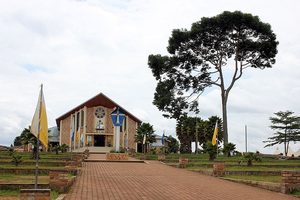

Between 1981 and 1989 three students at a Catholic girls' school in Kibeho, southern Rwanda, said that a woman who named herself "Mother of the Word" appeared to them, with messages of repentance and prayer and a vision of bloodshed that many later read in light of the 1994 genocide. On 29 June 2001 the local bishop declared the apparitions to the three worthy of belief; the Catholic Church describes the judgment as a matter of free belief, not of faith. The other six traditions have no formal view, but each has teaching on revelation after the Bible and on Mary.
| Date | 28 November 1981 to 28 November 1989; the diocese treats 1982–83 as the decisive period |
|---|---|
| Place | Kibeho, Nyaruguru District, southern Rwanda: the Catholic college and parish, in the Diocese of Gikongoro (formed from the Diocese of Butare in 1992) |
| Claimed by | Catholic Church; three students, Alphonsine Mumureke, Nathalie Mukamazimpaka and Marie Claire Mukangango, who named the lady Nyina wa Jambo, "Mother of the Word" |
| Type | Marian apparitions (private revelation), with a reported vision of future violence |
| Official status | Public devotion authorized by Bishop Jean Baptiste Gahamanyi, 15 August 1988; apparitions to the three declared authentic by Bishop Augustin Misago of Gikongoro, 29 June 2001, text released by the Holy See on 2 July; recognition "not a requirement of faith"; feast on 28 November |
| Investigations | Diocesan medical commission (installed 20 March 1982) and theological commission (14 May 1982), about twenty years; sixteen conclusions; four other claimants not recognized |
What is claimed
According to Bishop Misago's declaration, on 28 November 1981 Alphonsine Mumureke, a student at the Kibeho college (a boarding school run by the Benebikira Sisters), said she saw a lady of incomparable beauty who presented herself as Nyina wa Jambo, "Mother of the Word." Schoolmates first took her to be crazy, possessed or seeking attention, and some said they would believe if the lady showed herself to others. Two more students then reported visions: Nathalie Mukamazimpaka from January 1982, and Marie Claire Mukangango, "well known for her strong opposition," from 2 March 1982. The declaration says several witnesses took the apparitions seriously because of Marie Claire. The visionaries had apparitions in turn, not together.
The declaration lists the message as an urgent call to repentance and conversion, constant prayer, devotion to Mary through the rosary, and a chapel to be built. Marie Claire said she was taught the Rosary of the Seven Sorrows, which the declaration says "does not replace" the Holy Rosary. Her last apparition was on 15 September 1982, Nathalie's on 3 December 1983, and Alphonsine's on 28 November 1989 (dates as given by the National Catholic Register).
In August 1982 the three are said to have seen a river of blood, people killing one another and unburied bodies. Retellings date this to 15 August (National Catholic Register) or 19 August (Aleteia). Misago's declaration singles out the apparition of 15 August 1982, and writes that, "looking back," the misfortune of Rwanda in the decade since "might have been, in one way or another, predicted" through Kibeho. It calls what happened at Kibeho in April 1994 and April 1995 a "double racist massacre."
History and devotion
Kibeho belonged to the Diocese of Butare under Bishop Gahamanyi until the Diocese of Gikongoro was formed in 1992. He refused to approve any messages or missions claimed by visionaries while the case was under study. On 15 August 1988 he authorized public devotion at the site, adding that this was not a recognition of the apparitions' supernatural character. The first stone of the Shrine of Our Lady of Sorrows was laid on 28 November 1992. Misago, consecrated first bishop of Gikongoro on 28 June 1992, wrote that the parish church was severely damaged in April 1994, and that pilgrimages resumed from Christmas Eve 1995 after a rite of purification. Cardinal Crescenzio Sepe consecrated the new shrine on 31 May 2003 (Fides).
Misago himself was arrested on 14 April 1999, a few days after President Pasteur Bizimungu publicly raised accusations against him, and tried in Kigali for taking part in the 1994 genocide, which some people in his diocese had alleged. On 15 June 2000 the court acquitted him of all charges; the judge found the evidence on the killing of schoolchildren "nothing palpable" (Irish Times). Prosecutors, who had sought the death penalty, said they would appeal, and in May 2001 JusticeInfo reported the appeal pending; the outcome is not given in the sources consulted. The survivors' group Ibuka said the pope's letters may have biased the court; the Justice Minister said the Church's influence had nothing to do with it (Christianity Today). Misago died on 12 March 2012.
Investigations
The medical commission (20 March 1982) and the theological commission (14 May 1982) examined the visionaries one by one, giving priority to the first eight who claimed visions between 28 November 1981 and 28 November 1982; the declaration calls this "a working hypothesis, not a presumption of authenticity." It records skepticism from the start, says the public "did everything to find a natural explanation" without much success, and holds that Alphonsine, Nathalie and Marie Claire met all the Church's criteria for private apparitions. It adds that "no decisive objection" had been raised against them and that there are "more reasons to believe in the apparitions than to deny them." It gives the commissions' conclusions in sixteen points but not their full reports.
The declaration is also the Church's finding about other claimants. It does not consider the apparitions of Jesus reported from July 1982, because those claimants developed "disquieting personal situations," and it says the growing number of claimants, with messages of "banalities" or "troubling and confusing predictions," disoriented public opinion. Four other young claimants were not recognized.
On the reading of the August 1982 vision as a warning, the declaration speaks hesitantly ("in one way or another") and from hindsight. Against the objection that the genocide and the "relapse" of converted people into sin count against the apparitions, it answers that these "cannot be taken as a sufficient argument against the credibility" of Kibeho. The sources consulted for this page report no independent scientific study of the visionaries and no written record of the vision from before 1994.
Official status
The declaration was read by Bishop Misago at Mass in Gikongoro cathedral on 29 June 2001, with all the Catholic bishops of Rwanda and the nuncio present, and the Holy See released the text on 2 July. It says Mary appeared at Kibeho from 28 November 1981, recognizes only the three initial visionaries, and judges the message conformable to Scripture and Tradition. It states that such a judgment "does not guarantee infallibility" and rests on "proofs of probability," that recognition "should not be considered a requirement of faith," and that each Christian is free to believe or not. The message is "not a new revelation" but a reminder of ordinary Church teaching. The Catholic World Report (2021) calls Kibeho the only Marian apparition in Africa that the Church has approved.
No other church has issued a ruling. The Catholic Church treats approved apparitions as private revelation (Catechism 67); see the rosary, intercession of the saints and spiritual gifts.
Where each church stands
- Catholic:
Bishop Misago's declaration of 29 June 2001 recognizes the apparitions to the three visionaries and leaves belief free. Under Catechism 67, private revelations "do not belong, however, to the deposit of faith." Pope Francis told the Rwandan bishops on 3 April 2014 that "the Mother of Jesus wished to appear in your country to several children." Cardinal Antoine Kambanda, Archbishop of Kigali, is quoted by the National Catholic Register (2021) calling the genocide "one of the most important proofs for me of the authenticity" of the apparitions.
- Orthodox:
The Orthodox churches have made no statement about Kibeho. The Orthodox priest Lawrence Farley wrote in 2024 that he could not recall one Orthodox priest who believed in the truth of modern Marian apparitions, and said such revelations were "without precedent in the early Church." Other Orthodox may differ; there is no synodal ruling.
- Lutheran:
Lutheran churches have made no statement about Kibeho. The Smalcald Articles (III.8.3) hold that "God grants His Spirit or grace to no one, except through or with the preceding outward Word."
- Reformed:
Reformed churches have made no statement about Kibeho. The Westminster Confession (1.1, 1.6) says God's "former ways" of revealing his will are "now ceased" and that nothing "is to be added" to Scripture, which many Presbyterians apply to new visions; the Christian Reformed Church's 1973 synod report on Pentecostalism is more open to the Spirit's gifts (discussed here).
- Anglican:
Neither the Church of England nor the Anglican Church of Rwanda has made a statement about Kibeho. Article VI of the Thirty-Nine Articles says what is not read in Scripture or proved by it is "not to be required of any man, that it should be believed as an article of the Faith," and Article XXII calls invocation of saints "a fond thing." Anglicans differ widely on how these apply to Marian devotion.
- Methodist:
Methodist bodies have made no statement about Kibeho. John Wesley, in his sermon on "The Nature of Enthusiasm" (§38), counseled: "Trust not in visions or dreams; in sudden impressions, or strong impulses of any kind."
- Baptist:
Baptist bodies have made no statement about Kibeho. The Second London Confession (1689, 1.1, 1.6), which many Baptists hold, says God's "former ways" of revealing his will are "now ceased" and that nothing is to be added to Scripture "by new Revelation of the Spirit."
Sources
- Bishop Augustin Misago, Declaration bearing the final judgment on the "Apparitions of Kibeho" (29 June 2001), EWTN
- Judgement on the Apparitions of Kibeho (Holy See release summary, 2 July 2001), EWTN
- Pronechen, "Our Lady of Kibeho," National Catholic Register, 24 November 2021
- Aleteia, "Did Our Lady warn us of the Rwandan genocide?" (2019)
- Catholic World Report, "Meet Our Lady of Kibeho" (2021)
- Fides, Cardinal Sepe consecrates Kibeho Marian shrine (31 May 2003)
- Fides, "Mgr Misago has died" (15 March 2012)
- Irish Times, "Rwandan bishop cleared of 1994 genocide charges" (16 June 2000)
- Christianity Today, "Influence of Roman Catholic Church in Acquittal of Rwandan Bishop Debated" (20 June 2000)
- JusticeInfo, "Church members in the dock for role in Rwanda genocide" (14 May 2001)
- JusticeInfo (French), death of Mgr Misago (2012)
- Pope Francis, address to the bishops of Rwanda, 3 April 2014
- Catechism of the Catholic Church, para. 67
- Farley, "Marian Devotion, Orthodox and Roman Catholic" (2024), Orthochristian
- Smalcald Articles, Part III, Article 8 (Book of Concord)
- Westminster Confession of Faith, ch. 1 (OPC)
- Church of England, Articles of Religion
- Wesley, Sermon 37, "The Nature of Enthusiasm" (CCEL)
- Second London Baptist Confession (1689), ch. 1
- Photograph of the Kibeho shrine, Wikimedia Commons (CC BY-SA 4.0)