John Henry Newman 1801–1890
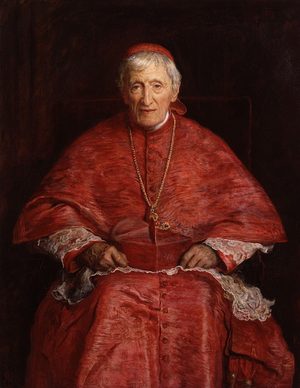

John Henry Newman was an Anglican priest and fellow of Oriel College, Oxford, a leader of the Oxford Movement, who was received into the Catholic Church on 9 October 1845 and made a cardinal in 1879. His Essay on the Development of Christian Doctrine asked how a faith given once can grow without ceasing to be itself, a question every tradition answers differently (see Holy Tradition). The Church of England commemorates him on 11 August; the Catholic Church canonized him in 2019 and named him a Doctor of the Church in 2025.
| Lived | 21 February 1801, City of London, to 11 August 1890, Edgbaston, Birmingham |
|---|---|
| Church | Church of England priest (ordained 1824); Catholic from 9 October 1845; Catholic priest, ordained in Rome; Oratorian; cardinal-deacon of San Giorgio in Velabro (12 May 1879) |
| Role | Fellow of Oriel College (1822); vicar of St. Mary's, Oxford (1828); leader of the Oxford Movement; founder of the Oratory in England, at Birmingham; lecturer for the Catholic University in Dublin |
| Influenced by | Richard Whately; Hurrell Froude and John Keble; the Church Fathers; Joseph Butler's Analogy |
| Influenced | The Anglo-Catholic movement in the Church of England; Catholic writing on doctrinal development, conscience and the university |
| Writings | Tracts for the Times (from 1833), including Tract 90 (1841); Essay on the Development of Christian Doctrine (1845); The Idea of a University (Dublin lectures, 1852); Apologia Pro Vita Sua (1864); Grammar of Assent (1870); Letter to the Duke of Norfolk (1875) |
| Honored | 9 October (optional memorial, Catholic General Roman Calendar); 11 August in the Church of England calendar (Commemoration) |
Life
Newman was born in London, the eldest of six children of a banker. He was elected a fellow of Oriel on 12 April 1822, was ordained on 13 June 1824, and in 1828 became vicar of St. Mary's, the university church, where his Parochial Sermons were preached. On 14 July 1833 John Keble preached the Assize sermon "National Apostasy," the day later counted as the start of the Oxford Movement; Newman began the Tracts for the Times that year. Tract 90 (February 1841) held that the Thirty-Nine Articles condemned the corruptions of Rome and not the decrees of Trent (so the Catholic Encyclopedia). The Heads of Houses at Oxford called its reading an "evasion" (15 March 1841), the Bishop of Oxford required the tracts to cease, and charges from other bishops continued for about three years.
Newman withdrew to Littlemore, retracted his severe words against Rome in February 1843 and resigned St. Mary's that September. He wrote the Essay on the Development of Christian Doctrine as he moved toward Rome; on 9 October 1845 the Passionist Dominic Barberi received him into the Catholic Church. He was ordained in Rome, established the Oratory of St. Philip Neri in England, worked in Birmingham and settled at Edgbaston. In 1852 he addressed Ireland on The Idea of a University. Charles Kingsley's remark in January 1864 that truth "had never been a virtue with the Roman clergy" drew from him the Apologia Pro Vita Sua (1864). The Grammar of Assent followed in 1870 and the Letter to the Duke of Norfolk, answering William Gladstone's attack on "Vaticanism," in 1875 (dated 27 December 1874). Leo XIII made him a cardinal on 12 May 1879. He took the motto Cor ad cor loquitur ("heart speaks to heart"), died on 11 August 1890, and lies in the same grave as his friend Ambrose St. John.
What he taught
Development. The Essay says that "To be deep in history is to cease to be a Protestant" (introduction, sec. 5), and argues that Christian ideas, like others, unfold over time: "here below to live is to change, and to be perfect is to have changed often" (ch. 1). The Catholic Encyclopedia says he explained the variations of dogma he had once objected to in the Catholic Church by a theory of evolution. A true development, he held, keeps the original type, and he proposed seven notes to tell it from a corruption: preservation of type, continuity of principles, power of assimilation, logical sequence, anticipation of its future, conservative action upon its past, and chronic vigor (ch. 5). Daniel Lattier summarizes the theory as holding that revelation was given once for all, while the church grows in understanding, sometimes issuing new definitions confirmed by an infallible authority (see papal infallibility and the papacy).
Conscience and the Church. In the Letter to the Duke of Norfolk he wrote that "Conscience is the aboriginal Vicar of Christ" and ended with the line that, if toasts must bring in religion, "I shall drink - to the Pope, if you please, - still, to Conscience first, and to the Pope afterwards." He had opposed defining papal infallibility in 1870 as inopportune (Fordham Sourcebook); in a confidential letter to his bishop, W. B. Ullathorne, he called the partisans outside the Council "an insolent and aggressive faction," and the letter was made public without his consent. The Catholic Encyclopedia adds that he accepted the definitions. In his cardinal's speech of 1879 he described himself as a lifelong enemy of "Liberalism," the doctrine that "one creed is as good as another."
What historians say
The historian Owen Chadwick's Birkbeck Lectures, From Bossuet to Newman: The Idea of Doctrinal Development (1957; 2nd ed. 1987), trace the idea that doctrine can change legitimately, from Bossuet's view of doctrine as largely unchanging to Newman's account of necessary change in its expression. Daniel Lattier's dissertation (Duquesne, 2012) sets Newman beside the Orthodox theologian Georges Florovsky and argues that Newman's theory is compatible with Orthodox understandings of revelation and Tradition, while observing that many Orthodox theologians of the twentieth and twenty-first centuries have serious reservations about doctrinal development. Erik Sidenvall (2004) has studied the Protestant reviews of the Essay in 1845–47.
The Catholic Encyclopedia (1913) records two disputes. In the Church of England the bishops' charges against Tract 90 and the Oxford censure of it as an "evasion" ended the Tractarians' hope of a settlement within the church; the Encyclopedia says Newman was "on his death-bed" as regards the Anglican Church from 1841. In the Catholic Church, his encouragement of lay learning and of the Rambler brought him into quarrels with Archbishop Manning and W. G. Ward, who favored a stricter ultramontane line, and it says he spent a quarter of a century "under suspicion from one side or another."
How the churches see Newman
- Catholic:
Pope Benedict XVI beatified Newman at Birmingham on 19 September 2010, during his visit to the United Kingdom. Pope Francis canonized him in Rome on 13 October 2019, with four others. On 1 November 2025 Pope Leo XIV proclaimed him a Doctor of the Church and, with Thomas Aquinas, co-patron of the Church's educational mission. A decree of the Dicastery for Divine Worship, released on 3 February 2026, inscribed his optional memorial on 9 October, the day of his reception, in the General Roman Calendar, calling him "a radiant light for the Church on pilgrimage through history." On development, Dei Verbum 8 (1965) teaches that "This tradition which comes from the Apostles develops in the Church with the help of the Holy Spirit" and that "there is a growth in the understanding of the realities and the words which have been handed down."
- Orthodox:
The Orthodox Church has made no statement about Newman. Daniel Lattier's dissertation (Duquesne, 2012) reports that many twentieth- and twenty-first-century Orthodox theologians have expressed serious reservations about doctrinal development, and argues that Newman's theory is nonetheless compatible with Orthodox understandings of revelation and Tradition, though on authority the two need "mutual enrichment." For the Orthodox position on Tradition and Rome, see the Orthodox claim.
- Lutheran:
No Lutheran church has made a statement about Newman. The Swedish Lutheran theologian Nathan Söderblom is reported by Erik Sidenvall (Studies in Church History 38, 2004) to have called the Essay in 1910 "the most significant theological work, written by England's foremost theologian." The Lutheran Confessions' general teaching is that the writings of "no man should be regarded as equal" to Scripture (Formula of Concord, Solid Declaration, Rule and Norm).
- Reformed:
No Reformed church has made a statement about Newman. The Westminster Confession (1646) teaches that the whole counsel of God for salvation, faith and life is "expressly set down in Scripture," or "by good and necessary consequence may be deduced from Scripture" (1.6), and that "All synods or councils, since the Apostles' times, whether general or particular, may err; and many have erred" (31.3). On that teaching later church definitions stand below Scripture (see Scripture alone).
- Anglican:
The Church of England commemorates Newman in its calendar on 11 August, the date of his death. On 1 July 2019 it welcomed his canonization and called him "one of the key leaders of the Oxford Movement" and "a central figure in both Catholic and Anglican theology"; it added that he and his colleagues contributed to "a renewal in the understanding of Anglicanism as standing in continuity with the early and medieval Church." A delegation of the Anglican Communion and the Church of England attended the canonization in Rome. In 1841, by contrast, the Oxford Heads of Houses called Tract 90 an "evasion" and the Bishop of Oxford ended the tracts. For the wider story, see the Anglican record.
- Methodist:
No Methodist church has made a statement about Newman. The Articles of Religion (Article V, adopted in 1784 from Wesley's revision of the Anglican Articles) teach that Scripture "containeth all things necessary to salvation," so that what is not read in it or proved by it is not to be required as an article of faith.
- Baptist:
No Baptist body has made a statement about Newman. The Second London Confession (1689), which many Baptists hold, calls Holy Scripture "the only sufficient, certain, and infallible rule of all saving Knowledge, Faith and Obedience" (1.1) (see Scripture alone).
Sources
- Catholic Encyclopedia (1913), "John Henry Newman" dates and events of the life; the 1870 letter; cardinalate; motto
- Newman, Apologia Pro Vita Sua (1865 text), chapter 3 Tract 90; Heads of Houses, 15 March 1841
- Newman, Essay on the Development of Christian Doctrine, introduction
- Newman, Essay on the Development of Christian Doctrine, chapter 1
- Newman, Essay on the Development of Christian Doctrine, chapter 5 (the seven notes)
- Newman, Letter to the Duke of Norfolk (Fordham Internet Modern History Sourcebook)
- Vatican News, "St. John Henry Newman inscribed in General Roman Calendar" (3 February 2026)
- Pope Francis, homily at the canonization Mass, 13 October 2019
- Catholic Bishops' Conference of England and Wales, Newman Canonisation beatification at Birmingham, 2010
- Vatican II, Dei Verbum, para. 8
- Church of England, "Canonisation of John Henry Newman" (1 July 2019)
- Chadwick, From Bossuet to Newman: The Idea of Doctrinal Development (Cambridge University Press, 1957; 2nd ed. 1987)
- Lattier, John Henry Newman and Georges Florovsky: An Orthodox-Catholic Dialogue on the Development of Doctrine (Duquesne dissertation, 2012)
- Sidenvall, "Dealing with Development: The Protestant Reviews of Newman's Essay on the Development of Christian Doctrine, 1845-7," Studies in Church History 38 (2004)
- Solid Declaration of the Formula of Concord (Book of Concord)
- Westminster Confession of Faith, chs. 1 and 31
- Articles of Religion of the Methodist Church, Article V
- Second London Baptist Confession (1689), ch. 1
- Millais portrait of Newman, Wikimedia Commons (public domain)