Charles Haddon Spurgeon 1834–1892
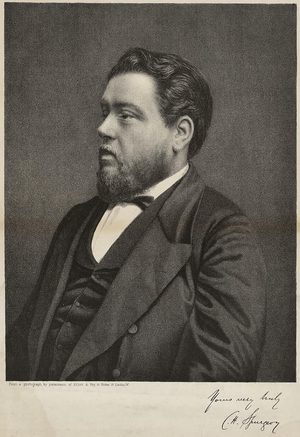

Charles Haddon Spurgeon was the pastor of the Metropolitan Tabernacle in London, whose printed sermons were read around the world. He taught Calvinist doctrine, baptism of believers only, and in 1864 attacked the Church of England's teaching that baptism regenerates. In 1887 he left the Baptist Union over the Down-Grade Controversy. Each tradition has a view of him, from admiration to disagreement over baptism.
| Lived | 19 June 1834, Kelvedon, Essex, to 31 January 1892, Menton, France |
|---|---|
| Church | Baptist; raised in a Congregationalist family, converted in a Primitive Methodist chapel (1850), baptized as a believer (1850) |
| Role | Pastor of New Park Street Chapel, Southwark (1854), and of the Metropolitan Tabernacle (1861 to 1892); founder of the Pastors' College and the Stockwell Orphanage |
| Influenced by | The Second London Baptist Confession (1689), which he reissued in 1855; the lay preacher at Colchester (name unknown) |
| Influenced | Students of the Pastors' College; Baptist and other readers of his printed sermons |
| Writings | Weekly printed sermons (Metropolitan Tabernacle Pulpit); The Sword and the Trowel (from 1865); The Treasury of David (1869–1885); Autobiography (compiled by his wife and secretary, 1897–1900) |
| Honored | No canonization or feast day in a church calendar was found; honored by Baptists through Spurgeon's College, London, and the Spurgeon Library at Midwestern Baptist Theological Seminary |
Life
Spurgeon was born at Kelvedon, Essex, on 19 June 1834, the eldest of seventeen children, in a Congregationalist family. His own diary dates his new birth to 6 January 1850: by his later account a snowstorm drove him into a Primitive Methodist chapel in Colchester, where an untrained lay preacher gave out Isaiah 45:22 ("Look unto me, and be ye saved"). He was baptized as a believer on 3 May 1850 in the River Lark at Isleham Ferry, by W. W. Cantlow, and in 1851 began preaching and became pastor at Waterbeach.
In 1854, aged nineteen, he became pastor of New Park Street Chapel in Southwark. The crowds forced a move to the Surrey Gardens Music Hall, where on 19 October 1856 a false alarm of fire caused a crush in which seven people died; he was shattered and for a time thought of leaving the ministry. The Metropolitan Tabernacle, built to hold some 6,000, opened at the Elephant and Castle in 1861. He married Susannah Thompson in 1856, began the Pastors' College (dated 1856 by Spurgeon's charity, 1857 in other accounts) and in 1867 the Stockwell Orphanage, which the college and charity still trace to him. The Treasury of David, his commentary on the Psalms, appeared in seven volumes between 1869 and 1885.
In 1864 he preached against baptismal regeneration, and in 1887 left the Baptist Union (see below). He preached his last sermon at the Tabernacle on 7 June 1891 and died at Menton on 31 January 1892; he was buried at West Norwood Cemetery in London.
What he taught
Spurgeon held the Calvinist doctrines of grace. In 1855 he reissued the Second London Baptist Confession of 1689 for his congregation, and his diary for 7 April 1850 already says, "Arminianism does not suit me now." He preached election in sermons such as "Free Will, a Slave" (2 December 1855, on John 5:40), and, as Reformed Baptist writers stress, opposed the hyper-Calvinism that discouraged the gospel call to all. He held that Scripture is the final authority (Scripture alone).
On baptism he held the Baptist view, that it is an ordinance for believers, which pictures what faith has already received and does not confer grace. In "Baptismal Regeneration" (sermon no. 573, on Mark 16:15 to 16, preached at the Metropolitan Tabernacle on 5 June 1864) he quoted the Prayer Book service ("this child is regenerate") and said that he knew of no other Protestant church in England teaching the doctrine. His thesis was that baptism without faith saves no one. He added, "I hate their doctrine, but love their honesty" (as Fullerton reports it), and objected that clergymen who disbelieved the Prayer Book should not subscribe to it. Follow-up sermons included "Children Brought to Christ, Not to the Font" (24 July 1864) and "The Book of Common Prayer Weighed in the Balances of the Sanctuary." See also infant baptism.
What historians say
The first sermon was printed and sold widely; W. Y. Fullerton, his early biographer, reports a quarter of a million copies, and says about 150 pamphlets and sermons answered it and that Spurgeon resigned from the Evangelical Alliance in the dispute.
The Down-Grade Controversy began with articles in The Sword and the Trowel (March and April 1887) warning that some ministers had given up the full deity of Christ and other doctrines. Spurgeon withdrew from the Baptist Union in October 1887 (the exact day is variously given); on 18 January 1888 its Council voted that his charges, which named no one, "ought not to have been made," and in April 1888 the Union adopted a doctrinal declaration. Historians differ on the outcome. Mark Hopkins calls it "the most disastrous episode" of Spurgeon's career and the severest crisis the Union ever faced, and holds that Spurgeon "generated more heat than light"; Tom Nettles, writing from within Baptist life, presents Spurgeon as a theologian governed by his principles, in Living by Revealed Truth (2013). Hopkins reports that Spurgeon's health failed and that his wife Susannah wrote that his fight for the faith had cost him his life. The Metropolitan Tabernacle, an independent Baptist church, has remained outside the Union since 1887.
The date of his conversion has been questioned, since a local historian notes that weather records suggest heavy snow fell in London on 13 January rather than the 6th; the 6 January date rests on Spurgeon's own diary and later retellings.
How the churches see Spurgeon
- Catholic:
No official Catholic statement about Spurgeon was found. On the doctrine he attacked, the Council of Trent (Session 7, canon 5) anathematized the claim that baptism is "not necessary unto salvation," and the Catechism (1257) says God has bound salvation to baptism but is not himself bound by it. His 1864 sermon was aimed at the Church of England, not at Rome.
- Orthodox:
The Orthodox Church has made no statement about Spurgeon. Its general teaching on his central point is in the Confession of Dositheus (Jerusalem, 1672), Decree 16, which holds baptism necessary for salvation on the authority of John 3:5 and extends it to infants.
- Lutheran:
No Lutheran church body has issued a statement about Spurgeon that was found. Lutheran teaching differs from his on baptism: Luther's Small Catechism says it "works forgiveness of sins" and gives salvation to those who believe, with the Word joined to the water; Article IX of the Augsburg Confession holds baptism necessary and teaches that infants are to be baptized. Lutherans hold this together with justification by faith alone.
- Reformed:
Reformed churches share his teaching on election and grace: the Westminster Confession (ch. 3) and the Canons of Dort teach unconditional election, and the 1689 Baptist confession he reissued follows the Westminster Confession. They differ on baptism: the Westminster Confession (28.1, 28.4, 28.5) calls it a sign and seal of the covenant of grace, baptizes the infants of believers, and says grace is conferred in God's time, not tied to the moment. No Reformed church body has given an official view of Spurgeon.
- Anglican:
The Book of Common Prayer (1662) thanks God, after an infant's baptism, that the child "is regenerate," and Article XXVII calls baptism "a sign of Regeneration or new Birth." In the Gorham case (1850) the Privy Council nonetheless upheld an Evangelical clergyman whose bishop had refused him on this very doctrine, so Anglicans have differed on what "regenerate" means. Spurgeon's sermon fell within that dispute; no official Church of England response to it was found.
- Methodist:
Spurgeon was converted at a Primitive Methodist chapel in Colchester, but no Methodist body has issued a statement about him that was found. Methodist doctrine differs on predestination (Wesley's teaching was Arminian) and holds baptism to be a sign of new birth: Wesley's Treatise on Baptism says that by baptism we are born again, and the United Methodist By Water and the Spirit (1996) calls it God's act, not saving apart from faith.
- Baptist:
The Second London Confession (29.1) calls baptism an ordinance "to be unto the party baptized a sign" of fellowship with Christ in his death and resurrection, and the Baptist Faith and Message (2000, art. VII) says it is a symbol; Spurgeon's own view matches both. The Metropolitan Tabernacle keeps his memory as an independent Baptist church; the Southern Baptist Midwestern Seminary has his library and Southern Baptist Theological Seminary's Tom Nettles has written the major recent study. The Baptist Union's Council censured him in January 1888 (see above).
Sources
- Spurgeon Center, "About Spurgeon" (Midwestern Baptist Theological Seminary)
- Christian History timeline of Spurgeon's life
- Spurgeon's Autobiography, vol. 1, ch. 10 (diary, 1850) and ch. 11 (baptism)
- Spurgeon's Autobiography, vol. 1, ch. 11 "A Good Confession"
- Gospel Coalition, "Spurgeon's Conversion in a Primitive Methodist Chapel"
- Gazette (Colchester), on the date of Spurgeon's conversion
- Surrey Gardens Music Hall disaster (Spurgeon archive, reformedreader.org)
- Metropolitan Tabernacle, history
- Spurgeon's, "Happy 190th Birthday Charles Spurgeon" (Pastors' College, Stockwell Orphanage)
- Spurgeon, The Treasury of David, 1869–85 (sacred-texts.com)
- Spurgeon, "Baptismal Regeneration," no. 573 (5 June 1864)
- Spurgeon, "Free Will: A Slave," 2 December 1855
- Spurgeon, "Children Brought to Christ, Not to the Font" (24 July 1864)
- Fullerton, C. H. Spurgeon: A Biography (1920), ch. 17 "Two Great Controversies"
- Tim White, on Spurgeon's "Baptismal Regeneration" (summarizing Fullerton)
- Hopkins, "The Down-Grade Controversy," Christian History 29 (1991)
- Nettles, Living by Revealed Truth (Christian Focus, 2013), review in Evangelical Times
- Credo Magazine, on Spurgeon's 1855 reissue of the 1689 Confession
- Second London Baptist Confession (1689), ch. 29
- Council of Trent, Session 7, canons on Baptism
- Confession of Dositheus (Jerusalem, 1672), Decree 16
- Small Catechism (Book of Concord)
- Church of England, Articles of Religion (Article XXVII)
- Gorham Judgment (1850), Ruskin at Lancaster
- Spurgeon Library, Midwestern Baptist Theological Seminary
- Portrait of Charles Haddon Spurgeon, Wikimedia Commons (public domain)