The Peshitta 2nd–5th century
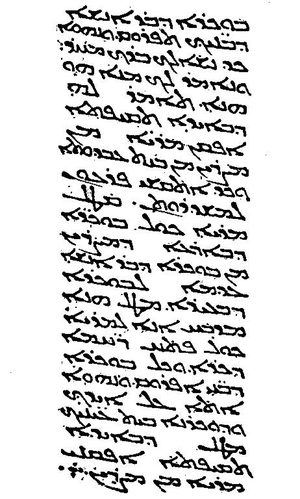

The Peshitta is the standard Bible of the Syriac-speaking churches: an Old Testament translated from Hebrew in the second century and a New Testament, a revision of earlier Syriac texts, that became standard about AD 400. Its New Testament has 22 books, five fewer than the canon printed in the Bibles of the seven traditions on this site. Of those traditions, only the Syriac-rite Eastern Catholic churches share it as their traditional Bible, and scholars of every church value it as an ancient witness to the biblical text.
| Published | Old Testament, second century; New Testament revision, early fifth century. Oldest dated manuscript: Pentateuch copied at Amida in 464. First printed New Testament: Vienna, 1555 |
|---|---|
| Translators | Unknown. The Old Testament translator is not named; some link the New Testament revision to Rabbula, bishop of Edessa (411–35), a link scholars dispute |
| Language | Syriac (the Aramaic of Edessa) |
| Old Testament from | Hebrew, not the Septuagint |
| New Testament from | An earlier Syriac version (the Old Syriac Gospels), revised toward the Greek |
| Books | Old Testament: the Hebrew books; deuterocanonical books vary from manuscript to manuscript. New Testament: 22 books, without 2 Peter, 2 and 3 John, Jude and Revelation |
| Approach | Translation from the Hebrew (Old Testament); more literal revision of an earlier Syriac text (New Testament) |
| Copyright | The ancient text is not under copyright; critical editions and modern English translations carry their publishers' copyrights |
| Used by | The Syriac churches, East and West, including the Church of the East, the Syriac Orthodox Church and the Maronite Church, in Syriac or in translations such as Malayalam |
How it was made
The first Syriac Old Testament was made in the second half of the second century and has been called the Peshitta since at least the ninth century, when the name appears in the writings of Mushe bar Kipho. The Syriac word probably means "simple," though "widespread" has also been proposed. The translator is unknown: Theodore of Mopsuestia (d. 428) called him an unknown man who made mistakes, and later Syriac tradition credited Hiram of Tyre, the priest Asya, the apostles or Mark. Michael Weitzman placed the work in Edessa from about 150, by a non-rabbinic Jewish group that later may have turned Christian; Romeny argues that the Syriac script points to Christian authorship and the translators' knowledge of Hebrew to Jewish origin. Quotations in Tatian's Diatessaron suggest that the core books existed by about 170 (Gorgias Encyclopedic Dictionary of the Syriac Heritage).
The New Testament has a separate history. Tatian's Gospel harmony, the Diatessaron (early 170s), was read in worship until the early fifth century. The Old Syriac version, the oldest translation of the four Gospels as separate books, is generally placed in the mid-third century. The Peshitta revised it against different Greek manuscripts and is more literal; under Rabbula it became the standard Syriac New Testament. In 1904 F. C. Burkitt credited Rabbula, bishop of Edessa (411–35), with making it; Arthur Vööbus (1951) showed that Rabbula himself quoted the Old Syriac and the Diatessaron, so that Rabbula may have promoted the Peshitta and suppressed the Diatessaron without having made the text. Later Syriac revisions followed: the Philoxenian, made for Philoxenos of Mabbug, and the Harklean (615/16) of Thomas of Harqel, which covers all 27 books; Paul of Tella's Syro-Hexapla (613–17) rendered the Septuagint Old Testament word for word.
British Library Add. 14425, which contains Genesis to Deuteronomy, was copied at Amida (Amed) in 464 by the deacon Yuhanan, according to its colophon. The Ambrosian codex at Milan (Ms. 7a1) is the oldest codex of the complete Old Testament. Printing began with the New Testament in Vienna in 1555; the Old Testament appeared in the Paris Polyglot (1645) and London Polyglot (1657), and the Leiden critical edition, begun in 1959, has published 13 of 17 planned volumes.
How it translates
Unlike the other early Christian Old Testaments, the Peshitta was translated from the Hebrew Bible rather than the Septuagint. The New Testament revision is more literal than the Old Syriac and omits the passage on the woman taken in adultery (John 7:53–8:11) and a few verses such as Luke 22:17–18.
The canon is its best-known feature. Its New Testament has 22 books and lacks 2 Peter, 2 and 3 John, Jude and Revelation; those five were first translated into Syriac in the sixth century and are in the Harklean version. The Old Testament canon and book order were not fixed in the first millennium: books were copied in groups such as the Pentateuch, Chronicles and Ezra-Nehemiah may not have been canonical early on, and the deuterocanonical books (the Apocrypha) differ from one complete Bible to another. The Milan codex even includes part of Josephus's Jewish War.
Its wording shaped Syriac prayer and poetry: many terms of Syriac spirituality originate in it. East Syriac readers also studied Theodore of Mopsuestia, who doubted the Peshitta's authority, as their main interpreter. Some writers, among them George Lamsa in The Holy Bible from the Ancient Eastern Text (1933), have held that the Peshitta preserves the original Aramaic of the New Testament; the standard reference works describe the New Testament Peshitta as a revision of an earlier Syriac translation of the Greek.
Reception and revisions
The Peshitta remained the standard text of the West Syriac churches, and Bar Ebroyo (d. 1286) said Syrians everywhere used it; only occasionally did Syro-Hexapla passages enter West Syriac lectionaries. Scholars outside the Syriac churches value it because it is ancient and reflects the Hebrew and Greek texts as they stood when it was made.
In the West the Peshitta arrived through Moses of Mardin, an envoy of the Syriac Orthodox patriarch, who sought a way to print Syriac New Testaments in 1549. With Johann Albrecht Widmanstetter, chancellor of the Austrian lands, he persuaded Ferdinand I to pay for the type, and the Vienna edition was finished on 27 September 1555 (Library of Congress; Morgan Library). In 1569 Immanuel Tremellius, whose scholarship belonged to Heidelberg, issued the Syriac New Testament in Hebrew characters at Geneva from the press of Henri Estienne, with his own Latin version, using a Vatican manuscript he thought older than Widmanstetter's source. The Vienna edition lacked the five missing books: Louis de Dieu printed Revelation at Leiden in 1627 from a manuscript left by Joseph Scaliger, and Edward Pococke edited 2 Peter, 2 and 3 John and Jude from a Bodleian manuscript (Leiden, 1630).
Modern English versions include James Murdock's New Testament (1851) and Lamsa's Bible (1933). In Kerala, the monks of Mannanam monastery pioneered a Malayalam translation of the Peshitta in the first half of the twentieth century.
Where each church stands on the the Peshitta
- Catholic:
The Catholic Church has named no Syriac version. Trent (Session IV, 1546) held the Latin Vulgate "authentic" for teaching and preaching, and the Second Vatican Council (Dei Verbum 22) says the Church "has always given a place of honor to other Eastern translations" beside the Septuagint and Latin versions, while asking for new translations "especially from the original texts." The Syriac-rite Eastern Catholic churches (the Maronite and Syro-Malabar among them) are the only churches in the seven traditions' communions that inherit the Peshitta as their traditional Bible, along with its Syriac liturgical heritage; which text each lectionary reads today is for the church concerned to say.
- Orthodox:
The Eastern Orthodox Church has made no statement about the Peshitta. Its Old Testament is the Greek Septuagint, read in worship (Confession of Dositheus, 1672, Q. 3; see which Old Testament Orthodoxy holds). The Peshitta belongs to the Syriac Orthodox Church of Antioch, an Oriental Orthodox church not in communion with the Eastern Orthodox, and to the Church of the East.
- Lutheran:
The Lutheran confessions name no translation. The Formula of Concord (Epitome, Rule and Norm) makes "the prophetic and apostolic Scriptures of the Old and of the New Testament alone" the standard and gives no book list. Lutheran churches have made no statement about the Peshitta.
- Reformed:
The Westminster Confession (1.8) holds the Old Testament in Hebrew and the New in Greek "authentical," the text to which the church is finally to appeal, and requires translation into each nation's tongue. It says nothing of the Peshitta. Immanuel Tremellius's Syriac New Testament (Geneva, 1569), described above, was an early Protestant edition.
- Anglican:
Article VI of the Thirty-Nine Articles receives "all the Books of the New Testament, as they are commonly received," which includes the five the Peshitta lacks. The Church of England has made no statement on the Peshitta. Edward Pococke, ordained a priest of the Church of England in 1629 and later the first Laudian professor of Arabic at Oxford, published the missing epistles in Syriac in 1630.
- Methodist:
Article V of the United Methodist Articles of Religion says it receives "all the books of the New Testament, as they are commonly received." No Methodist body has made a statement about the Peshitta.
- Baptist:
The Second London Confession (1677; 1689), which many Baptists hold, calls the Hebrew Old Testament and Greek New Testament "authentical" (1.8) and requires translation into every nation's language. Baptist bodies have made no statement about the Peshitta.
Sources
- Gorgias Encyclopedic Dictionary of the Syriac Heritage, "Peshitta" name, date, authorship, Rabbula, canon, editions
- Gorgias Encyclopedic Dictionary of the Syriac Heritage, "Bible (General)" Diatessaron, Old Syriac, Philoxenian, Harklean, canon, use
- Kessel, "Syriac palimpsests: the oldest dated biblical manuscript in existence" (British Library Add. 14425, colophon of 464)
- Wikimedia Commons, Peshitta manuscript plate (public domain)
- Library of Congress, Syriac New Testament, Vienna, 1555
- Morgan Library, Syriac New Testament (Vienna, 1555)
- Wilkinson, "Immanuel Tremellius' 1569 Edition of the Syriac New Testament," Journal of Ecclesiastical History (2007)
- Hall, on the Syriac Epistles of 2 Peter, 2 and 3 John and Jude, Journal of Biblical Literature (1884) Pococke's 1630 edition and de Dieu's Revelation (1627)
- Edward Pococke, New World Encyclopedia ordination 1629, Laudian chair
- Mannanam Syriac manuscripts, Aramaic Project Malayalam Peshitta translation
- Second Vatican Council, Dei Verbum, 22
- Council of Trent, Session IV (decree on the edition and use of the sacred books)
- Formula of Concord, Epitome (Book of Concord)
- Westminster Confession of Faith, chapter 1 (OPC)
- Church of England, Articles of Religion, Article VI
- United Methodist Church, Articles of Religion, Article V
- Second London Baptist Confession (1689), chapter 1