Shroud of Turin first recorded 1350s
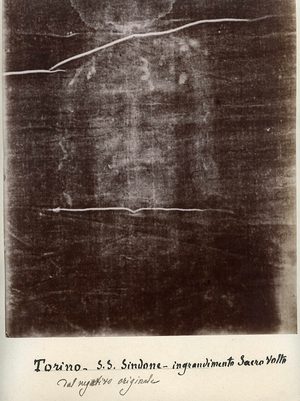

The Shroud of Turin is a linen cloth bearing the faint front and back image of a man who appears to have been scourged and crucified. Many Catholics and other Christians venerate it as the burial cloth of Jesus; others hold it to be a medieval work. The Holy See has never declared it genuine or false, and every tradition has had to say what it makes of a relic of this kind.
| Date | First documented in the 1350s at Lirey, France; in Savoy hands by 1453; in Turin since 14 September 1578 |
|---|---|
| Place | Turin Cathedral (Chapel of the Holy Shroud), Italy; Archdiocese of Turin |
| Claimed by | Catholic devotion; the cloth passed from the House of Savoy to the Holy See by the will of Umberto II (d. 18 March 1983) and stays in Turin |
| Type | Relic: a linen cloth with the image of a crucified man, believed by its venerators to be the burial cloth of Christ |
| Official status | Never declared authentic or inauthentic by the Holy See; John Paul II (1998): the Church "has no specific competence to pronounce" on it; Benedict XVI and Francis call it an icon; belief in its authenticity is not required |
| Investigations | Bishop Pierre d'Arcis's memorandum (1389); photographs (1898); STURP team (1978–81); radiocarbon dating (1988; Nature 1989: AD 1260–1390); challenges to it (2005, 2019, 2022); a reproduction attempt (2009–10) |
What is claimed
According to those who venerate it, the cloth is the linen in which Joseph of Arimathea wrapped the body of Jesus after the crucifixion (Matt 27:59; John 19:40, KJV). The image shows, front and back, a bearded man with marks that devotees match to the Gospel account of the Passion: scourge wounds, wounds on the head, wrists and feet, and a wound in the side (John 19:34). The STURP team's summary reports hemoglobin, and a positive test for serum albumin, in the blood marks.
The image is very faint. When Secondo Pia photographed the cloth in 1898, the plate showed it, in the Catholic Encyclopedia's words, as "apparently a negative": the photograph looked more lifelike than the cloth, which devotees take as a sign that the image is not a painting. The Church asks nobody to believe in it as a matter of faith.
History and devotion
The Archdiocese of Turin's own outline dates the cloth's certain history from 1353, when Geoffroy de Charny placed it in the church he built at Lirey, in Champagne. Bishop Pierre d'Arcis of Troyes later wrote that expositions at Lirey began about 1355 and that his predecessor Henri de Poitiers had judged the cloth to be painted. In 1389 d'Arcis appealed to the Avignon pope Clement VII to stop what he called scandals, saying that an artist had confessed to painting it. According to the Catholic Encyclopedia (1912), Clement did not forbid exhibition but ruled that it be announced as "only a picture made to represent it"; the same article says the authenticity of these documents is not disputed.
Marguerite de Charny passed the cloth to the Savoy dukes (the Turin outline cites legal acts of 1453), and it was kept at Chambéry. Pope Julius II approved an Office and Mass of the Shroud by the bull Romanus Pontifex (25 April 1506). On 4 December 1532 a fire in the Chambéry chapel melted the silver casket, and molten silver scorched and holed the cloth; Poor Clare nuns repaired it in 1534. In 1578 Duke Emanuel Philibert moved it to Turin, where it has remained. Umberto II left it to the Pope at his death in 1983. Public expositions followed in 1998, 2000, 2010 and 2015.
Investigations
The STURP study (1978–81). A team of American scientists, the Shroud of Turin Research Project, examined the cloth in Turin in October 1978. Their summary of October 1981, written by John Heller, reported no pigments, paints, dyes or stains on the fibrils, hemoglobin in the blood marks, and an image formed by oxidation of the linen's fibers that no known method accounts for in full. It concluded that the image is "that of a real human form of a scourged, crucified man" and "not the product of an artist." The microscopist Walter McCrone, whose institute reports that he found red ochre and vermilion by microscopy and X-ray diffraction, concluded that the image was painted; Heller and Adler, for STURP, disputed that the iron compounds were a painting pigment.
Radiocarbon dating (1988). Samples were cut in the cathedral sacristy on 21 April 1988 and dated by the laboratories of Arizona, Oxford and Zurich. Cardinal Anastasio Ballestrero, Archbishop of Turin, announced the result on 13 October 1988, and Nature published it on 16 February 1989 (Damon et al.): a calendar age of AD 1260 to 1390 "with at least 95% confidence," which the authors called "conclusive evidence" that the linen is medieval.
Challenges to the dating. In 2005 the retired STURP chemist Raymond Rogers argued that the sampled corner was a medieval repair, dyed and rewoven, and not part of the original cloth (Nature news, 24 January 2005). In 2019 Tristan Casabianca, Emanuela Marinelli and Giuseppe Pernagallo, who obtained the 1988 raw data in 2017 after a legal request, reported in Archaeometry that the data are not homogeneous and called for new testing. The science writer Philip Ball, who was at Nature in 1989, wrote that nothing published gave compelling reason to think the 1989 study substantially wrong, but that it was apparently not definitive either (Chemistry World, 9 April 2019). In 2022 Liberato De Caro and colleagues (Heritage 5) reported that one thread from the Shroud, tested by wide-angle X-ray scattering, matched linen of the first century and not of the Middle Ages.
Sceptical findings. Luigi Garlaschelli of the University of Pavia announced in 2009, and published in the Journal of Imaging Science and Technology (2010), a life-size image made by rubbing linen over a volunteer with an acid-bearing pigment, using only medieval materials. The International Center of Sindonology answered that it is far from a reproduction of the cloth.
Official status
The Holy See has never declared the Shroud authentic. John Paul II said at Turin on 24 May 1998: "Since it is not a matter of faith, the Church has no specific competence to pronounce on these questions," and called the Shroud "a challenge to our intelligence." Benedict XVI, before the cloth on 2 May 2010, called it "an Icon written in blood." Francis, at Turin on 21 June 2015, said: "An icon of this love is the Shroud." The Archdiocese of Turin states that faith "is not afraid of historic and scientific research" as long as it is serious. The Church permits veneration of the cloth, and belief that it is the burial cloth of Christ is not required of Catholics. See images and relics for how the traditions differ on venerating relics at all.
Where each church stands
- Catholic:
The Church has made no ruling on authenticity. Julius II approved an Office of the Shroud in 1506; the Catholic Encyclopedia article by Herbert Thurston (1912) held that the image was probably painted, and noted that the preponderance of learned Catholic opinion then opposed authenticity. Catholics may venerate it without being bound to hold it genuine; see Miracles.
- Orthodox:
The Orthodox Church has made no official statement. In October 2009 the Moscow Patriarchate's Fr Georgi Zavershinski said the Church "is not in the position to approve or disprove anything," that its stance was unchanged, and that the Shroud "has led many people to God." Orthodox teaching honors relics (Nicaea II, canon 7) and icons.
- Lutheran:
No Lutheran church body has issued a statement on the Shroud. The Smalcald Articles (II.2.22–23) call relics "neither commanded nor counseled" and reject any claim that they bring forgiveness or indulgence, while Lutherans keep sacred images for remembrance and teaching (Luther, Against the Heavenly Prophets).
- Reformed:
Calvin's Treatise on Relics (1543) notes several towns, Nice and Besançon among them, that each claimed to possess the sudary of Christ, says that they "give each other mutually the lie," and argues that the Gospels contradict them. He does not name Turin; the translator's note applies the passage to it. The Second Helvetic Confession (ch. 5) says: "Much less do we believe that the relics of the saints are to be adored and reverenced."
- Anglican:
The Church of England has made no statement on the Shroud. Article XXII rejects "the Romish Doctrine" about the worshipping and adoration of relics, and practice varies: Anglo-Catholics keep relics as aids to devotion. The Anglican New Testament scholar John A. T. Robinson, Bishop of Woolwich, gave a paper on the Shroud and the Gospels' grave cloths at the 1977 Albuquerque conference and went to Turin in 1978.
- Methodist:
No Methodist body has issued a statement on the Shroud. Article of Religion XIV, Wesley's abridgement of Anglican Article XXII, calls the Romish doctrine of worshipping and adoring images and relics "a fond thing, vainly invented."
- Baptist:
No Baptist convention has issued a statement on the Shroud. Many Baptists hold that venerating relics is superstition (images and relics). John Heller, a Southern Baptist biophysicist on the STURP team, told Christianity Today on 7 October 1983: "I see no reason to extend that faith to a piece of cloth."
Sources
- Archdiocese of Turin, Historical outline of the Shroud (sindone.org) 1353, 1453, 1506, 1532, 1578; the "Faith is not afraid" statement
- Thurston, "The Holy Shroud," Catholic Encyclopedia (1912) the 1389 appeal, Clement VII, Julius II (1506 bull), Pia's negative
- Shroud of Turin Website (shroud.com), chronology dates of the d'Arcis memorandum, 1532 fire, 1578, 1978, 1983, 1988; a pro-authenticity site
- STURP, "A Summary of STURP's Conclusions" (1981)
- McCrone Institute, Shroud of Turin research
- Damon et al., "Radiocarbon dating of the Shroud of Turin," Nature 337 (16 February 1989) reprint of the paper
- Nature news, 24 January 2005 (Rogers)
- Casabianca, Marinelli and Pernagallo, Archaeometry (2019)
- Ball, Chemistry World, 9 April 2019
- De Caro et al., Heritage 5 (2022), 860–870
- Garlaschelli, "Life-size Reproduction of the Shroud of Turin and its Image," JIST (2010)
- International Center of Sindonology, on the 2009 reproduction
- John Paul II, address at the Cathedral of Turin before the Shroud (24 May 1998)
- Benedict XVI, meditation before the Shroud, Turin (2 May 2010)
- Francis, Angelus at Turin (21 June 2015)
- Interfax-Religion report of the Moscow Patriarchate statement (6 October 2009), via John Sanidopoulos
- Calvin, Treatise on Relics (1543), CCEL
- Second Helvetic Confession (1566), ch. 5
- Beth Spring, "A Shroud of Turin Scientist Speaks Out," Christianity Today (7 October 1983)
- Robinson, "The Shroud of Turin and the Grave Cloths of the Gospels," Albuquerque Proceedings (1977)
- Secondo Pia print, Wikimedia Commons (public domain)