Lancelot Andrewes 1555–1626
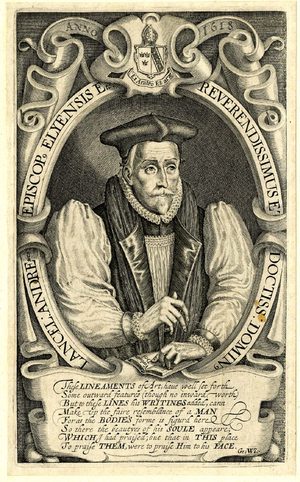

Lancelot Andrewes was a Church of England bishop under Elizabeth I, James I and Charles I, a preacher at court, and the first-named translator of the King James Version. He answered Cardinal Bellarmine for the king, and his sermons and private prayers made him a model of Anglican piety. Which Anglican party he belongs to is still argued, and the other traditions know him chiefly through those debates.
| Lived | 1555, parish of All Hallows, Barking, London, to 25 September 1626, Southwark (some older sources give 26 September) |
|---|---|
| Church | Church of England; ordained 1580; consecrated bishop of Chichester 1605 |
| Role | Master of Pembroke Hall, Cambridge (1589–1605); Dean of Westminster (1601–05); bishop of Chichester (1605), Ely (1609) and Winchester (1619); head of the First Westminster company of Bible translators |
| Influenced by | The Greek and Latin Fathers; Cambridge Puritanism in his youth (Eamon Duffy) |
| Influenced | William Laud and the High Church party that published his sermons; T. S. Eliot, whose 1926 essay revived his reputation |
| Writings | Tortura Torti (1609); Responsio ad Apologiam Cardinalis Bellarmini (1610); XCVI Sermons (published after his death); Preces Privatae (private prayers, unpublished in his lifetime) |
| Honored | 25 September, Lesser Festival, Church of England ("Bishop of Winchester, Spiritual Writer"); 26 September, Episcopal Church; buried in Southwark Cathedral |
Life
Andrewes was born in 1555 in the parish of All Hallows, Barking, London, the son of Thomas Andrewes, who became master of Trinity House. He went to the Coopers' Free School at Ratcliff and to Merchant Taylors' School, then to Pembroke Hall, Cambridge, where he became a fellow in 1576. He was ordained in 1580 and served as the college's catechist, then as chaplain to the Earl of Huntingdon, President of the North. In 1589, with Sir Francis Walsingham's help, he took the living of St Giles, Cripplegate, and he became a prebendary of St Paul's and Master of Pembroke (until 1605). He was made Dean of Westminster in July 1601.
Under James I he rose quickly. He took part in the Hampton Court Conference (1604), was consecrated bishop of Chichester on 3 November 1605 and became the king's almoner, moved to Ely in 1609 and to Winchester in 1619. He was named first among the translators of the King James Version (published 1611) and headed the First Westminster company, which translated Genesis through 2 Kings. In 1609 he published Tortura Torti in the king's cause against Cardinal Bellarmine. He died on 25 September 1626 at Southwark and was buried in St Saviour's, now Southwark Cathedral. The church historian Thomas Fuller wrote of him, "The world wanted learning to know how learned this man was."
What he taught
Authority. A statement attributed to Andrewes and often quoted by Anglicans reads: "One canon reduced to writing by God himself, two testaments, three creeds, four general councils, five centuries, and the series of Fathers in that period" determine the boundary of the faith. It gives Scripture first place and the early church a normative place under it (see the Church Fathers and Scripture alone).
The Eucharist. Replying to Bellarmine, Andrewes wrote, in the translation printed in the Schaff-Herzog Encyclopedia, that Christ said "This is my body," not "This is not my Body in this mode," and that "about the object we are both agreed; all the controversy is about the mode." Duffy adds that he stressed the objective presence of Christ and the sacrificial character of the Eucharist, priestly absolution, and kneeling at communion, and that incense was used in his episcopal chapels (the Lord's Supper; the Mass as sacrifice).
King and pope. Tortura Torti answered Bellarmine, writing as Matthaeus Tortus, and defended James I's apology for the oath of allegiance that the Crown required of Catholics after the Gunpowder Plot (see Robert Bellarmine). A second reply, the Responsio ad Apologiam (1610), answered Bellarmine's Apologia (1609).
Predestination. Duffy writes that Andrewes began as a Protestant shaped by Cambridge Puritanism, that his views changed in the 1590s, and that his later sermons set predestination aside in favor of perseverance and good works (predestination).
Preaching and prayer. At Whitehall on Christmas Day 1622, before James I, he preached on the Magi: "A cold coming they had of it at this time of the year," in "the very dead of winter." Eliot drew on this sermon in Journey of the Magi. His Preces Privatae, prayers in Greek, Latin and Hebrew arranged for daily use, were not published in his lifetime; F. E. Brightman's English edition (1903) cites the Greek liturgies of St James, St Basil and St John Chrysostom in the Paris edition of 1560 that Andrewes used.
What historians say
His modern fame owes much to T. S. Eliot, whose essay "Lancelot Andrewes" appeared in the Times Literary Supplement on 23 September 1926 and was reprinted in For Lancelot Andrewes (1928); Eliot ranked the sermons with "the finest English prose of their time, of any time." Eamon Duffy, reviewing the 2005 Oxford selection edited by Peter McCullough, argues that Eliot's picture of a serene via media misleads: after Andrewes's death Laud and John Buckeridge published the XCVI Sermons as a High Church statement, Puritan printers circulated his earlier, more Protestant writings, and the canonical image is in Duffy's words "a deliberately contrived posthumous manifesto." McCullough's study in the Historical Journal (1998) traces how that canon of his works was formed. The Orthodox scholar Nicholas Lossky argues in Lancelot Andrewes the Preacher (1991) that the sermons show the influence of the Greek Fathers.
Duffy also records what troubled his contemporaries and later readers. Andrewes took part in the attempt to convert recusant Catholics in the north, and his Gunpowder sermons play grimly on the executions of Catholics. He privately doubted the case in the Essex divorce yet acquiesced in the commission's verdict, and Duffy writes that his place at court sometimes required accommodations of conscience. To many Puritans his ceremonial theology looked like popery (Executions under Elizabeth I; the penal laws; the Anglican record).
How the churches see Andrewes
- Catholic:
The Catholic Church has made no statement about Andrewes. He figures in Catholic history as Bellarmine's opponent in the oath of allegiance dispute: Paul V's briefs of 22 September 1606 and 23 August 1607 condemned the oath James I required, which the Catholic Encyclopedia says contained clauses "to which no Catholic could in conscience subscribe." On the Eucharist the Council of Trent (Session 13, 1551) taught that the whole substance of the bread and wine is changed (ch. 4, canon 2); Andrewes held that the dispute was about the mode. Leo XIII's Apostolicae Curae (1896) judged Anglican orders "absolutely null and utterly void"; the archbishops answered in Saepius Officio (1897) (the question of Anglican orders).
- Orthodox:
The Orthodox Church has made no statement about Andrewes. His private prayers draw on the Greek liturgies, and Nicholas Lossky, a Russian Orthodox scholar writing in French (and a son of Vladimir Lossky), made his sermons the subject of a book whose subtitle calls them the origins of "the mystical theology of the Church of England" (Oxford, 1991). Orthodox teaching on the Eucharist is that the Holy Spirit changes the gifts into Christ's body and blood, the Synod of Jerusalem (1672) using the Greek metousiosis; the Orthodox Church receives seven ecumenical councils, where Andrewes's formula names four.
- Lutheran:
No Lutheran church has made a statement about Andrewes. The Lutheran confessions teach that Christ's body is present "under the bread, with the bread, in the bread," and that even unworthy communicants receive it with the mouth (Formula of Concord, Solid Declaration VII). The Schaff-Herzog Encyclopedia, summarizing Anglican teaching, cites Andrewes as holding that the controversy with Rome concerned the mode of Christ's presence and not the fact (the Lord's Supper).
- Reformed:
No Reformed church has made a statement about Andrewes. Duffy reports that his High Church theology seemed to many of the godly to savor of popery, and that Puritans answered Laud's use of his name by circulating his earlier writings. On the Supper, the Westminster Confession (29.6–7) rejects transubstantiation and any bodily presence in, with or under the elements, and teaches that believers receive and feed on Christ crucified spiritually, by faith.
- Anglican:
The Church of England keeps 25 September as a Lesser Festival: "Lancelot Andrewes, Bishop of Winchester, Spiritual Writer, 1626." The Episcopal Church lists "Lancelot Andrewes, Bishop of Winchester" on 26 September. His formula of one canon, three creeds, four councils and five centuries is often cited as a short description of Anglican authority. On the Supper, Article XXVIII teaches that the bread is "a partaking of the Body of Christ" received "after an heavenly and spiritual manner" (see also Richard Hooker and George Herbert).
- Methodist:
No Methodist church has made a statement about Andrewes. Methodism inherited the Anglican article on the Supper: to those who receive with faith the bread is "a partaking of the body of Christ," received after a heavenly and spiritual manner, and transubstantiation is rejected (Article XVIII). This Holy Mystery (United Methodist General Conference, 2004) affirms "the real, personal, living presence of Jesus Christ" without claiming to explain how.
- Baptist:
No Baptist body has made a statement about Andrewes. Baptist churches are congregational and have no bishops. Most Baptists hold the Supper to be an ordinance of remembrance: the Baptist Faith and Message (art. VII) calls it "a symbolic act of obedience," while the Second London Confession (30.7) says that worthy receivers "spiritually receive, and feed upon Christ crucified."
Sources
- Dictionary of National Biography, "Andrewes, Lancelot" (1885) dates of the life and offices
- Westminster Abbey, "Lancelot Andrewes"
- The King's Bible, "King James Version translators" First Westminster company, Genesis through 2 Kings; Fuller's remark
- Duffy, review of Lancelot Andrewes: Selected Sermons and Lectures, London Review of Books 28:15 (2006)
- McCullough, "Making dead men speak: Laudianism, print, and the works of Lancelot Andrewes, 1626–1642," Historical Journal 41 (1998)
- Curry, article on Hooker, Andrewes and Eliot, Dionysius 36 (2018) Eliot's essay in the TLS, 23 September 1926; Lossky
- Lossky, Lancelot Andrewes the Preacher (1555–1626), trans. Andrew Louth (Clarendon Press, 1991) Kenneth Stevenson's review, Scottish Journal of Theology
- Andrewes, Sermon of the Nativity, Christmas Day 1622 (Project Canterbury)
- Brightman, The Preces Privatae of Lancelot Andrewes (Methuen, 1903)
- Morris, "Revisiting Anglican Classics: Lancelot Andrewes's Preces Privatae"
- Andrewes, Tortura Torti (London, 1609), and Responsio ad Apologiam Cardinalis Bellarmini (London, 1610), library catalogue records
- Schaff-Herzog Encyclopedia of Religious Knowledge, "The Anglican Doctrine" (Lord's Supper) Andrewes's reply to Bellarmine on the Eucharist
- Anglican Compass, "One Canon, Two Testaments" (Andrewes's formula)
- Catholic Encyclopedia, "Pope Paul V" the briefs of 1606 and 1607 on the oath
- Catholic Encyclopedia, "Cardinal Bellarmine"
- Council of Trent, Session 13 (Waterworth translation)
- Answer of the Archbishops of England to the Apostolic Letter Apostolicae Curae (Saepius Officio), 1897
- Church of England, Common Worship calendar (Lesser Festivals) 25 September: Lancelot Andrewes, Bishop of Winchester, Spiritual Writer, 1626
- Episcopal Church, Calendar of the Church Year
- Formula of Concord, Solid Declaration VII (Book of Concord)
- Westminster Confession of Faith, ch. 29
- Second London Baptist Confession (1689), ch. 30
- This Holy Mystery: A United Methodist Understanding of Holy Communion (2004)
- Simon van de Passe portrait, Wikimedia Commons (public domain)