Blood of Saint Januarius first recorded 1389
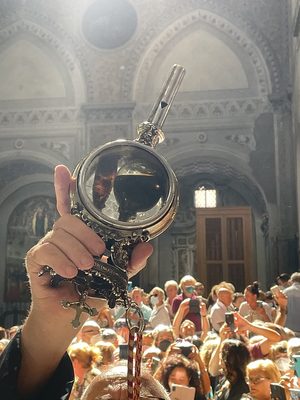

Naples keeps in its cathedral a reliquary with two glass ampoules of dark matter that Catholic tradition says is the blood of St Januarius (Gennaro), a bishop beheaded about 305. Three times a year the mass is reported to turn liquid when the archbishop presents it, and the city treats a failure as an omen. Scientists have disputed what the substance is and how it behaves, and the Church has venerated the relic without ruling on the liquefaction. See also statues, icons and relics.
| Date | Martyrdom c. 305 (traditional); the liquefaction first reported in 1389 |
|---|---|
| Place | Naples Cathedral, Chapel of the Treasury of St Januarius, Italy |
| Claimed by | Catholic Church; the Archdiocese of Naples, whose archbishop presents the relic |
| Type | Relic: dried blood said to liquefy and later solidify again, on set days |
| Official status | Venerated for centuries; St Januarius is an optional memorial on the General Roman Calendar (19 September) and is kept on 21 April by the Orthodox Church in America; reported not to have had official Church recognition as a miracle |
| Investigations | Spectroscopy by Gennaro Sperindeo (1902); an examination permitted by the Church in 1989; a replication by Luigi Garlaschelli, Franco Ramaccini and Sergio Della Sala (Nature, 1991); the sealed ampoules have not been opened |
What is claimed
According to Catholic tradition, Januarius (Italian Gennaro), bishop of Benevento, was beheaded at Pozzuoli near Naples about 305 in the persecution under Diocletian; the Roman Martyrology names him with several companions. The Catholic Encyclopedia (1910) says little is known of his life and that the surviving Acts are late. As the story is told, a bystander gathered some of his blood after the execution (a version summarized by Skeptic magazine).
The Catholic Encyclopedia describes a silver reliquary holding two glass phials. The smaller holds only traces of blood; the larger is normally more than half full of a dark, solid mass. According to the National Catholic Register, a priest, usually the archbishop, holds the reliquary up and turns it sideways before the people. The mass, which clings to one side of the ampoule, is reported to liquefy within a few minutes to an hour, to turn red and to bubble; sometimes it takes hours or days, and sometimes it does not liquefy. When it does, the officiant announces "Il miracolo è fatto" (the miracle is done), the Te Deum is sung and the faithful kiss the reliquary (Catholic Encyclopedia).
This is said to occur on three occasions: the Saturday before the first Sunday of May (commemorating the transfer of his remains to Naples), 19 September (his feast) and 16 December (the anniversary of the 1631 eruption of Vesuvius), the reliquary then being shown for about eight days. The Catholic Encyclopedia reports other claims by defenders: temperature records kept by Professors Fergola, Punzo and Sperindeo showed no direct relation between the air temperature and the liquefaction, and weighings in 1902 and 1904 found the reliquary about 26 grams heavier when the phial appeared full than when it appeared half full.
History and devotion
The Catholic Encyclopedia says the first certain record of the liquefaction is from 1389, not 1456 as once supposed. Garlaschelli and Torzo (EXARC Journal, 2026) give the date as 17 August 1389, and note that a Naples chronicle of 1382 discusses the cult of Januarius but mentions neither the relic nor any liquefaction. The Martyrology says his body was brought to Naples; the Breviary account has it pass through Benevento and Monte Vergine before reaching the city.
Januarius became the principal patron of Naples, and the relic became a focus of civic devotion. Failures to liquefy are taken in Naples as omens of misfortune, and the National Catholic Register lists them in September 1939, 1940, 1943, 1973 and 1980 and in December 2016 and 2020. When the blood did not liquefy in December 2016, Monsignor Vincenzo De Gregorio, abbot of the Chapel of the Treasury, urged the faithful to pray rather than dwell on omens (reported by Catholic News Agency). On 21 March 2015, while Pope Francis was at the cathedral, Cardinal Crescenzio Sepe announced that the blood had partially liquefied (Catholic World Report).
Investigations
Spectroscopy and weighing
In 1902 Gennaro Sperindeo passed light through the phial while the contents were liquid and reported the spectral lines of blood. The Catholic Encyclopedia itself notes that this shows only that blood is present, not why it liquefies. Garlaschelli and Torzo write that the weight changes of 1902–04 were not confirmed by tests made at the Church's request in 1979–83. The Spectator (1991) reported that the Church had agreed, two years before, to an examination by three hematologists. The vials are sealed inside a case, so no one has analyzed the contents directly.
The replication of 1991
On 10 October 1991 Nature (vol. 353, p. 507) published a letter, "Working bloody miracles," by Garlaschelli, Ramaccini and Della Sala. They prepared from iron chloride, salts and calcium carbonate a gel that was thixotropic: it stood solid when still and turned liquid when shaken, over repeated cycles. They observed that ferric chloride occurs as a mineral on Vesuvius. They wrote that the Church forbids a complete analysis of the relic and that their replication seemed to "render this sacrifice unnecessary." A 1994 paper in Chemistry in Britain described a colloidal iron oxide-hydroxide gel of the right color.
Replies and later work
The magician and skeptic James Randi, who used Garlaschelli's samples in his demonstrations, answered an audience question by granting that a copy made by ordinary means does not disprove a miracle, and held that examining the original would settle the doubt (Skeptic). In 2026 Garlaschelli and Torzo argued that a substance with a low melting point, such as dyed coconut oil, fits the behavior as well, and said that whether further tests go ahead "depends upon the Catholic Church." The historian Francesco Paolo de Ceglia of the University of Bari traces the relic and the natural explanations of it in The Natural History of a Neapolitan Miracle (2025).
Official status
Catholic reports say the liquefaction has not been the subject of official Church recognition, though it is locally accepted and celebrated by the archbishop (Catholic World Report). Italian press accounts commonly call it a prodigio (prodigy). The cult of Januarius himself is approved: his memorial on 19 September is optional on the General Roman Calendar. Since the Church has made no declaration about the liquefaction, belief in it is not part of the faith Catholics must hold. The Catechism says private revelations do not belong to the deposit of faith (CCC 67). In his 2021 homilies, Archbishop Domenico Battaglia urged the faithful not to read good or bad omens in the blood and to see in it a sign of the blood of Christ (press reports).
Where each church stands
- Catholic:
The Council of Trent (Session XXV, 1563) taught that the bodies of the martyrs are to be venerated by the faithful, since God grants many benefits through them. The Roman Martyrology names Januarius, his memorial is on the General Roman Calendar, and the Archbishop of Naples presents the blood. The Church has not recognized the liquefaction as a miracle and does not require belief in it. The Catechism (156) counts "the miracles of Christ and the saints" among the motives of credibility, and (67) says private revelations do not belong to the deposit of faith.
- Orthodox:
The Orthodox Church in America keeps 21 April as the day of the "Hieromartyr Januarius, Bishop of Benevento, and his companions, at Pozzuoli." The Second Council of Nicaea (787, canon 7) required relics in every consecrated church. No statement on the Naples liquefaction by an Orthodox church was found.
- Lutheran:
No Lutheran church body has made a statement about the blood of Januarius. The Smalcald Articles (II.2.22–23) reject relics as a means of indulgence and forgiveness, and the Apology of the Augsburg Confession (XXI) faults the slide from invoking saints to worshipping images and statues.
- Reformed:
No Reformed church has made a statement about the blood of Januarius. The Westminster Confession (1.1) holds that God's former ways of revealing his will have ceased, and B. B. Warfield, in Counterfeit Miracles (1918), whose third chapter treats Roman Catholic miracles, argued that miracles ended with the apostolic age and that later claims were counterfeit.
- Anglican:
The Church of England and the Anglican Communion have no statement on the blood of Januarius. Article XXII of the Thirty-Nine Articles calls the Roman doctrine of the worshipping and adoration of images and relics "a fond thing vainly invented." Anglo-Catholics and Evangelicals differ in how far they honor saints and relics.
- Methodist:
The Methodist churches have made no statement about the blood of Januarius. Article XIV of their Articles of Religion repeats Anglican Article XXII on relics. John Wesley, in the sermon "The More Excellent Way" (no. 89), held that miraculous gifts became rare after the early centuries because Christian love had grown cold, not because they were no longer needed.
- Baptist:
No Baptist body has made a statement about the blood of Januarius. The Second London Confession (1689, 1.1) says that God's former ways of revealing his will have ceased, and Baptists hold, with other evangelicals, that venerating relics is superstition.
Sources
- Catholic Encyclopedia, "St. Januarius" (1910)
- National Catholic Register, "The Blood of St. Januarius: Everything to Know About the Miracle of Liquefaction"
- Catholic World Report, "Cardinal 'blanches' while celebrating recurring miracle of saint's liquefied blood" official recognition; Sepe and the 2015 papal visit
- Catholic News Agency, "San Gennaro's blood didn't liquefy, so pray anyway, abbot says" (December 2016)
- Catholic World Report, "St. Januarius' blood liquefies for the second time in 2021" (Battaglia's homily)
- Garlaschelli, Ramaccini and Della Sala, "Working bloody miracles," Nature 353 (1991), p. 507 (text at CICAP)
- Garlaschelli and Torzo, "Mysteriously Liquefying Blood Relics in Italy," EXARC Journal 2026/2
- Skeptic, "The Liquefying 'Blood' of St. Januarius"
- The Spectator, "Miracles, bloody miracles," 23 November 1991
- Francesco Paolo de Ceglia, The Natural History of a Neapolitan Miracle (Routledge, 2025)
- Orthodox Church in America, Lives of the Saints, 21 April
- Liturgy Office of England and Wales, General Roman Calendar, September
- Council of Trent, Session 25 (1563)
- Catechism of the Catholic Church, 67
- Smalcald Articles, Part II, Article II (Book of Concord)
- Apology of the Augsburg Confession, Article XXI (Book of Concord)
- Westminster Confession of Faith, chapter 1 (OPC)
- B. B. Warfield, Counterfeit Miracles (1918)
- Church of England, Articles of Religion (Article XXII)
- United Methodist Church, Articles of Religion (Article XIV)
- John Wesley, Sermon 89, "The More Excellent Way"
- Second London Baptist Confession (1689), chapter 1
- Photograph of the reliquary, Wikimedia Commons (CC BY 4.0)