William Carey 1761–1834
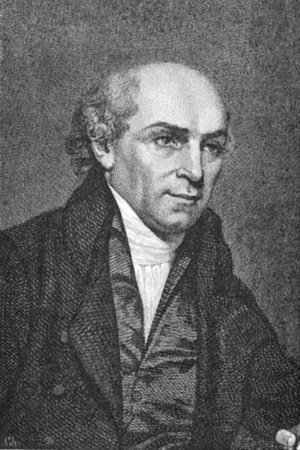

William Carey was a shoemaker and Particular Baptist pastor from Northamptonshire who sailed for India in 1793 as the first missionary of the Baptist Missionary Society, which he helped found. He argued that Christ's command to preach to all nations binds every Christian, translated the Bible at Serampore, and campaigned against the burning of widows. Every tradition has a view of the missionary movement he began, though few have said anything of him by name.
| Lived | 17 August 1761, Paulerspury, Northamptonshire, to 9 June 1834, Serampore, Bengal |
|---|---|
| Church | Born into the Church of England; left it for the Dissenters; baptized as a believer on 5 October 1783 and a Particular Baptist minister |
| Role | Pastor at Moulton and Leicester; first missionary of the Baptist Missionary Society; teacher of Bengali, Marathi and Sanskrit at Fort William College, Calcutta (from 1801); Bible translator; co-founder of Serampore College |
| Influenced by | John Ryland Jr., who baptized him; Andrew Fuller, his friend and the Society's first secretary, whose The Gospel Worthy of All Acceptation defended the free offer of the gospel |
| Influenced | The Baptist Missionary Society (1792) and later Baptist missions; his Serampore colleagues Joshua Marshman and William Ward; Adoniram Judson, who became a Baptist on his way to India in 1812 and was baptized at Serampore |
| Writings | An Enquiry into the Obligations of Christians, to use Means for the Conversion of the Heathens (1792); Bengali New Testament (printed 1801); Sanskrit New Testament (1808); a Bengali grammar, dictionary and textbooks for Fort William College |
| Honored | Memorial lectern in Westminster Abbey (1949); 19 October in Holy Women, Holy Men (2010), the Episcopal Church's trial-use volume of commemorations |
Life
Carey was born on 17 August 1761 at Paulerspury, Northamptonshire, into the Church of England, and trained as a shoemaker. He joined the Dissenters and was a founding member of a Congregational church at Hackleton (about 1781). On 5 October 1783 John Ryland Jr. baptized him in the River Nene, and he joined the Baptist church at Olney. He began as pastor at Moulton in 1785 and moved to the Harvey Lane church in Leicester in 1789, earning a living by teaching school and making shoes.
His Enquiry into the Obligations of Christians, to use Means for the Conversion of the Heathens appeared on 12 May 1792. At Nottingham that month he preached on the words "Expect great things from God. Attempt great things for God." On 2 October 1792 at Kettering the Baptist ministers formed the Particular Baptist Society for Propagating the Gospel among the Heathen, later the Baptist Missionary Society (now BMS World Mission). Fuller preached at the commissioning of Carey and the physician John Thomas, and they sailed from Dover on 13 June 1793, reaching Calcutta that November.
The East India Company restricted missionary work in its territory. Joshua Marshman and William Ward arrived at the end of 1799 and took shelter in the Danish settlement of Serampore; Carey joined them in January 1800 and the mission and its press began. Krishna Pal, the first Indian convert, was baptized in December 1800, and the Bengali New Testament was printed in 1801. That year Carey was appointed professor at Fort William College in Calcutta, a post he held for about thirty years. A fire in 1812 destroyed the press and years of translation work. Serampore College was founded in 1818 and received a charter from Frederick VI of Denmark in 1827; in that year the Serampore mission broke with the Society in London, and it was reconciled in 1830. Carey died at Serampore on 9 June 1834.
What he taught
The Enquiry argued that Christ's command to "preach the gospel to every creature" (Mark 16:15, KJV; see also Matthew 28:19) binds all Christians for all time, and that Christians must "use means" to obey it. Carey and Fuller were Particular Baptists, the Calvinist Baptists. Fuller's The Gospel Worthy of All Acceptation answered the "hyper-Calvinism" that rejected evangelistic appeals to sinners; by the 1790s his position was called "Fullerism" (predestination). As a Baptist, Carey baptized believers on profession of faith (baptism).
Carey's method joined preaching, translation and schools. Timothy George reports that by 1817 the Serampore missionaries had 103 schools, and that Carey himself translated the whole Bible into Bengali, Oriya, Marathi, Hindi, Assamese and Sanskrit and parts of it into twenty-nine other languages. By 1805 Carey, Marshman and Ward had concluded that the evangelization of India must rest chiefly with Indian Christians, and Serampore College was meant to train them; it also admitted non-Christian students and taught science alongside theology. He urged the government to prohibit the burning of widows (sati). His biographer George Smith writes that when Governor-General Bentinck's prohibition reached Carey on a Sunday morning, he asked another to preach and wrote the official Bengali translation himself; Evangeline Anderson-Rajkumar dates that Sunday to 6 December 1829. Near his death he asked others to "say nothing about Dr. Carey" (George).
What historians say
Historians agree on the outline of Carey's life and differ on its proportions. The number of languages is counted differently: George says the Serampore translators worked in about 48 languages and dialects, while the New Schaff-Herzog Encyclopedia credits Carey with some twenty-six. Brian Stanley (Baptist Quarterly, 2020) notes that Carey's income as professor at Fort William and Bengali translator to the government paid for much of Serampore College, and that the college's cost lay at the heart of the 1827 break with the Society in London. Stanley also sees ambiguities in its founding vision: to train Indian Christians as missionaries, yet to admit non-Christians; to teach in Bengali on a Sanskrit base, yet to meet a growing demand for English.
The credit for ending sati is disputed. Anderson-Rajkumar, of Serampore College, writes that credit has been given to Rammohan Roy, Bentinck and others as well as Carey, but that Carey raised his voice in protest and kept the government's attention through the Friend of India and Samachar Darpan. Smith (1885) reports a count, gathered by Indians at Carey's request, of 275 widow burnings in six months of 1803 in the district around Calcutta. Lata Mani argues in Contentious Traditions that the 1829 prohibition was a pragmatic exercise of colonial power rather than a humanitarian act, and that missionaries sometimes used sensational and inaccurate accounts to raise money at home; Andrea Major accepts much of this but writes that dismissing humanitarian motives entirely is also problematic. Rammohan Roy led the Indian campaign against the practice and challenged its claimed scriptural basis (Major).
How the churches see Carey
- Catholic:
The Catholic Church has made no statement about Carey. Catholic missions in India were much older: Francis Xavier landed at Goa on 6 May 1542, and the Synod of Diamper in 1599 sought the reunion of the Thomas Christians of Malabar with Rome (Catholic Encyclopedia).
- Orthodox:
The Eastern Orthodox Church has made no statement about Carey. Its own tradition of putting Scripture into a people's language is that of Cyril and Methodius. The Serampore College Act of 1918 gave seats on the college senate to the Syrian Orthodox, an Oriental Orthodox church not in communion with the Eastern Orthodox, and by 1920 almost half of the college's ninety-two Christian students were Syrian Orthodox (Stanley).
- Lutheran:
No Lutheran church body has made a statement about Carey. Lutheran missionary work in India was older: Bartholomäus Ziegenbalg and Heinrich Plütschau, trained at Halle, reached the Danish colony of Tranquebar on 9 July 1706 under a mission begun by King Frederick IV of Denmark, and the New Testament printed there in Tamil was the first in any Indian language (Boston University School of Theology). Serampore was also Danish: Carey's mission took shelter there, and its college received its charter from the Danish king. Stanley notes that the Halle mission, like Serampore, taught natural science as a path to knowledge of the Creator.
- Reformed:
The Reformed churches have made no statement about Carey. His mission rested on the Calvinism of the Particular Baptists, and Fuller's defense of the free offer of the gospel was an argument within Calvinism over whether the gospel is to be offered to all (predestination). Presbyterians soon had their own work: the Church of Scotland sent Alexander Duff, who reached Calcutta on 27 May 1830 and led a General Assembly institution teaching science and letters in English within a Christian framework.
- Anglican:
Westminster Abbey holds a memorial to Carey, a walnut lectern given by the Baptist Missionary Society on 11 October 1949, with the inscription "Missionary in India and Translator of the Bible." The Episcopal Church's Holy Women, Holy Men (2010) lists him on 19 October, with a collect asking "a heart for the spreading of thy Gospel"; the Church of England's calendar commemorates Henry Martyn on the same date. Carey was born into the Church of England, and the Church Missionary Society, formed by Anglican evangelicals in 1799, followed the Baptist society of 1792.
- Methodist:
The Methodist churches have made no statement about Carey. Thomas Coke, who headed the first Methodist missionary committee (1790), sent missionaries to the West Indies from 1792, the year of the Baptist Society's founding, and died at sea on 3 May 1814 on a voyage to found missions in the East (United Methodist Church; SOAS Library). The Serampore College Act of 1918 gave Methodists seats on the college senate with Anglicans, Baptists, Congregationalists, Lutherans, Presbyterians and Syrian Orthodox (Stanley).
- Baptist:
The Baptist Missionary Society that Carey helped found in 1792 continues as BMS World Mission (Baptist history). Michael Haykin writes for the Southern Baptist International Mission Board that Carey "was most visible at the fountainhead of this movement," and quotes Fuller's recollection of Carey's words before he sailed: "Well, I will go down, if you will hold the rope." Carey baptized Krishna Pal, the first Indian convert, in December 1800, in keeping with the Baptist practice of baptizing believers.
Sources
- Southern Baptist Historical Library and Archives, "William Carey" birth, baptism, Olney, pastorates, Society
- Christian History, "William Carey Timeline" (1992) dates of the life
- Christian History Institute, "Winning the World: Carey and the Modern Missionary Movement"
- Timothy George, "The Lasting Contributions of a Wretched Worm," Christian History
- Banglapedia, "Carey, William"
- New Schaff-Herzog Encyclopedia, "Carey, William" (CCEL)
- Boston University School of Theology, "Andrew Fuller (1754–1815)"
- George Smith, The Life of William Carey (1885), on sati (CCEL)
- Anderson-Rajkumar, "Carey and Sati," Evangelical Review of Theology 17:3
- Brian Stanley, "The Vision of a Christian Higher Education for India," Baptist Quarterly 51:1 (2020)
- Andrea Major, "Sati and the Civilising Mission," Voluntary Action History Society (2012)
- Haykin, "The Forgotten Missional Theologian," International Mission Board (2018)
- Westminster Abbey, "William Carey" memorial
- Episcopal Church Standing Commission on Liturgy and Music, William Carey, Holy Women, Holy Men (2010)
- Boston University School of Theology, "Alexander Duff (1806–1878)"
- Boston University School of Theology, "Bartholomäus Ziegenbalg (1682–1719)"
- Catholic Encyclopedia, "St. Francis Xavier"
- Catholic Encyclopedia, "St. Thomas Christians"
- United Methodist Church, "Thomas Coke (1747–1814)"
- SOAS Library, Methodist Missionary Society archive, on Coke's death
- Carey portrait, Wikimedia Commons (public domain)