Zacharias Ursinus 1534–1583
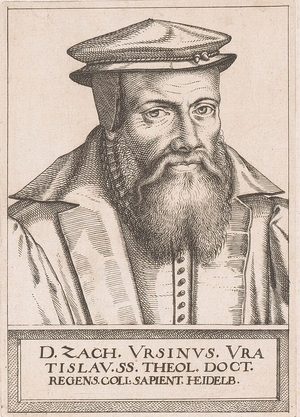

Zacharias Ursinus was a student of Philipp Melanchthon who became a Reformed professor at Heidelberg and the chief drafter of the Heidelberg Catechism (1563), later one of the Reformed Three Forms of Unity. Lutherans, who lost the Palatinate's church to it, and Catholics, whom its Question 80 names, have each had to answer it, and Reformed churches still teach from it.
| Lived | 18 July 1534, Breslau, to 6 March 1583, Neustadt an der Haardt (now Neustadt an der Weinstraße) |
|---|---|
| Church | Trained at Wittenberg under Melanchthon; took the Reformed side on the Lord's Supper in 1559; Reformed Church of the Palatinate |
| Role | Teacher at Breslau (1558–59); head of the Collegium Sapientiae at Heidelberg from 1561, with a theology doctorate in 1562; teacher at the Casimirianum, Neustadt, from 1578 |
| Influenced by | Philipp Melanchthon; Peter Martyr Vermigli, with whom he worked at Zürich; Calvin, whom he visited at Geneva on a study tour (1557–58) |
| Influenced | Caspar Olevianus, his colleague on the catechism; David Pareus, who edited his lectures; Reformed churches that use the Heidelberg Catechism |
| Writings | Theses on the Sacraments (1559); Smaller and Larger Catechisms (1561–62; the larger is the Summa theologiae); Heidelberg Catechism (1563), with others; a treatise on the Lord's Supper (1564); Admonitio christiana against the Book of Concord (1581); lectures on the catechism, published after his death |
| Honored | Reformed churches keep no calendar of saints; he is remembered through the Heidelberg Catechism, divided into fifty-two Lord's Days since 1563 |
Life
Ursinus was born at Breslau on 18 July 1534. He matriculated at Wittenberg on 30 April 1550 and grew close to Melanchthon, whom he accompanied to the colloquy at Worms in 1557; a study tour then took him to Geneva, Paris, Zürich and other cities. Back at Breslau in 1558 he taught at the Elisabethschule. His Theses on the Sacraments (1559) took the Reformed side in the dispute over the Lord's Supper, and he left his post. In October 1560 he settled at Zürich and worked with Peter Martyr Vermigli.
Frederick III, Elector Palatine from 1559, had been a Lutheran when he came to the throne. A quarrel over the Supper between the strict Lutheran Tilemann Hesshus and the Reformed Wilhelm Klebitz led him to study the question, and a debate at Heidelberg in 1560 moved him to the Reformed confession. He called Caspar Olevianus in 1560 and Ursinus, who reached Heidelberg on 9 September 1561 and took charge of the Collegium Sapientiae, a seminary for clergy; he received his doctorate on 25 August 1562. The elector commissioned a catechism, which a synod at Heidelberg approved in January 1563. In November 1563 the Palatinate Church Order printed it divided into fifty-two Lord's Days, one for each Sunday of the year.
Frederick died in 1576. His son Louis VI, a Lutheran, replaced the catechism with Luther's catechism and the Formula of Concord, according to Philip Schaff. Ursinus was dismissed on 7 October 1577, declined a call to Bern, and from 1578 taught at the Casimirianum, a Reformed academy at Neustadt under the protection of Frederick's son John Casimir. He died there on 6 March 1583.
What he taught
The Heidelberg Catechism begins with the question "What is your only comfort in life and in death?" and answers: "That I am not my own, but belong" to "my faithful Savior, Jesus Christ" (Q&A 1, Christian Reformed Church translation). Its second question divides the whole into three parts: sin and misery, deliverance, and thankfulness. It defines true faith as "a sure knowledge" together with "a wholehearted trust" (Q&A 21), and sacraments as "visible, holy signs and seals" (Q&A 66).
On the Lord's Supper it teaches that the bread "does not become the actual body of Christ" (Q&A 78), while believers are united to Christ's body through the Holy Spirit, "although he is in heaven and we are on earth" (Q&A 76). Question 74 holds that infants belong to "God's covenant and people" and should receive baptism, which replaced circumcision as the sign of the covenant (infant baptism). Question 80 contrasts the Supper with the Mass (the Mass as sacrifice).
Ursinus's own writings carry the same teaching further. Peter Lillback traces the Reformed teaching of a covenant of creation, or of nature, set against the covenant of grace, to Ursinus's Summa theologiae (1562), where the law is paired with the first and the gospel with the second; he also notes that Olevianus used the same terms, and scholars still discuss who spoke first. After Ursinus's death David Pareus edited his lectures on the catechism, the work best known in English (translated by G. W. Williard, 1852); because it rests partly on student notes it reflects his students' and editors' hands. Ursinus also answered Tilemann Hesshus on the Fathers and the Supper and in 1581 wrote against the Book of Concord.
What historians say
Authorship is debated. Frederick's preface credits the catechism to the elector's theologians, and an old tradition names Ursinus and Olevianus as its two authors. The Christian Reformed Church's introduction says the work was a team's, with Ursinus probably the primary writer and Olevianus a lesser role. Lyle Bierma (An Introduction to the Heidelberg Catechism, 2005) argues for a committee in which Ursinus did most of the work; older German scholars had credited Olevianus with turning Ursinus's Latin Smaller Catechism into the warmer German style, and Walter Hollweg (1963) found no contemporary evidence of Olevianus's authorship.
Question 80 is the catechism's most disputed passage. It is absent from the first German edition (early 1563), appears in shorter form in the second (March 1563) and in expanded form in the third (about April 1563). A Christian Reformed Church report suggests it may answer the Council of Trent's decree on the Mass of September 1562, but calls this conjecture. The Peace of Augsburg (1555) recognized only Lutherans and Catholics, so the Reformed faith in the Palatinate had no legal protection; Frederick appealed to Melanchthon and the Altered Augsburg Confession in his defense, and the New Catholic Encyclopedia calls the catechism fundamentally Calvinist, with "some Lutheran tendencies." Ursinus's own suffering was dismissal and removal from Heidelberg in 1577; for criticism of Reformed churches generally, see the Reformed record.
How the churches see Ursinus
- Catholic:
No Catholic document naming Ursinus was found. The Council of Trent (Session 22, September 1562) taught that in the Mass "the victim is one and the same" as on the cross, "only the manner of offering is different"; the Catechism of the Catholic Church (1367) says that the sacrifice of Christ and that of the Eucharist "are one single sacrifice." Question 80 of the Heidelberg Catechism calls the Mass "a condemnable idolatry" (CRC translation). The Christian Reformed Church sent a study of Catholic eucharistic teaching to the Catholic bishops of Canada and the United States in 2002, and reported that Catholic representatives found the doctrine "stated clearly and accurately." Synod 2004 declared that Q&A 80 "can no longer be held in its current form"; Synod 2006 bracketed its last three paragraphs as not reflecting the teaching of today's Catholic Church (the question as posed to Reformed readers).
- Orthodox:
No statement by an Orthodox church about Ursinus or the Heidelberg Catechism was found.
- Lutheran:
The Palatinate's change under Frederick III from Lutheran to Reformed teaching, and its reversal under Louis VI, belong to Lutheran as well as Reformed memory; Ursinus's 1581 Admonitio christiana opposed the Book of Concord. The Formula of Concord (Epitome VII) rejects the teaching that the bread and wine are "figures, similitudes, and representations of the far absent body and blood of Christ"; the Heidelberg Catechism says Christ's body is in heaven (Q&A 76, 80). Albert Collver of the Missouri Synod writes that the Reformed confessed Christ "present in some sort of spiritual way but not present with His body and His blood," and that Lutherans differ on what church fellowship requires. In 1997 the ELCA approved a full-communion agreement with the Presbyterian Church (U.S.A.), the Reformed Church in America and the United Church of Christ (A Formula of Agreement; Churchwide Assembly vote 839–193).
- Reformed:
The Heidelberg Catechism was approved by a synod at Heidelberg in January 1563 and by the Synod of Dort in 1619, which added it to the Belgic Confession and the Canons of Dort as the Three Forms of Unity. The Christian Reformed Church calls it "the most widely used and warmly praised catechism of the Reformation period." The Presbyterian Church (U.S.A.) includes it in its Book of Confessions, and the Reformed Church in America and the Christian Reformed Church also adopt it. The Christian Reformed Church's 2004 and 2006 acts on Question 80 (see the Catholic reading) are its own; the catechism stays in its text with those paragraphs bracketed.
- Anglican:
No Anglican statement on Ursinus was found. Article XXVIII of the Thirty-Nine Articles says transubstantiation "cannot be proved by holy Writ," and Article XXXI says that "the sacrifices of Masses" were "blasphemous fables, and dangerous deceits," language near Question 80; Anglicans differ over how those articles are to be read today.
- Methodist:
No Methodist statement on Ursinus was found. The Methodist Articles of Religion, as printed by the United Methodist Church, say in Article XVIII that transubstantiation "cannot be proved by Holy Writ" and in Article XX that the sacrifice of Masses is "a blasphemous fable and dangerous deceit."
- Baptist:
No Baptist statement on Ursinus was found. The Second London Confession (1677; 1689), which many Baptists hold, has a chapter "Of God's Covenant" (7) in the Reformed pattern, but says that those who profess repentance and faith are "the only proper subjects" of baptism (29.2), so Baptists decline the infant baptism taught in Q&A 74 of the Heidelberg Catechism.
Sources
- Allgemeine Deutsche Biographie, "Ursinus, Zacharias" (J. Ney, 1895) dates and career
- Schaff, Encyclopedia of Religious Knowledge, "Ursinus" (CCEL) date of death
- Schaff, Creeds of Christendom vol. 1, on the Heidelberg Catechism (CCEL) Palatinate after 1576
- Christian Reformed Church, Heidelberg Catechism (introduction, Q&A 1, 2, 21, 66, 74, 76, 78, 80)
- CRC, The Lord's Supper and the Roman Catholic Mass: A Discussion on Question and Answer 80 (rev. 2008)
- The Banner, Synod 2006 on Heidelberg Catechism Q&A 80
- Christian Study Library, "The Origins of the Heidelberg Catechism" (summarizing Bierma)
- Heidelberg Catechism site, "Authors"
- Bierma, "Olevianus and the Authorship of the Heidelberg Catechism: Another Look," Sixteenth Century Journal (1982)
- Bierma, An Introduction to the Heidelberg Catechism (Baker Academic, 2005)
- Lillback, "Ursinus' Development of the Covenant of Creation," Westminster Theological Journal 43 (1981)
- Heidelblog, "Ursinus' Arguments That This Is My Body Is A Promise Of Grace" (2025)
- Encyclopedia.com, "Ursinus, Zacharias" (New Catholic Encyclopedia)
- Catechism of the Catholic Church, 1366-1367
- Epitome of the Formula of Concord, Article VII, negative theses (Book of Concord)
- Collver, "Lutherans? Reformed? A Thumbnail History," The Lutheran Witness (2010)
- ELCA, A Formula of Agreement (1997)
- ELCA, history of full communion agreements
- PC(USA), "New translation of Heidelberg Catechism explored" (2014)
- Church of England, Articles of Religion (XXVIII, XXXI)
- United Methodist Church, Articles of Religion (XVIII, XX)
- Second London Baptist Confession (1689), ch. 29
- Second London Baptist Confession (1689), ch. 7
- Portrait of Zacharias Ursinus, Rijksmuseum RP-P-1908-1817, Wikimedia Commons (CC0)