Mark of Ephesus c. 1392–1444
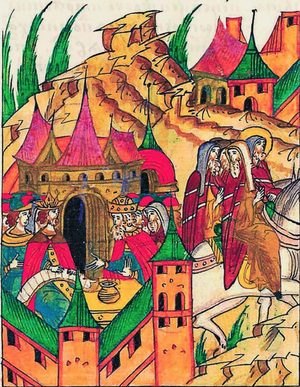

Mark Eugenikos, Metropolitan of Ephesus, refused to sign the decree of union with Rome at the Council of Ferrara-Florence in 1439. The Orthodox Church honors him as a saint and a "Pillar of Orthodoxy"; Catholic reference works treat him as the man who did most to defeat a union that a general council had declared. His arguments touch the Filioque, purgatory, the epiclesis and papal primacy.
| Lived | c. 1392, Constantinople, to 23 June 1444 (buried at the Mangana monastery, Constantinople); some older works give 1443 or 1445 |
|---|---|
| Church | Orthodox Church (Church of Constantinople); monk, then bishop |
| Role | Metropolitan of Ephesus (c. 1436); delegate of the patriarchs of Antioch and Alexandria at the Council of Ferrara-Florence (1438–39); leader of the opposition to the union |
| Influenced by | His teachers John Chortasmenos and Gemistos Plethon; the hesychast theology of Gregory Palamas |
| Influenced | George Scholarios (later Patriarch Gennadios II), who took up the leadership of the anti-unionists at Mark's death |
| Writings | Three discourses on purgatory; Syllogistic Chapters against the Latins; Syllogistic Chapters on the Divine Essence and Energy; a confession of faith; the encyclical letter "To all the Orthodox Christians throughout the earth and the islands" (c. 1440–41); hymns and liturgical services (collected in Migne, Patrologia Graeca 160) |
| Honored | 19 January in the Orthodox calendar; glorified as a saint by the Synod of Constantinople under Patriarch Seraphim I in 1734; named with Photios and Gregory Palamas one of the "Pillars of Orthodoxy" |
Life
Born Manuel in Constantinople about 1392, he was taught first in his father's school and then by John Chortasmenos and the philosopher Gemistos Plethon. In his twenty-sixth year he gave his property to the poor and became a monk on the island of Antigone, taking the name Mark; he later lived at the Mangana monastery in Constantinople. About 1436 Emperor John VIII made him Metropolitan of Ephesus, according to the Schaff-Herzog encyclopedia against his will, and he went to the council as representative of the patriarchs of Antioch and Alexandria.
The council, called by Pope Eugenius IV, opened at Ferrara in 1438 and moved to Florence in January 1439 because of plague at Ferrara and the pope's money troubles (Catholic Encyclopedia). About 700 Greeks attended, led by the emperor and Patriarch Joseph II (OCA). Purgatory came first; the Catholic Encyclopedia records Mark's sharp exchange with the Dominican John of Turrecremata, and that stage closed on 17 July 1438. From 8 October 1438 the Filioque was the only subject. Mark, who by the New Catholic Encyclopedia's count was the sole Greek speaker in all but three sessions, argued against the Filioque and accused the Latins of falsifying their own texts. With the emperor pressing for agreement (OCA), Bessarion of Nicaea, Isidore of Kiev and others backed the Latin formula, and on 3 June 1439 the Greeks agreed that the Spirit proceeds from the Father and the Son as from one principle and one cause. Patriarch Joseph died on 10 June. On 6 July 1439 the decree Laetentur caeli was proclaimed in the cathedral of Florence. According to the OCA, every Greek bishop signed it except Mark; Orthodox tradition adds that Pope Eugenius said on hearing this, "Then we have accomplished nothing."
Back in Constantinople, according to encyclopedia.com the emperor and the bishops offered him the patriarchal see, hoping to soften his opposition, and he refused. After Metrophanes was elected patriarch he set out for Mount Athos, was arrested, and was held for about two years on Lemnos (New Catholic Encyclopedia). He wrote his encyclical there, which Archimandrite Meletios Vadrachanis dates to 1440–41. Released, he led the opposition in the capital. In his last illness he asked his former pupil George Scholarios to carry on. He died on 23 June 1444.
What he taught
On the Filioque, Mark held that the Spirit proceeds from the Father alone as source, and that the Greek "through the Son" and the Latin "and the Son" do not state one faith; he held also that the word was added to the creed without warrant. Laetentur caeli answers that the Greeks and Latins each spoke of one meaning in different words, and that "through the Son" signifies the Son as cause (Greek) or principle (Latin) of the Spirit (Filioque). On purgatory Mark rejected a cleansing fire that satisfies a debt of punishment; he did not reject prayer for the dead (prayer for the dead without purgatory). The decree says only that souls of the penitent are "cleansed after death by cleansing pains" and helped by the prayers and masses of the living.
He held that the bread and wine become Christ's body and blood through the words of institution together with the epiclesis, the prayer that calls down the Holy Spirit, and the signs of the cross, according to Christiaan Kappes's study of the debate. The Latin spokesman Turrecremata held that Christ's words alone effect the change; the council's Decree for the Armenians (22 November 1439) names the Savior's words as the "form" of the sacrament (words of institution or epiclesis; the Lord's Supper). He objected to papal claims to universal jurisdiction (OrthodoxWiki); the decree defines that the pope "holds the primacy over the whole world" and is "the true vicar of Christ," with Constantinople second among the patriarchs. His theology was hesychast and he wrote on the divine essence and energies in the line of Gregory Palamas.
His encyclical calls the Latins heretics, rejects the union as false, and urges the faithful to "flee from them and from communion with them" and to "hold firmly to the traditions which you have received, both written and by word of mouth" (Pogodin's translation). He holds that no middle ground exists between contradictory doctrines and that those who accepted the union sought gain rather than truth.
What historians say
The first question is how much one man decided. The New Catholic Encyclopedia calls Mark "the most effective single influence that destroyed the union"; Orthodox writers reply that the union failed because the faithful and most of the bishops recognized it was not the apostolic faith. The Orthodox Church in America adds that nearly the whole Orthodox world rejected it: Isidore of Kiev, who tried to impose it at Moscow, was driven out; on 12 December 1452, with the Turks at the walls, it was proclaimed at Hagia Sophia and most of the people backed Scholarios; and a synod at Constantinople in 1483–84 declared the council's decrees void and its assembly never lawfully convened (Paschalidis, in Melloni, 2016).
The Jesuit historian Joseph Gill, whose The Council of Florence (1959) and Personalities of the Council of Florence (1964) are standard Catholic accounts, treats Mark's policy from the Roman Catholic side. The Greek Orthodox scholar Constantine Tsirpanlis wrote Mark Eugenicus and the Council of Florence: A Historical Re-evaluation of His Personality (1979). Kappes's The Epiclesis Debate at the Council of Florence (2019) studies Mark and Turrecremata and the doctrinal authority of each. The New Catholic Encyclopedia calls him an austere, learned monk whose polemics mixed serious theology with personal attacks; Orthodox writers answer that he defended the creed, which in his words "must be preserved inviolate" (OrthodoxWiki).
The circumstances are also disputed. The OCA says the emperor and the patriarch pressed the Greeks to accept; the Catholic Encyclopedia says the Greeks' declarations were only personal opinions and that the synod's approval was still needed. It adds that some Greek deputies, pressed by popular discontent, abandoned their position, and that the Muscovite princes refused to abide by the decrees. For the Catholic reading of the Greek mind and the Orthodox rejection, see the Greek Catholic churches, formed in later unions, and the Orthodox record. The year of Mark's death is given as 1443 in older reference works and as 1444 or 1445 in newer ones.
How the churches see Mark
- Catholic:
The Catholic Encyclopedia (1913) counts Florence as the seventeenth ecumenical council and states that all parties admit its ecumenical character. Its decree Laetentur caeli (6 July 1439) defines the Filioque, the "cleansing pains" of purgatory and the primacy of the Roman pontiff, and says the Filioque was "licitly and reasonably added to the creed." The sources cited here record no official Catholic judgment of Mark himself. The 1995 clarification of the Pontifical Council for Promoting Christian Unity says the Greek ekporeusis "signifies only the relationship of origin to the Father alone," while the Latin processio is "a more common term." The New Catholic Encyclopedia calls Mark an austere and learned monk and the single most effective influence against the union.
- Orthodox:
The Orthodox Church honors Mark as a saint; the Synod of Constantinople under Patriarch Seraphim I glorified him in 1734, and his day is 19 January. With Photios the Great and Gregory Palamas he is called a "Pillar of Orthodoxy." The Orthodox as a whole rejected the union of Florence, which the synod of 1483–84 declared void (Orthodox Church).
- Lutheran:
The Lutheran confessions make no statement about Mark. On his subject of purgatory, the Smalcald Articles (II.2.12) say that it "and every solemnity, rite, and commerce connected with it, is to be regarded as nothing but a specter of the devil."
- Reformed:
The Reformed churches have made no statement about Mark. The Westminster Confession of Faith (32.1) says of souls after death, "Besides these two places, for souls separated from their bodies, the Scripture acknowledgeth none," that is, heaven and hell, which excludes purgatory.
- Anglican:
The Church of England has made no statement about Mark. Article XXII of the Thirty-Nine Articles calls "the Romish Doctrine concerning Purgatory" "a fond thing vainly invented," and Article XXI holds that general councils "may err, and sometimes have erred." Article V confesses "The Holy Ghost, proceeding from the Father and the Son."
- Methodist:
Methodist bodies have made no statement about Mark. Article XIV of the Methodist Articles of Religion (1784), adapted by Wesley from the Anglican Articles, rejects "the Romish doctrine concerning purgatory."
- Baptist:
Baptist bodies have made no statement about Mark. The Second London Confession (1689), which many Baptists hold, confesses the "holy Spirit proceeding from the Father and the Son" (2.3) and says of souls after death, "besides these two places for Souls separated from their bodies, the Scripture acknowledgeth none" (31.1).
Sources
- OrthodoxWiki, "Mark of Ephesus" death date, burial, 1734 glorification, feast
- New Catholic Encyclopedia, "Eugenicus, Mark, Metropolitan of Ephesus" (encyclopedia.com) early life, monastic name, Lemnos, writings, characterization
- "Mark of Ephesus" (encyclopedia.com), citing Gill, Personalities of the Council of Florence (Oxford, 1964)
- Schaff-Herzog Encyclopedia, "Mark Eugenicus" metropolitan about 1436, 1734 synod
- Catholic Encyclopedia (1913), "Council of Florence" purgatory and Filioque sessions, 6 July 1439, Greek reaction
- Council of Florence, session 6 (<i>Laetentur caeli</i>) and session 8 (Decree for the Armenians), Tanner translation
- Orthodox Church in America, "The Great Schism in the Papacy and the Conciliar Movement"
- Mark of Ephesus, encyclical letter (translation of Archimandrite Amvrossy Pogodin, Jordanville, 1963)
- Archimandrite Meletios Vadrachanis on the encyclical (dated 1440–41, from Lemnos)
- Gill, Joseph, The Council of Florence (Cambridge University Press, 1959)
- Kappes, Christiaan, The Epiclesis Debate at the Council of Florence (2019)
- Paschalidis, "Concilium Constantinopolitanum 1484," in Melloni (ed.), The Great Councils of the Orthodox Churches (Brepols, 2016)
- Pontifical Council for Promoting Christian Unity, The Greek and Latin Traditions regarding the Procession of the Holy Spirit (1995)
- Smalcald Articles, Part II, Article 2 (Book of Concord)
- Westminster Confession of Faith, chapter 32
- Church of England, Articles of Religion (V, XXI, XXII)
- Methodist Articles of Religion (1784), Article XIV (Schaff, Creeds of Christendom, vol. 3)
- Second London Baptist Confession (1689), chapters 2 and 31
- Facial Chronicle, vol. 13, p. 312, Wikimedia Commons (public domain)