George Herbert 1593–1633
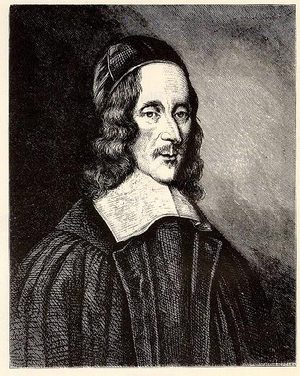

George Herbert was a Cambridge orator and member of Parliament who gave up the prospect of court preferment to become the rector of Bemerton, near Salisbury. His poems in The Temple (1633) and his manual A Priest to the Temple (1652) shaped how many Anglicans picture a parish priest and a life of prayer. The churches honor him unevenly, and critics still argue whether his theology was Calvinist or high-church.
| Lived | 3 April 1593, Montgomery (the Dictionary of Welsh Biography says London), to 1 March 1633, Bemerton, Wiltshire |
|---|---|
| Church | Church of England; priest from 1630 |
| Role | Public Orator of Cambridge (from 1620); Member of Parliament for Montgomery (1624–25); prebendary of Leighton Ecclesia (1626); rector of Fugglestone with Bemerton (1630–33) |
| Influenced by | The Bible and the Book of Common Prayer, whose services and Catechism his parson uses; his friend Nicholas Ferrar of Little Gidding |
| Influenced | The poets Henry Vaughan and Samuel Taylor Coleridge (Episcopal Lesser Feasts and Fasts); John Wesley's first hymnbook (1737) |
| Writings | The Temple (1633); A Priest to the Temple, or The Country Parson (printed 1652); hymns drawn from The Temple, among them "Teach me, my God and King" and "Let all the world in every corner sing" |
| Honored | 27 February in the Church of England (Lesser Festival) and the Episcopal Church |
Life
Herbert was the fifth son of Richard Herbert and Magdalen Newport. His father died in 1596, and his mother married Sir John Danvers in 1609. He entered Westminster School in 1605 and Trinity College, Cambridge, in 1609, became a fellow of the college, took his M.A. in 1616 and was elected Public Orator of the university in 1620. The post brought him into contact with the court of James I and Prince Charles. He sat for Montgomery in the Parliaments of 1624 and 1625 and gave up the oratorship in the later 1620s. In 1626 he became a prebendary of Leighton Ecclesia in Huntingdonshire, a few miles from Nicholas Ferrar's community at Little Gidding, and raised money to restore its church.
On 5 March 1629 he married Jane Danvers, a cousin of his stepfather, at Edington. In April 1630 he was instituted rector of Fugglestone with Bemerton, near Salisbury, and in September 1630 ordained priest. He died of consumption on 1 March 1633, just before his fortieth birthday, and was buried at Bemerton. On his deathbed he sent the manuscript of his poems to Ferrar, and The Temple was printed at Cambridge by Buck and Daniel in 1633; by 1680 it had gone through thirteen printings. A Priest to the Temple first appeared in Herbert's Remains (1652), and Izaak Walton's Life of Mr. George Herbert followed in 1670. The Episcopal Lesser Feasts and Fasts quotes Herbert's own description of his poems as "a picture of the many spiritual conflicts that have passed betwixt God and my soul."
What he taught
Herbert's teaching lies in a book of poems and a manual, not a treatise. The Temple runs from "The Church-Porch" through the long central sequence "The Church" to "The Church Militant." The central sequence ends with "Love (III)": "Love bade me welcome: yet my soul drew back." A Priest to the Temple has thirty-seven chapters. The first defines the pastor as "the Deputy of Christ for the reducing of Man to the Obedience of God" and says a priest "may do that which Christ did." It calls Scripture "the book of books" (ch. 4), to be read with prayer and by comparing passage with passage (Scripture alone), and lists "Commenters and Fathers" among the means of understanding it, "which the Parson by no means refuseth" (the Church Fathers). It also says "The Countrey Parson's Library is a holy life" (ch. 33).
The parson follows the Church of England's forms. On Sundays he reads "divine Service twice fully," preaches in the morning and catechizes in the afternoon (ch. 8), and prefers "the ordinary Church-Catechism, partly for obedience to Authority" (ch. 21). At baptism he wears a surplice, "willingly and cheerfully crosseth the child," thinks the ceremony "not onely innocent, but reverend," and urges all to recall their baptism often (ch. 22; baptism, infant baptism). Before Communion he catechizes his flock, and he holds that anyone who "can distinguish the Sacramentall from common bread" should receive, whatever his age. At the table he prays, "thou art not only the feast, but the way to it." The poem "The H. Communion" says: "Onely thy grace, which with these elements comes, / Knoweth the ready way" (the Lord's Supper).
What historians say
Details of his life are disputed. Most accounts place his birth at Montgomery; the Dictionary of Welsh Biography gives London. Sources date his resignation as Orator between 1626 and 1628, and they differ on when he was ordained priest: the Episcopal Lesser Feasts and Fasts says 1626, while a chronology on the Luminarium site gives September 1630. The Church Times, reviewing John Drury's Music at Midnight (2013), says the book corrects the familiar story that the aristocratic Herbert chose a tumbledown parish over one suited to his rank.
The larger debate is over his churchmanship. Barbara Lewalski's Protestant Poetics (1979) read the religious lyric of the period against Reformation theology, and Richard Strier's Love Known (1983) reads Herbert in that light. Christopher Hodgkins (1993) places him between "Old Conformist" and Puritan, near Calvin as popularized by William Perkins. Stanley Stewart, reviewing Hodgkins in the John Donne Journal (1994), grants that Herbert has Calvinist elements but argues that the Calvinist reading is pressed too far, noting that the poem "Lent" defends an observance Calvin disliked. Louis Martz's The Poetry of Meditation (1954) traced the method of Herbert's poems to meditative practice derived from the Exercises of Ignatius of Loyola, and Rosemond Tuve and R. V. Young have linked elements of his work to medieval and Catholic sources. The Oxford Bibliographies entry notes that Drury follows Walton's picture of a loyal churchman.
Herbert himself is not a subject of the Anglican record. That chapter covers the settlement of which his Church was a part, including the penal laws and the Great Ejection of 1662, which came after his death (the Great Ejection).
How the churches see Herbert
- Catholic:
The Catholic Church has made no statement about Herbert. Leo XIII's bull Apostolicae Curae (13 September 1896) declared that "ordinations carried out according to the Anglican rite have been, and are, absolutely null and utterly void"; it therefore treats his priesthood as lacking the sacrament of orders (apostolic succession). Critics have read his poems in connection with Catholic devotion: Louis Martz traced their method to Ignatian meditation, though others contest how far that reading holds.
- Orthodox:
The Orthodox Church has made no statement about Herbert.
- Lutheran:
The commemorations in the Concordia Publishing House list for Lutheran Service Book do not include Herbert. Individual Lutheran writers have read him closely. Grant Klembara of 1517.org reads "Love (III)" as a dialogue in which Christ pursues a guilty sinner and answers his hesitations with grace, and Anthony Dodgers of Gottesdienst reads the same poem as pointing to the Lord's Supper, where the guest is welcomed through Christ's forgiveness. Both present him as a Church of England rector.
- Reformed:
No Reformed church has made a statement about Herbert that this site has found. The Puritan Richard Baxter wrote in the preface to his Poetical Fragments (1681) that after the Scripture poems none were "so savoury to me as Mr. George Herbert's," because "Herbert speaks to God like one that really believeth a God." Some scholars place Herbert's theology near Calvin's (Lewalski; Hodgkins); others dispute this (Stewart), as the history above sets out.
- Anglican:
The Church of England's Common Worship calendar lists "George Herbert, Priest, Poet, 1633" as a Lesser Festival on 27 February, with its own collect and readings. The Episcopal Church's Lesser Feasts and Fasts (2018) keeps 27 February as "George Herbert, Priest and Poet, 1633" and notes that two of his poems are well-known hymns in The Hymnal 1982 ("Teach me, my God and King," no. 592; "Let all the world in every corner sing," nos. 402 and 403).
- Methodist:
John Wesley's first hymnbook, A Collection of Psalms and Hymns (Charleston: Timothy, 1737), contains six pieces from The Temple ("Praise," "Prayer," "Discipline," "The Sinner's Prayer," "Frailty" and "Longing"). The Duke edition notes that none of the 1737 pieces is original to Wesley and that he "altered or adapted nearly all" of them; some Herbert texts were altered again in Hymns and Sacred Poems (1739). The Methodist churches have made no formal statement about Herbert that this site has found.
- Baptist:
No Baptist body has made a statement about Herbert that this site has found. His parson baptizes infants and crosses them in the font (ch. 22), a practice Baptists do not follow: the Second London Confession (1677; reissued 1689), which many Baptists hold, says that "Those who do actually professe repentance towards God" and faith in Christ "are the only proper subjects of this ordinance" (29.2).
Sources
- Dictionary of Welsh Biography, "Herbert, George (1593–1633)" family, education, orator, Parliament, publications
- Lesser Feasts and Fasts 2018, February 27: George Herbert (Episcopal Church)
- Church of England, Lesser Festivals (Common Worship)
- Church of England, The Calendar (Common Worship)
- Herbert, A Priest to the Temple, or The Country Parson (1652 text), Project Canterbury
- Herbert, The Temple (1633; later edition scan, Internet Archive)
- George Herbert, Luminarium biography
- Luminarium, An Outline of Herbert's Life
- George Herbert's Life Before Bemerton, georgeherbert.org.uk
- Hymnary.org, George Herbert (hymn texts)
- Wesley, Collection of Psalms and Hymns (Charleston, 1737), Duke Center for Studies in the Wesleyan Tradition
- Baxter, Poetical Fragments (1681; 1821 reprint), preface
- Concordia Publishing House, Lutheran Service Book commemorations
- Klembara, "A Poet's Conversation with Love," 1517.org (2020)
- Dodgers, "George Herbert: A Poet for Life in God's House," Gottesdienst (2020)
- Stewart, "A Priest to the Geneva Temple" (review of Hodgkins), John Donne Journal 13 (1994)
- Oxford Bibliographies, "George Herbert"
- Church Times, review of Drury, Music at Midnight (29 November 2013)
- Review of Martz, The Poetry of Meditation, Cambridge Core
- Leo XIII, Apostolicae Curae (1896)
- Second London Baptist Confession (1689), ch. 29
- Robert White portrait, Wikimedia Commons (public domain)