Eucharistic Miracle of Lanciano 8th century
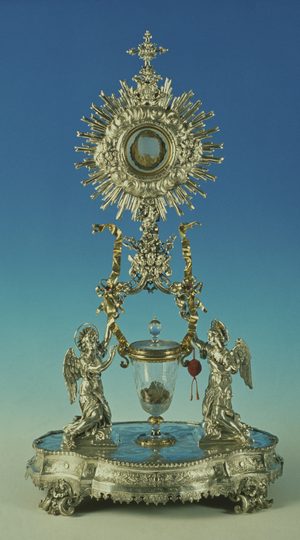

At Lanciano, in the Abruzzo region of Italy, the Church of San Francesco keeps a piece of tissue and five small lumps that Catholic tradition says are the flesh and blood into which a consecrated host and wine were changed in the eighth century, to answer a monk's doubt about the real presence. Tests in 1970–71 are cited by defenders and questioned by critics, and a report attributed to the World Health Organization has been called a fraud by the cardiologist who examined it.
| Date | 8th century, as tradition dates it (some writers say c. 730–750); no contemporary record survives |
|---|---|
| Place | Lanciano, Abruzzo, Italy; the relics are in the Church of San Francesco |
| Claimed by | Catholic Church; venerated by the Archdiocese of Lanciano-Ortona |
| Type | Eucharistic miracle: a consecrated host said to have become flesh and the wine blood, preserved as relics |
| Official status | Venerated for centuries; John Paul II called it a "famous miracle" (2004); no decree of the Holy See approving it is cited in the sources consulted |
| Investigations | Odoardo Linoli and Ruggero Bertelli, samples taken 18 November 1970, report 4 March 1971; an alleged 1973 WHO commission has no record |
What is claimed
According to the tradition, a monk of the Basilian (Greek-rite) order, who doubted that Christ is truly present in the Eucharist, was saying Mass in the church of Saints Legonziano and Domiziano at Lanciano (anciently Anxanum). At the consecration the host became living flesh and the wine became blood, which clotted (in the usual telling, into five lumps). The monk is said to have shown the people what had happened. The account names no one and gives no year; the eighth century is the traditional date, and the first witnesses to the story come long after it (see below).
What is kept today is a thin disc of dried tissue and five brownish lumps. They are shown in an ostensorium (a monstrance with a window) and a crystal chalice. John Paul II, in a letter of 4 October 2004, described Lanciano as "custodian of two Eucharistic miracles" and wrote of the Church of St Francis, "where the relics are preserved of the famous miracle that dates back to the eighth century."
History and devotion
No source from the eighth century survives. The Italian skeptics' committee CICAP (Silvano Fuso, 2006) notes that nothing older than 1574 is cited for an event said to be nearly eight hundred years earlier; that year Archbishop Gaspare Rodriguez of Lanciano visited the relics. Skeptics read the gap as a sign that the account grew up later; the sources consulted record no earlier document.
Devotion has continued, and John Paul II noted in 2004 that the miracles draw pilgrims "from Italy and abroad"; he recalled visiting the church while Archbishop of Kraków. In 1970 the archbishop of Lanciano authorized a scientific examination of the relics and its publication in a scientific journal (Eucharistic Miracles catalog, eucharisticmiracles.faith).
Investigations
The 1970–71 study
Odoardo Linoli, a pathologist of Arezzo, took samples on 18 November 1970 and presented his results on 4 March 1971; they appeared in Quaderni Sclavo di Diagnostica 7 (1971), pp. 661–674. Ruggero Bertelli of the University of Siena is reported to have confirmed the findings. As the study is summarized by its defenders, Linoli reported that the flesh is heart muscle (he later said he "had in my hand the endocardium"), that the blood is human and of group AB (the group reported for the Shroud of Turin), that its protein pattern resembled fresh serum, and that no preservatives were present. Defenders, including the cardiologist Franco Serafini, take this as showing that the relics are human heart tissue and blood; Serafini wrote that the presence of human blood is "qualitatively unquestionable."
Kelly Kearse and Frank Ligaj reviewed the study (Journal of Forensic Science and Research, 2024). They call it "commendable" as an early attempt at objective evaluation, but note that Linoli is the only named investigator, that the antisera were tested against only two other species, so "it cannot be declared that the results are specific for human blood," and that bacteria in old, contaminated material can also give an AB result. They state that their paper does not aim to show that all Eucharistic miracles are false. Fuso (CICAP) holds that whether bread and wine have changed into flesh and blood cannot be investigated scientifically.
The "WHO report"
From the 2000s, accounts of Lanciano (the Vatican exhibition catalogue The Eucharistic Miracles of the World, and a ZENIT interview with Linoli in May 2005) said that in 1973 the World Health Organization named a scientific commission that spent fifteen months and about 500 tests confirming Linoli, with a summary published in New York and Geneva in 1976. Kearse and Ligaj report that when they asked the WHO and the United Nations, neither had any record of such an investigation. Serafini found a document in the friars' safe at Lanciano that he called "a terrible fraud": most of its pages were about Egyptian mummies, with Lanciano pages attached at the front and back. The Catholic writer Stacy Trasancos likewise found no original source and reports that the friars agreed not to use it again. No source consulted says who produced it.
Official status
The Church's definitions concern the real presence, not Lanciano: the Council of Trent defined the real presence and transubstantiation (Session XIII, 1551) and did not define any miraculous sign. The Eucharistic Miracles catalog (eucharisticmiracles.faith) lists Lanciano as "historically recognized" on the basis of centuries of devotion and diocesan acts, with no formal decree of the Holy See. EWTN Vatican (2024) reports that Paul VI recognized the miracle as authentic in the Holy Year 1975; the sources consulted give no document for this. The Catechism says of private revelations recognized by the Church that they "do not belong to the deposit of faith" (CCC 67). Aquinas (Summa theologiae III, q. 76, a. 8) taught that when flesh or blood appears in the sacrament Christ's body remains truly there, and that the appearance is either in the eyes of those who see or a real miraculous change in the outward form.
Where each church stands
- Catholic:
The Catholic Church teaches that at the consecration the whole substance of bread and wine becomes Christ's body and blood (Trent, Session XIII, ch. 4 and canon 1; Catechism 1376). The diocese has venerated the relics for centuries, and John Paul II, who visited them as a cardinal, called the event a "famous miracle" in 2004. The Holy See has issued no definition about it: what the councils bind is the real presence, not Lanciano.
- Orthodox:
The Orthodox Church has made no statement about Lanciano; the tradition makes the monk a Basilian, a Greek-rite order. Orthodox teaching holds that the bread and wine are truly changed into Christ's body and blood in the Divine Liturgy (Liturgy of St. John Chrysostom, epiclesis). The Synod of Jerusalem (1672, decree 17) uses the Greek metousiosis, and Philaret's catechism (Q 339–340) says "changed, or transubstantiated," but both decline to explain the manner.
- Lutheran:
No Lutheran church body has made a statement about Lanciano. The Lutheran confessions teach that Christ's body and blood are truly present "under the bread and wine" (Augsburg Confession X; Small Catechism), and the Formula of Concord (Solid Declaration VII) rejects transubstantiation, so the presence does not depend on a visible change of the elements.
- Reformed:
The Reformed churches have made no statement on Lanciano. Their confessions deny that the bread becomes Christ's body (Heidelberg Catechism Q 78) and call transubstantiation "repugnant not to Scripture alone" (Westminster Confession 29.6). They also hold that God's former ways of revealing his will have ceased (Westminster Confession 1.1), and B. B. Warfield, in Counterfeit Miracles (1918), argued that miraculous gifts ended with the apostolic age and judged later miracle claims, including Roman Catholic ones, to be counterfeit.
- Anglican:
The Church of England and the wider Anglican Communion have no statement on Lanciano. Article XXVIII says transubstantiation "cannot be proved by holy Writ" and is "repugnant to the plain words of Scripture," while holding that the Body of Christ is given and received "only after an heavenly and spiritual manner"; Article XXII calls the Roman doctrine of the adoration of relics "a fond thing vainly invented." Anglicans range from Reformed and receptionist views to Anglo-Catholic belief in an objective real presence (Church Comparison, Transubstantiation).
- Methodist:
The Methodist churches have made no statement about Lanciano. Article XVIII of their Articles of Religion, inherited from the Anglican article, calls the bread "a partaking of the Body of Christ" and rejects transubstantiation as repugnant to Scripture. John Wesley, in the sermon "The More Excellent Way" (no. 89), held that miraculous gifts largely ceased after the early centuries because Christian love had "waxed cold," not because they were no longer needed.
- Baptist:
No Baptist body has made a statement on Lanciano. The Baptist Faith and Message (2000), art. VII, calls the Lord's Supper "a symbolic act of obedience" by which the church memorializes Christ's death, and Baptists do not hold that the bread and cup are changed.
Sources
- John Paul II, Letter to Archbishop Carlo Ghidelli of Lanciano-Ortona (4 October 2004) wording on the relics and the miracle
- O. Linoli, "Ricerche istologiche, immunologiche e biochimiche sulla carne e sul sangue del Miracolo Eucaristico di Lanciano," Quaderni Sclavo di Diagnostica 7 (1971), 661–674 the 1970–71 study
- Physician Tells of Eucharistic Miracle of Lanciano, ZENIT (May 2005), on EWTN Linoli interview; the WHO account
- K. Kearse and F. Ligaj, "Scientific Analysis of Eucharistic Miracles: Importance of a Standardization in Evaluation," Journal of Forensic Science and Research (2024) critique of the 1971 study; the WHO and UN reply
- Stacy Trasancos, "The Fake Lanciano WHO Report" Serafini's findings on the report
- Silvano Fuso, "Il Miracolo eucaristico di Lanciano," CICAP no source before 1574; scientific investigation
- Eucharistic Miracles catalog, Lanciano entry Church status; 1970 authorization
- EWTN Vatican, "The Eucharistic Miracle of Lanciano" (17 October 2024) report of recognition by Paul VI, 1975
- Thomas Aquinas, Summa theologiae III, q. 76, a. 8
- Catechism of the Catholic Church, 67 and 1373–1377
- B. B. Warfield, Counterfeit Miracles (1918)
- John Wesley, Sermon 89, "The More Excellent Way"
- Church Comparison, Transubstantiation (positions and confessional sources)