Johann Gerhard 1582–1637
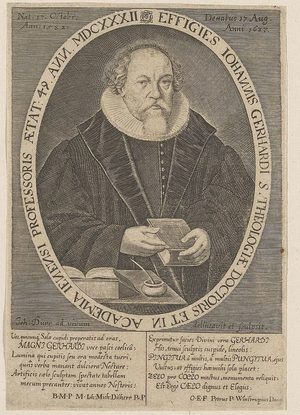

Johann Gerhard was a professor of theology at Jena whose Loci Theologici (1610–22) became the standard presentation of Lutheran doctrine in the age of Lutheran orthodoxy, and whose Sacred Meditations (1606) were translated into most European languages. His Confessio Catholica (1634–37) answered the Catholic controversialists of his day by arguing from Catholic authors that the Augsburg Confession is the teaching of the universal church.
| Lived | 17 October 1582, Quedlinburg, to 17 August 1637, Jena |
|---|---|
| Church | Lutheran; Duchy of Saxe-Coburg and the University of Jena |
| Role | Superintendent of Heldburg (1606); general superintendent at Coburg (1615); professor of theology at Jena (1616–37) |
| Influenced by | Johann Arndt, who comforted him in a boyhood illness; Martin Chemnitz, whose gospel harmony he completed |
| Influenced | Later Lutheran dogmatic theology; his Loci were reissued in 1657, 1762–89 and 1863–75 |
| Writings | Sacred Meditations (1606); Loci Theologici (9 vols., 1610–22); Manual of Comfort (1611); Harmony of the Gospels (1626–27); Confessio Catholica (4 parts, 1634–37) |
| Honored | 17 August, as "Theologian," in Lutheran Service Book (Lutheran Church–Missouri Synod) |
Life
Gerhard was born in Quedlinburg in 1582. In a serious illness in boyhood (his fifteenth year, according to most biographers) he vowed to study theology if he recovered, and the pastor Johann Arndt, later the author of True Christianity, comforted him. He studied at Wittenberg, where for two years he turned to medicine, then at Jena (master's degree, 1603) and Marburg (1604–05). He took his doctorate at Jena in November 1606 and in the same year became superintendent at Heldburg in the Duchy of Coburg at the call of Duke Johann Casimir. In 1615 he became general superintendent at Coburg, where he drew up a church order, and in April 1616 the duke released him at the renewed call of Jena, where he was professor of theology until his death. The New Schaff-Herzog Encyclopedia counts twenty-four calls from other universities that he declined.
The Thirty Years' War began two years after he reached Jena. The Lutheran writer Norman Greve reports that his estate was burned and that he was once taken captive, and that in 1611 he lost his wife, an infant child and his health; he later married again and had ten children. He died at Jena on 17 August 1637 with the words "Come, Lord, come," according to one biography, and was buried on 20 August.
What he taught
The Loci Theologici present the doctrine of the Lutheran confessions in the order of the articles of faith, beginning with Scripture because, in the New Schaff-Herzog's account, the canon underlies the other articles; according to the same entry he held that inspiration extends even to the Hebrew vowel points. Lutheran writers stress his view that theology is practical, shaping faith and life. He treated the person of Christ, the personal union of his two natures and the communication of their attributes at length (On the Person and Office of Christ in the English edition), the doctrine on which Lutherans and Reformed parted over Christ's presence in the Lord's Supper.
On predestination he taught, in Martin Diers's summary of the Loci, that God is "moved to elect some people to eternal life by no human merits"; that election is in Christ, whom faith receives; and that reprobation "is not absolute." He rejected the decree of the supralapsarian Calvinists, who place election and reprobation before the Fall and apart from Christ.
Against Rome he wrote the Confessio Catholica (four parts, 1634–37), built on Matthias Flacius's Catalogue of Witnesses to the Truth. Its first part is general, and the other three take the disputed articles, the papacy among them, in the order of Robert Bellarmine's Controversies. It aims to show from writers approved by the Roman Church that the Augsburg Confession is both evangelical and catholic, using "catholic" in its sense of universal, not Roman. His Sacred Meditations (fifty-one short devotions) were reprinted many times and translated into most European languages, Greek among them.
What historians say
The Neue Deutsche Biographie credits Gerhard with opening the period of High Orthodoxy (c. 1615/30–80) and notes that in the Loci he moved from the older loci method toward an analytic method shaped by neo-Aristotelian metaphysics. The New Schaff-Herzog entry calls the work the consummation of Lutheran dogmatics begun by Melanchthon, and the Heidelberg scholar Johann Anselm Steiger titled his 1997 study of Gerhard's theology and piety as that of "the church father of Lutheran orthodoxy" (Kirchenvater der lutherischen Orthodoxie). Robert Preus's The Theology of Post-Reformation Lutheranism (Concordia, 1970–72) examines orthodox Lutheran theology from 1577 to 1713, Gerhard among its principal figures, including its methodology of theology and its relation of natural and revealed religion. Steiger's studies also set Gerhard's dogmatics beside his devotional writing, letters and sermons, and trace how he and other Lutheran theologians received medieval mysticism.
The same New Schaff-Herzog entry names a weakness: his defense of Scripture's authority through inspiration of the vowel points, which it says the Jesuits exploited. A Lutheran Classical essay records the title "the third after which there is no fourth" given to him after Luther and Chemnitz, and the Concordia Publishing House commemoration reading ranks him likewise after those two. The Neue Deutsche Biographie notes that he avoided sharp attacks on the Helmstedt theologian Georg Calixt. His Loci were not fully translated into English until Concordia Publishing House began its edition in 2006 with On the Nature of Theology and Scripture (translated by Richard J. Dinda), a series announced as seventeen volumes; its publisher, Paul McCain, called the work "the most comprehensive presentation of Lutheran doctrine available." Election in view of faith (intuitu fidei) is a continuing debate: Diers writes that later teachers of that doctrine appeal to Gerhard, while he argues the wording was misused. For the wider record of Lutheran polemic and war, see the Lutheran record.
How the churches see Gerhard
- Catholic:
The Catholic Church has issued no act or document naming Gerhard. His Confessio Catholica answers the Catholic positions of Bellarmine and the Council of Trent, whose canons remain Catholic teaching. Catholic reference works carry entries on him: the bibliography of the encyclopedia.com entry on Gerhard lists articles in the Lexikon für Theologie und Kirche and by Yves Congar in Catholicisme. The Catholic apologist Dave Armstrong began a series of replies to the Confessio Catholica in 2025, noting that Gerhard dealt directly with Catholic sources such as Bellarmine.
- Orthodox:
The Orthodox Church has made no statement about Gerhard. Its formal answers to Lutheran teaching come from either side of his lifetime: Patriarch Jeremias II of Constantinople answered the Tübingen Lutherans in letters ending in 1581, and the Synod of Jerusalem (1672) taught that man is justified "not by faith alone, but also by works" (see Luther).
- Lutheran:
Lutherans honor Gerhard as a teacher and not as a confessional authority; the Formula of Concord says the writings of "no man should be regarded as equal" to Scripture. Lutheran Service Book, the hymnal of the Lutheran Church–Missouri Synod, commemorates "Johann Gerhard, Theologian" on 17 August, the day of his death, and Concordia Publishing House ranks him among the most influential Lutheran theologians after Luther and Martin Chemnitz. Lutheran writers disagree about whether his language on faith in election departs from the Formula of Concord.
- Reformed:
The Reformed churches have made no statement about Gerhard, but their confessions teach the doctrines on which Lutheran theologians such as Gerhard opposed them. The Heidelberg Catechism (questions 47–48) says that with respect to his human nature Christ is no longer on earth, while with respect to "his Godhead, majesty, grace and spirit" he is at no time absent from us. The Canons of Dort (1618–19) teach that election is not founded on foreseen faith, and that faith and the other saving gifts are its "fruits and effects."
- Anglican:
The Church of England and the Anglican Communion have made no statement about Gerhard. His Sacred Meditations circulated in English: Ralph Winterton, a fellow of King's College, Cambridge, translated them in 1627, and the translation was reprinted, including a sixth edition in 1640.
- Methodist:
The Methodist churches have made no statement about Gerhard. In July 2006 the World Methodist Council affirmed the 1999 Joint Declaration on the Doctrine of Justification, which concerns Lutheran teaching on justification, a subject Gerhard treated in the Loci.
- Baptist:
No Baptist body has made a statement about Gerhard. The Second London Confession (1677) reserves baptism for those who "actually profess" repentance and faith (29.2), whereas the Lutheran confessions he defended, beginning with the Augsburg Confession (art. IX), retain infant baptism.
Sources
- Encyclopedia.com, "Gerhard, Johann" dates; Loci 1610-22; Confessio catholica 1634-37; bibliography
- Neue Deutsche Biographie, "Gerhard, Johann" offices and dates; High Orthodoxy; method; Calixt
- New Schaff-Herzog Encyclopedia of Religious Knowledge, "Gerhard, Johann" career; Loci; Confessio catholica; assessment; vowel points
- Greve, "Johann Gerhard," Lutheran Spokesman (2015, updated 2022)
- Studium Journal, "Johann Gerhard 1583-1637" timeline; death and burial; family
- The Reader's Biographical Encyclopaedia (1922), "Gerhard, Johann" (from Britannica) Arndt; Jena
- Lutheran Classical, essay on Johann Gerhard
- Lutheran Service Book commemorations (Concordia Publishing House)
- Concordia Publishing House, reading for the Commemoration of Johann Gerhard, Theologian
- LCMS Reporter, "CPH produces first volume of Gerhard work" (2 November 2006)
- Diers, "Election Intuitu Fidei in Gerhard's Theological Commonplaces" (LutheranTheology.com) cites Gerhard, Theological Commonplaces, Commonplace X (CPH, 2013)
- Steiger, Johann Gerhard (1582-1637): Studien zu Theologie und Frömmigkeit des Kirchenvaters der lutherischen Orthodoxie (Frommann-Holzboog, 1997)
- Preus, The Theology of Post-Reformation Lutheranism, 2 vols. (Concordia, 1970-72)
- Gerhard, Sacred Meditations, trans. Ralph Winterton (Cambridge, 1627), ESTC S118757
- Armstrong, "Reply to Lutheran Johann Gerhard (1582-1637) #1" (Patheos, 2025)
- Heidelberg Catechism, questions 47-48 (CCEL)
- Canons of Dort, First Head of Doctrine (CCEL)
- Solid Declaration of the Formula of Concord (Book of Concord)
- Orthodox Church in America, "Patriarch Jeremias II and the Dialogue with the Lutherans"
- Schaff, Creeds of Christendom, on the Synod of Jerusalem (1672)
- Methodist Church in Britain, Joint Declaration on the Doctrine of Justification (2017 update)
- Second London Baptist Confession (1689), ch. 29
- Portrait by Johann Dürr, Rijksmuseum, Wikimedia Commons (CC0)