The Tyndale Bible 1526–1534
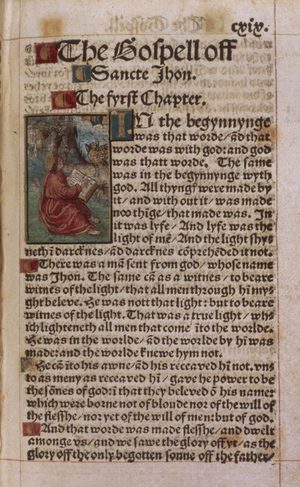

The Tyndale Bible is the English New Testament that William Tyndale had printed abroad in 1526 and revised in 1534, with the Pentateuch (1530) and Jonah (1531) that he translated from the Hebrew. It was the first complete printed English New Testament, and the first made from the Greek. English bishops burned it, and later English Bibles took over much of its wording. Each tradition has a view of the book, from Thomas More's attack on its word choices to a day on the calendar.
| Published | New Testament: Worms, 1526 (after an interrupted printing at Cologne, 1525); revised, Antwerp, November 1534. Pentateuch: Marburg, 1530. Jonah: 1531 |
|---|---|
| Translators | William Tyndale, with William Roye at Cologne (1525) |
| Language | Early Modern English |
| Old Testament from | Hebrew (the Pentateuch and Jonah only); Joshua to 2 Chronicles left in manuscript |
| New Testament from | Erasmus's Greek text (editions of 1516, 1519 and 1522), with Erasmus's Latin, the Vulgate and Luther's German New Testament (1522) consulted |
| Books | All 27 books of the New Testament, in Luther's order; the Pentateuch; Jonah. The 1534 New Testament adds 42 readings from the Old Testament, eight of them from the Apocrypha |
| Approach | Close to the Greek and Hebrew but in plain spoken English: accuracy to the originals and sense in English, in David Daniell's account |
| Copyright | Public domain |
| Used by | No church uses it as its official Bible; its wording lives on in the Great Bible (1539) and the King James Version (1611) |
How it was made
Tyndale and William Roye arranged in 1525 for Peter Quentel of Cologne to print a quarto New Testament with marginal notes. Johannes Cochlaeus, an opponent of the Reformation, learned of it from the printers and alerted the authorities; the press was stopped at Matthew 22, and Tyndale left up the Rhine. One fragment of the Cologne printing survives, in the British Library: the prologue and Matthew 1 to 22. At Worms, Peter Schoeffer printed a smaller octavo without notes in 1526, which was easier to smuggle. Estimates of the run range from about 3,000 to, in Daniell's view, as many as 6,000; copies are said to have come to England hidden in bales of cloth.
His Pentateuch followed in 1530, printed by Hans Luft at Marburg, with a prologue to each book and marginal notes, some sharp against the pope. In November 1534 Tyndale published a revised New Testament at Antwerp, prompted partly by a pirated edition of the 1526 text. It made over 4,000 changes, about half to match the Greek more closely (Brigham Young University Religious Studies Center). Its prologues came mostly from Luther, except that to Hebrews, where Tyndale disputes Luther's doubts about its apostolic authority; its notes were rarely polemical. The 1535 edition is taken to be his final text. After his arrest and death in 1536 (his life), printing of his work went on without him.
How it translates
Tyndale's New Testament was made from the Greek, where earlier English Bibles had followed the Latin Vulgate. He used Erasmus's Greek text and also consulted Erasmus's Latin, the Vulgate and Luther's German, but with independent judgment: bible-researcher.com calls him "by no means a slavish copier of Luther." His Old Testament work was from the Hebrew. Daniell credits him with "a wonderful ear for placing stresses," and says that he aimed to be exact to the originals and to make sense in English.
Some of his choices became the subject of controversy. He used "congregation" for ekklesia where the Vulgate tradition said "church," "senior" (later "elder") for presbyteros where it said "priest," "love" for agape where it said "charity," "favour" for "grace," "repentance" for "penance," and "acknowledging" for "confession" (Tyndale Society). He first used atonement at Romans 5:11 in 1526; the Pentateuch gave English Passover for pesah in Exodus 12 and scapegoat in Leviticus 16.
More read the changes as serving Luther: "church" became "congregation" because Luther denied that the Catholic Church was Christ's, "priest" became "senior" because Luther held that holy orders count for nothing, and "charity" was softened to "love" to lessen respect for good works (Lakowski's summary). Tyndale answered in 1531 on linguistic grounds, citing the Greek and Erasmus. More than half of the notes in the Cologne quarto were taken from Luther's German Bible.
Reception and revisions
Bishop Cuthbert Tunstall of London denounced the New Testament, and copies were burned at St Paul's Cross in October 1526. More attacked it at length in his Dialogue Concerning Heresies (1529) and Confutation (1532–33), calling it, in Lakowski's summary, "as counterfeit as a false copper groat" and proposing that it be called Tyndale's or Luther's Testament. A widely repeated account says that Tunstall later paid the merchant Augustine Packington at Antwerp for copies, and that the money helped Tyndale pay for the 1534 revision. Francis Fry listed twenty-one editions of the New Testament printed between Tyndale's death and 1550 (Catholic Encyclopedia).
John Rogers, Tyndale's friend and fellow-worker, published Matthew's Bible in 1537 under the name Thomas Matthew; the Catholic Encyclopedia calls it a compilation of Tyndale's and Coverdale's renderings. The Great Bible (1539) was based on Matthew's Bible, and the Geneva New Testament revised Tyndale's latest text. How much of the King James Version is his depends on the counting: Daniell cites 83 percent of its New Testament, and Nielson and Skousen found nearly 84 percent of its New Testament and about 76 percent of the Old Testament parts Tyndale translated unchanged.
Three copies of the 1526 Worms edition are known: the British Library's (complete except for the title page, bought in 1994 from Bristol Baptist College), one at St Paul's Cathedral with 71 leaves missing, and one found at Stuttgart in November 1996.
Where each church stands on the Tyndale's Bible
- Catholic:
The first reaction came from the English bishops: Tunstall denounced the book and burned copies in 1526, and More's Dialogue argued that "though the Church is a congregation, not every congregation is the Church" (Lakowski's summary). The 1582 preface to the Catholic Rheims New Testament (see the Douay-Rheims) says that it was made for "the more speedy abolishing" of "false and impious translations put forth by sundry sectes"; it does not name Tyndale. Vatican II, in Dei Verbum 22, asks that easy access to Scripture be provided for all the faithful and encourages translations. No Catholic statement about Tyndale's Bible by name is known.
- Orthodox:
No official Orthodox statement about Tyndale's Bible is known. The Synod of Jerusalem (1672) says every Orthodox Christian may hear Scripture but forbids the unprepared to read some parts, especially of the Old Testament. Orthodox Christians cite Cyril and Methodius, who translated Scripture into Slavonic in 863, as precedent for Scripture in the people's language (the Bible and the people).
- Lutheran:
The Missouri Synod's Reformation site (Deaconess Betsy Karkan, 2017) calls Tyndale "the Father of the English Bible" and says that Luther's work had "a significant influence" on his, as in his use of Luther's order of the New Testament books. Evangelical Lutheran Worship (ELCA, 2006) is listed as marking 6 October as a commemoration of Tyndale, "translator, martyr, 1536"; the Lutheran Service Book (Missouri Synod) has no such entry. Lutherans cite Article XXIV of the Augsburg Confession for worship in a language the people understand.
- Reformed:
No Reformed confession names Tyndale's Bible. The Westminster Confession (1.8) says that Scripture is to be "translated into the vulgar language of every nation," and its Larger Catechism (Q 156) binds all to read it. The Geneva Bible of 1560 revised Tyndale's latest New Testament (Catholic Encyclopedia; see the Geneva Bible). Ligonier Ministries (Todd Rester, 2026) says that Tyndale agreed with Luther on faith and justification.
- Anglican:
The Church of England keeps 6 October as a Lesser Festival of William Tyndale, translator of the Scriptures and martyr; the Episcopal Church's calendar lists him the same day. Henry VIII's injunction of 1538 ordered an English Bible placed in every parish, and the Great Bible of 1539 rested on Tyndale's work through Matthew's Bible. The King James Version (1611) took over much of his New Testament wording (Daniell). Article XXIV of the Thirty-Nine Articles requires worship in a tongue the people understand.
- Methodist:
The United Methodist Church has no official Bible translation (UMC), and no Methodist statement about Tyndale's Bible is known. Wesley wrote his Explanatory Notes upon the New Testament (1754) for "plain unlettered men," on the King James Version, whose New Testament Daniell traced largely to Tyndale. United Methodist News (Heather Hahn, 2017) lists Tyndale among reformers who "likewise wanted to produce a Bible in his people's language."
- Baptist:
Baptists do not claim Tyndale as a founder. Bristol Baptist College owned a 1526 Worms New Testament, left to it by the Baptist minister Andrew Gifford (d. 1784), until its sale to the British Library in 1994. Baptist Press calls Tyndale the first to translate the Bible into English from the original languages. The Baptist Faith and Message (2000, art. VI) defines a church as "an autonomous local congregation of baptized believers"; "congregation" is also the word Tyndale used for ekklesia, though no Baptist statement is known to connect the two.
Sources
- Bible-researcher.com, "Tyndale's Version" Cologne and Worms editions, source texts, 1530, 1534, 1535
- Library of Congress Information Bulletin, "'Let There Be Light'" (July 1997) Cologne raid, print-run estimate, surviving copies, Stuttgart find
- Brigham Young University Religious Studies Center, "Revisiting William Tyndale, Father of the English Bible" Cochlaeus, Worms octavo, 1530, 1534 changes, Tunstall and Packington, KJV share
- Brigham Young University Religious Studies Center, "William Tyndale and the Language of At-one-ment" atonement, Passover, scapegoat
- Daniell, Gloucester Cathedral Lecture, 2003 (Tyndale Society Journal 27) Greek source, 83% of the KJV New Testament, Tyndale's ear
- Tyndale Society, "Sir Thomas More's Dialogue" (Anne O'Donnell, S.N.D.) list of Tyndale's substitutions; his reply on linguistic grounds
- More, Dialogue Concerning Heresies, Book III, summarized by R. I. Lakowski More's objections to Tyndale's word choices
- Catholic Encyclopedia (1913), "Versions of the Bible" Worms, 1534, later editions, Matthew's Bible, Great Bible, Geneva
- West, "The Bristol 1526 Tyndale Testament," Tyndale Society Gifford, condition, sale to the British Library, 1994
- Preface of the 1582 Douay-Rheims (quoting the Rheims New Testament preface), drbo.org
- Vatican II, Dei Verbum 22
- Synod of Jerusalem (Confession of Dositheus) 1672, Question 1
- Karkan, "The Cradle of Christ in Every Home: Reformation Translations of the Bible," lutheranreformation.org (2017)
- Lutheran Service Book commemorations (Concordia Publishing House)
- Calendar of Saints (Lutheran), listing the Evangelical Lutheran Worship (ELCA, 2006) entry for 6 October not checked against the book itself
- Augsburg Confession, Article XXIV (Book of Concord)
- Westminster Confession of Faith 1.8 (OPC)
- Westminster Larger Catechism Q 156 (OPC)
- Rester, "Who Was William Tyndale?" Ligonier Ministries (2026)
- Church of England, Lesser Festivals (Common Worship)
- Episcopal Church, Calendar of the Church Year
- Church of England, Articles of Religion
- UMC, "Does the UMC have an official Bible translation?"
- Hahn, "6 ways the Reformation affects our world," United Methodist News (2017)
- Wesley, Preface to Explanatory Notes upon the New Testament (1754)
- Baptist Faith and Message 2000, Article VI
- Baptist Press, "Labor Day: 4 who exemplify laboring for the Lord"
- Wikimedia Commons, "Tyndale Bible - Gospel of John.jpg" (British Library reproduction, public domain)