John Calvin 1509–1564
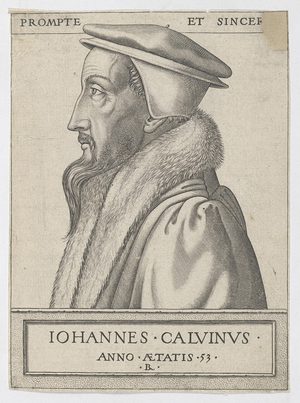

John Calvin was a French lawyer-turned-theologian whose Institutes of the Christian Religion and twenty-eight years of work in Geneva gave the Reformed churches their teaching and their pattern of church order. He taught unconditional election, and he took part in the Geneva trial that ended in the burning of Michael Servetus; both have made him a figure every tradition has had to answer.
| Lived | 10 July 1509, Noyon, to 27 May 1564, Geneva |
|---|---|
| Church | Reformed; pastor of Geneva (1536–38, 1541–64) |
| Role | Preacher, lecturer and author of the Genevan church order (1541); with Theodore Beza, founder of the Genevan Academy (1559) |
| Influenced by | Martin Bucer at Strasbourg; Augustine, whom the Institutes cite throughout on grace |
| Influenced | Theodore Beza, rector of the Academy; the Reformed and Presbyterian churches |
| Writings | Institutes (1536; final Latin 1559; French 1560); Commentary on Romans (1540); Consensus Tigurinus (1549); Defence of the Sound and Orthodox Doctrine on the Sacraments (1555) |
| Honored | Reformed churches do not canonize; the 500th anniversary of his birth was marked in 2009 |
Life
Calvin was born at Noyon in Picardy. He went to Paris in 1523, studied law at Orléans and Bourges, and published a commentary on Seneca's De Clementia in 1532. About 1533, when he fled Paris with Nicolas Cop, he underwent what he came to call a sudden conversion. In March 1536 his Institutes of the Christian Religion first appeared, and that summer Guillaume Farel persuaded him to remain in Geneva. He and Farel were banished in April 1538; Calvin served the French-speaking congregation at Strasbourg, where he came under the influence of Martin Bucer, published his Commentary on Romans (1540) and in August 1540 married Idelette de Bure, the widow of an Anabaptist (she died in 1549). Geneva called him back, and he returned on 13 September 1541.
The Ecclesiastical Ordinances, drafted by five pastors and six councillors under his direction, were ratified by a general assembly of citizens on 2 January 1542. They set four offices: pastors, teachers, elders and deacons. Twelve elders, chosen from the city's councils, met every Thursday with the ministers as the Consistory, which by the text had "no civil jurisdiction" and only "the spiritual sword of the word of God." The Supper was to be held four times a year. In 1549 Calvin signed the Consensus Tigurinus with Zurich on the Supper. In 1553 Michael Servetus was burned at Geneva (The burning of Michael Servetus). In 1559 Calvin became a citizen of Geneva, issued the final Latin Institutes and helped found the Academy (5 June), later the University of Geneva. He died on 27 May 1564.
What he taught
The Institutes open: "Our wisdom ... consists almost entirely of two parts: the knowledge of God and of ourselves" (1.1.1, Beveridge translation). Scripture is the means of that knowledge: it gathers impressions of God "which, till then, lay confused in our minds," as spectacles help weak eyes to read (1.6.1; Scripture alone). On predestination he wrote: "By predestination we mean the eternal decree of God, by which he determined with himself whatever he wished to happen with regard to every man" (3.21.5), and of reprobation, "The decree, I admit, is dreadful" (3.23.7). The elect are chosen in Christ, and believers are joined to Christ by the Spirit.
In the Lord's Supper he rejected both transubstantiation and a bare sign: Christ's body is in heaven, yet "the Spirit truly unites things separated by space" (4.17.10), so that believers truly receive Christ. He wished it celebrated "very frequently, at least once a-week" (4.17.43), though Geneva held it four times a year. The Church, he wrote, exists wherever "the word of God [is] sincerely preached and heard" and the sacraments are administered as Christ instituted (4.1.9); discipline by pastors and elders, exercised through the Consistory, was a mark of its order.
What historians say
Bruce Gordon's Calvin (Yale, 2009), which one reviewer called the most thorough of the anniversary biographies, stays close to Calvin's texts and to the politics he had to negotiate in Geneva. Richard Muller argues, against the thesis summed up as "Calvin against the Calvinists," that Reformed orthodoxy continued Calvin's teaching on predestination, placing it within God's providence without making it a deductive first principle; critics of continuity hold that later writers made it speculative. Philip Schaff, himself Reformed, wrote that Geneva's discipline rested on the false assumption that all citizens were church members, and that its zeal sometimes "transgressed the dictates of wisdom and moderation"; he also quoted the Catholic historian Kampschulte that no European religious society gave its clergy so "dignified, prominent, and influential" a position. Defenders note that the Consistory could only excommunicate and that fines and prison belonged to the Council; critics reply that the Consistory sent offenders to the Council, and that Calvin inspired both.
The Servetus case is the chief charge against him. Calvin supplied the articles of accusation, the council tried Servetus from 14 August to 25 October 1553, and he was burned on 27 October. Britannica says Calvin "pressed for execution, although by beheading rather than by fire." Sebastian Castellio replied that "To kill a man is not to defend a doctrine, it is to kill a man." Reformed writers answer that Catholic authorities at Lyons had already condemned Servetus, that Geneva's councils passed the sentence, and that every Reformed church consulted approved. In 1903 Geneva Protestants raised an expiatory monument at Champel (Servetus; the Reformed record).
How the churches see Calvin
- Catholic:
The Council of Trent, in its sixth session (13 January 1547), did not name Calvin, but its canons bear on his teaching: canon 17 condemns saying that justifying grace comes "only" to those predestined to life, others being predestined to evil; canon 6 that God works evil works "not permissively only, but properly"; canons 15 and 16 that a justified person must believe with certainty that he is among the predestinate or will persevere. Francis de Sales led the Catholic mission in the Calvinist Chablais from 1594; the Catholic Encyclopedia says that many returned to the Church in 1597–98. He was canonized in 1665 and named a Doctor of the Church in 1877. The Catholic theologian Alexandre Ganoczy (2009) finds convergence between Calvin's ecclesiology and Vatican II, on the Spirit and on shared ministry, and names papal authority and succession as the divisions that remain. AFP reported that L'Osservatore Romano in July 2009 wrote that "Calvin is a Christian."
- Orthodox:
A Confession of Faith in Calvinist terms was published in 1629 under the name of Patriarch Cyril Lucaris of Constantinople. The Synod of Jerusalem (1672) rejected it as a forgery and, in the Confession of Dositheus, condemned what Philip Schaff's summary calls "the Calvinistic doctrine of unconditional predestination." The Confession holds that God chose some for glory and rejected others "since He foreknew" how each would use free will, and that man is justified "not by faith alone, but also by works" (decrees 3, 13, 14).
- Lutheran:
Joachim Westphal of Hamburg attacked the Consensus Tigurinus, Calvin and Peter Martyr in 1552 (Farrago), and Calvin answered in 1555, 1556 and 1557. The Formula of Concord (1577), Solid Declaration VII, rejects "Sacramentarians" and names Beza, but not Calvin; it teaches that unworthy communicants receive Christ's body orally (¶¶60, 66). Article XI teaches election "only over the children of God" and that Christ's blood "is the propitiation for the sins of the whole world" (¶¶5, 28). The Leuenberg Agreement (1973) declares the Lutheran–Reformed condemnations inapplicable to the churches that sign it.
- Reformed:
The Reformed churches confess their teaching in later documents, not in Calvin's own books: the Westminster Confession (1646, ch. 3) teaches election "without any foresight of faith, or good works," and the Canons of Dort (1619) rejected election based on foreseen faith. Many Reformed writers hold, with Richard Muller, that these continue Calvin's teaching. On Geneva's failings Schaff, himself Reformed, wrote that its zeal sometimes went beyond "wisdom and moderation." In 1903 Geneva Protestants called themselves "respectful and grateful sons of Calvin" while "condemning an error which was that of his age." The Reformed churches do not canonize.
- Anglican:
Article XVII of the Thirty-Nine Articles calls predestination to life "the everlasting purpose of God" to deliver from damnation those he has chosen in Christ, finds consideration of it full of "sweet, pleasant, and unspeakable comfort" to the godly, and does not mention reprobation. Anglicans have read it in both Calvinist and Arminian ways; the Calvinist Lambeth Articles (1595) never became official. The Articles do not name Calvin.
- Methodist:
In his sermon Free Grace (1740) Wesley argued that unconditional election amounts to "God's decree of reprobation" (§8), that if it is true "then is all preaching vain" (§10), and that it "directly tends to destroy that holiness" which is the end of all God's ordinances (§11). Methodists teach prevenient grace, free for all, and the Methodist Articles of Religion (1784) contain no article on predestination.
- Baptist:
Baptists divided in the seventeenth century. English General Baptists (Smyth, Helwys, 1609–12) were Arminian; Particular Baptists were Calvinist. The Second London Confession (1677; reissued 1689), ch. 3, says some are "predestinated, or fore-ordained to Eternal Life," others being "left to act in their sin to their just condemnation," a milder wording than Westminster's. The Southern Baptist Baptist Faith and Message (2000), art. V, says election "is consistent with the free agency of man." Most Southern Baptists hold a modified view; some hold Calvin's.
Sources
- Christian History Institute, "Christian History Timeline: John Calvin" dates of the life
- Calvin, Institutes of the Christian Religion (Beveridge translation, CCEL) 1.1.1; 1.6.1; 3.21.5; 3.23.7; 4.1.9; 4.17.10; 4.17.43
- Calvin's Genevan Ecclesiastical Ordinances, 1541 (University of Oregon)
- Schaff, History of the Christian Church, vol. 8, on the Genevan Ordinances adoption on 2 January 1542; revision of 1561
- Schaff, History of the Christian Church, vol. 8, §132 "Calvin and Westphal"
- Gordon, Calvin (Yale University Press, 2009), reviewed by D. G. Hart, Modern Reformation
- Kim, "Did Calvin's Successors Distort his Doctrine of Predestination?" (Westminster Seminary California, 2006), on Muller
- The burning of Michael Servetus, in the Reformed record (this site; sources there)
- Council of Trent, Session 6 (Waterworth translation)
- Catholic Encyclopedia, "St. Francis de Sales"
- Ganoczy, "The Many Faces of Calvin" (Modern Reformation, 11 June 2009)
- AFP report on L'Osservatore Romano, July 2009 (reposted)
- Schaff, Creeds of Christendom, on the Synod of Jerusalem (1672)
- Formula of Concord, Solid Declaration VII (Book of Concord)
- Formula of Concord, Solid Declaration XI (Book of Concord)
- Leuenberg Agreement (1973)
- Church of England, Articles of Religion
- Wesley, Sermon 128, Free Grace (Wesley Center Online)
- Second London Baptist Confession (1689), ch. 3
- Baptist Faith and Message (2000), art. V
- Boyvin portrait, Wikimedia Commons (public domain)