Miracles in the Protestant revivals 1540–1918
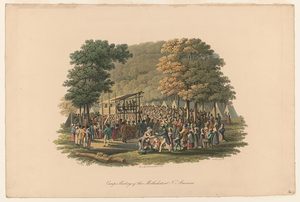

The Protestant churches have no shrines, no canonizations and no medical bureaus, yet their histories contain reports of healings, answered prayers and bodily "exercises" at revivals. Whether such things still occur is argued within several of the seven traditions (spiritual gifts, tongues and healing), and the Pentecostal movement, which is not one of the seven, grew out of this soil.
| Date | 1540 to 1918: Weimar (1540), Wesley's Journal (1746) and Letter to Middleton (1749), Cane Ridge (August 1801), the Holiness healing movement (1860s to 1880s), the Welsh Revival (1904–1905), Warfield's Counterfeit Miracles (1918) |
|---|---|
| Place | Weimar; England; Cane Ridge, Bourbon County, Kentucky; Boston and Old Orchard, Maine; south Wales |
| Claimed by | Individual witnesses (Luther, Wesley, Barton W. Stone, Charles Cullis, A. B. Simpson, Evan Roberts), not by any church body |
| Type | Healing in answer to prayer, revival "exercises" (falling, jerking), mass conversion |
| Official status | No procedure exists in the seven traditions for declaring a miracle; the question is treated as teaching on whether the gifts continue |
| Investigations | Collver (2012) on Weimar; Middleton's Free Inquiry (1749); Warfield (1918); critics of Cane Ridge and of the Welsh Revival |
What is claimed
Weimar, 1540. In June 1540 Philip Melanchthon, on his way to a colloquy in Alsace, was brought near death by a fever at Weimar. Luther was summoned. According to the later account of the elector's physician Matthaeus Ratzeberger, Luther prayed at the window, took Melanchthon's hand and told him he would not die; Melanchthon revived. Luther's letter to his wife of 2 July 1540 says Melanchthon "truly had been dead." Justus Jonas (7 July) and Melanchthon (8 July) credited prayer. (Luther, Melanchthon.)
Wesley, 1746. John Wesley's Journal for 17 March 1746 says that after leaving Newcastle his horse was so lame that he feared he must stop; he asked, "Cannot God heal either man or beast, by any means, or without any?" and his weariness, his headache and the horse's lameness ended at once. He set down the facts and left readers to account for them as they saw fit. Other entries report recoveries after prayer.
Cane Ridge, 1801. From about 6 to 12 August 1801 a Presbyterian communion meeting hosted by Barton W. Stone at Cane Ridge, near Paris, Kentucky, drew, by various estimates, 10,000 to 30,000 people. Stone's own account lists the "falling exercise," the jerks, dancing, barking, laughing, running and singing exercises; he admitted some excesses but called the revival "a genuine work of God."
The healing movement. Charles Cullis (1833–1892), a Boston Episcopal physician who had opened homes for consumptives from 1864, held healing services from 1881–82 and conventions across New England. A. B. Simpson (1843–1919) reported his own healing of a heart condition at one of Cullis's meetings and founded the Christian Alliance and the Evangelical Missionary Alliance (1887), which merged as the Christian and Missionary Alliance (1897); its "Fourfold Gospel" names Christ as Savior, Sanctifier, Healer and Coming King.
Wales, 1904–1905. Evan Roberts (1878–1951), a former miner, held a mission at Loughor arranged before the end of October 1904, and a revival spread through Wales until January 1906. Its supporters, such as the historian J. Edwin Orr, count about 100,000 converts. Orr's lecture on the revival describes no healings and says Roberts's experience was "not a glossolalic experience, so far as I know."
History and the argument
Calvin answered the Catholic demand for Protestant miracles by saying that Protestants preach no new gospel and so need no new signs (Institutes, Preface to Francis I; the argument in full). The Westminster Confession (1.1) says God's former ways of revealing his will are "now ceased." B. B. Warfield's Counterfeit Miracles (Scribner's, 1918) made the classic case in six chapters, covering patristic and Roman Catholic miracles, the Irvingites, faith-healing and mind-cure: the miraculous gifts were "part of the credentials of the Apostles" and ended with them. Wesley held that the gifts faded when love "waxed cold," and the Holiness and Pentecostal movements teach that they continue. Pentecostals date their beginning to Azusa Street (1906) and teach that healing is "an integral part of the gospel" (Assemblies of God, 1914). Among evangelical Calvinists, Wayne Grudem argues that the gifts continue, while John MacArthur's Strange Fire conference (2013) argued the opposite.
Investigations
Weimar. Albert Collver (Concordia Theological Quarterly, 2012) notes that Luther's exact words are known only from Ratzeberger, whom Theodor Kolde judged "valueless as history," and that Timothy Wengert calls the friendship of Luther and Melanchthon a "pious myth." Francis Pieper called the prayer fides heroica, an exception to the rule of praying for God's will; Collver reads it as a plea for God's will, like Luther's prayer for his dying daughter Magdalene in 1542.
Wesley and Middleton. The Cambridge clergyman Conyers Middleton argued in his Free Inquiry into the Miraculous Powers (1749) that miracles did not continue after the apostles. Wesley's Letter to Dr Conyers Middleton (4 January 1749) summarizes the case as making "all the primitive Fathers" "fools or knaves," defends Justin and Irenaeus as witnesses, and, citing Chrysostom, ascribes the later decline of miracles to a decline of faith and holiness in the Church.
Cane Ridge. John Rogers, who added reflections to Stone's Biography (1847), traced the "extravagances" to doctrinal error; the historian Earl West writes that strict Calvinists feared for predestination. Stone and several colleagues separated from the Synod of Kentucky and formed the Springfield Presbytery, which dissolved itself by its Last Will and Testament of 28 June 1804.
Wales. J. Vyrnwy Morgan, a critic (1909), counted 80,000 joining the four main Nonconformist denominations and said only 75 percent remained after five years; Orr answered with higher Church of England figures and a loss of about 2 percent. The Western Mail printed articles attacking Roberts's character, which Orr called unsupported. In 1906 Roberts, exhausted, was cared for by Jessie Penn-Lewis and withdrew from public view (Dictionary of Welsh Biography).
Official status
The seven traditions have no procedure for declaring a miracle, and none of the confessions and statements cited below names these episodes. Each speaks instead to whether the gifts continue. Belief in any of the episodes is not required of members of any of the seven.
Where each church stands
- Catholic:
The Catholic Church has said nothing about these Protestant episodes. It teaches that charisms, "whether extraordinary or simple and humble," are given to build up the Church (CCC 799), that some receive a charism of healing (CCC 1508), and that "discernment of charisms is always necessary" by the pastors (CCC 800). Catholic apologists have argued that the signs promised in Mark 16:17 mark the true Church; Calvin's reply is above.
- Orthodox:
The Orthodox Church has made no statement on Luther's prayer, Cane Ridge or the Welsh Revival. It seeks healing above all in holy unction and honors miracles in its saints; the OCA's The Orthodox Faith says tongues are "not ruled out" as a gift but not among the more important ones (see spiritual gifts).
- Lutheran:
Lutheran writers cite Luther's prayer for Melanchthon (Pieper's fides heroica; Collver's reading as prayer for God's will). The LCMS's Commission on Theology and Church Relations (1972) does not deny gifts "according to His good pleasure," but rejects tongues as the "indispensable sign" of the Spirit and holds that "the Word and the sacraments are the only means of grace."
- Reformed:
The Westminster Confession (1.1) says God's former ways of revealing his will are "now ceased," and Warfield's Counterfeit Miracles is the standard cessationist case. The Christian Reformed Church (1973) holds that Christ gives "whatever gifts he judges necessary" in every age, warns against excesses in tongues and faith healing, and rejects a second-blessing Spirit baptism. Grudem and other Reformed continuationists hold that the gifts continue.
- Anglican:
Wesley was a priest of the Church of England and Middleton a Cambridge clergyman; the Church of England has made no statement on their dispute. Its 1662 Visitation of the Sick prays for restoration "if it shall be thy good pleasure"; Common Worship provides laying on of hands or anointing, alongside medicine; A Time to Heal (2000) reviewed the healing ministry.
- Methodist:
Wesley held that miracles continued in the Church and declined because love "waxed cold" (Sermon 89, 1787), and his Journal records healings after prayer. He also dispensed medicines to the poor; the Journal for 6 June 1747 counts "fifty-one thoroughly cured." The United Methodist guidelines on the charismatic movement (1976) call it "closely related to the holiness movement and to the Wesleyan tradition."
- Baptist:
Baptist ministers took part in the Kentucky revival, and Baptists are divided on the gifts. The Second London Confession (1689, 1.1) says God's former ways of revealing himself are "now ceased"; the Baptist Faith and Message (2000) is silent on tongues and healing; the Southern Baptist International Mission Board barred candidates with a private prayer language from 2005 until 2015.
Sources
- Albert B. Collver III, "Fides Heroica? Luther's Prayer for Melanchthon's Recovery from Illness in 1540," Concordia Theological Quarterly 76 (2012): 117–127
- Ronald K. Rittgers, Christian History 142 (2022), on Luther's prayers for the sick
- Wesley, Journal, 17 March 1746 (CCEL edition)
- Wesley, Journal, 26 November 1746 to 20 July 1749 (entry of 6 June 1747)
- Wesley, Letter to Dr Conyers Middleton, 4 January 1749 (Wesley Corpus)
- Disciples of Christ Historical Society, "Cane Ridge Meetinghouse" (Encyclopedia of the Stone-Campbell Movement, 2004)
- Ohio Valley Restoration Research, "Spiritual Revival," citing Stone's Biography (1847) and Earl West
- Christian History Institute, "Divine disruption" (Cullis; Simpson)
- Nancy Hardesty, Faith Cure: Divine Healing in the Holiness and Pentecostal Movements (Hendrickson, 2003), on Cullis's homes
- Alliance World Fellowship, on Simpson's Fourfold Gospel
- Dictionary of Welsh Biography, "Roberts, Evan John (1878–1951)"
- J. Edwin Orr, "The Impact and Legacy of the Welsh Revival 1904–1905"
- B. B. Warfield, Counterfeit Miracles (Scribner's, 1918)
- Calvin, Institutes of the Christian Religion (1559), Preface to Francis I, sec. 3
- Catechism of the Catholic Church 799–801, 1508
- LCMS CTCR, The Charismatic Movement and Lutheran Theology (1972); CRCNA, Pentecostalism (Synod 1973); UMC Book of Resolutions, charismatic guidelines (1976); Wesley, Sermon 89; Second London Confession 1.1; Baptist Faith and Message (2000), with full citations in the spiritual gifts chapter on this site
- Challies, interview with Wayne Grudem on continuationism