Photios the Great c. 810–c. 893
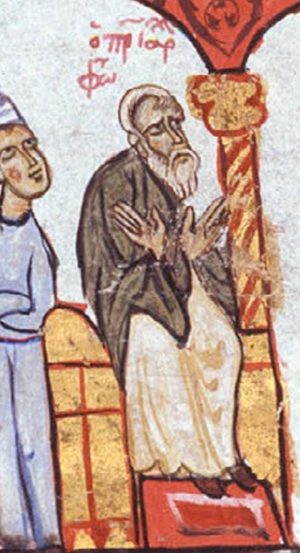

Photios was a layman, scholar and imperial secretary who became patriarch of Constantinople in a disputed succession and held the see twice (858–867 and 877–886). His quarrel with Pope Nicholas I over jurisdiction, Bulgaria and the Filioque is the first great conflict between Rome and Constantinople. The Orthodox Church honors him as a saint; the Catholic Encyclopedia (1913) called him the "chief author of the great schism"; and the work of Francis Dvornik (1948) led many historians to revise that picture.
| Lived | c. 810 (some sources say c. 820), Constantinople, to a date after 886, in monastic exile; sources give 891, c. 893 or 897 (6 February in the Orthodox calendar) |
|---|---|
| Church | Church of Constantinople; an Orthodox saint |
| Role | First secretary of state under Michael III; patriarch of Constantinople, installed at Christmas 857 (reckoned from 858) until autumn 867, and again from 877 or 878 until 886 |
| Influenced by | His relative Patriarch Tarasius (784–806), under whom the Second Council of Nicaea (787) restored the icons; the Greek Fathers |
| Influenced | Cyril and Methodius (Orthodox accounts name him as Cyril's teacher); the Orthodox case against the Filioque; Byzantine scholarship |
| Writings | Bibliotheca or Myriobiblon (notices of about 280 works); Amphilochia (answers on Scripture and theology); Encyclical to the Eastern Patriarchs (867); Nomocanon (883); Mystagogy of the Holy Spirit; letters and homilies |
| Honored | Orthodox: 6 February, "Saint Photios the Great" |
Life
Photios was born into a leading Constantinopolitan family. His parents were exiled by an iconoclast council during his childhood (Britannica). In the regency of Theodora (842–856) he taught, and a circle gathered around him for readings in Greek prose; his Bibliotheca, a digest of more than 270 works, grew from notes on these readings and was begun on a diplomatic mission to the Muslim world. He became first secretary of state while still a layman.
In 857 Bardas, who ruled for the young emperor Michael III, removed Patriarch Ignatius. The Catholic Encyclopedia says Ignatius was deposed on 23 November 857 after refusing communion to Bardas; Dvornik argues that Ignatius resigned and that Photios was canonically elected. Both the Catholic Encyclopedia and Dvornik report that Photios passed through the clerical ranks in six days and was consecrated at Christmas by Gregory Asbestas, a bishop whom Ignatius had excommunicated. A synod in 861, attended by papal legates, confirmed Photios. Nicholas I then took the side of Ignatius: a Roman synod in 863 declared Ignatius the lawful patriarch and Photios excommunicate unless he withdrew. Britannica adds that Photios refused to return to Rome dioceses transferred to Constantinople during the iconoclast period.
Boris, ruler of Bulgaria, was baptized in the 860s (the Orthodox Church in America says by Photios himself) and later asked Rome for bishops. In 867 Photios wrote an encyclical to the Eastern patriarchs listing Latin errors: Saturday fasting, the start of Lent, the marriage of priests, confirmation by priests, and the Filioque. A council at Constantinople that year condemned Nicholas I. In the autumn Michael III was murdered and Basil I took the throne. Photios was deposed and Ignatius restored; the Orthodox Church in America says Photios had refused Basil communion.
The council of 869–870 (Constantinople IV), with legates of Pope Adrian II, condemned Photios. After Ignatius died on 23 October 877, Photios returned as patriarch, and Pope John VIII recognized him. The council of 879–880 at Hagia Sophia, with papal legates, dealt with his status, the creed and Bulgaria. In 886 the emperor Leo VI, whom Britannica calls his pupil, removed him: the Catholic Encyclopedia reports a charge of conspiracy, Britannica that he resigned. He died in monastic exile.
What he taught
Photios's best-known doctrine is that the Holy Spirit proceeds from the Father alone. In the Mystagogy of the Holy Spirit, completed in or after his second patriarchate, he argues chiefly from John 15:26 ("the Spirit of truth, which proceedeth from the Father," KJV). The Orthodox read his central point as the monarchy of the Father: the Father alone is the source of the Son and the Spirit (The Filioque). The Mystagogy is, in Schaff's words, "a discussion of the procession alone." Orthodox writers add that a creed set by an ecumenical council may not be altered by one church (what makes a council ecumenical). Britannica adds that his information on the Latin side was inadequate in 867 and that he showed more understanding in the later Mystagogy.
On jurisdiction, the Orthodox Church in America says the council of 879–880 acknowledged "the independence and equality of both thrones and both churches" and abolished Latin customs in the Bulgarian church. The Catholic Encyclopedia says that in 861 Photios and the emperor appealed to the pope's authority and later denied it.
The Amphilochia, which Schaff counts as 324 discussions, mostly on biblical exegesis, and the Nomocanon (883) show him as exegete and canon lawyer. His part in the division between East and West was one strand of a wide career.
Photios is also credited with the mission to the Slavs. According to the Orthodox Church in America, Cyril, the future "Enlightener of the Slavs," was among his pupils; the Encyclopedia of Religion says Photios chose Cyril and Methodius to preach to the Slavs. John Paul II's Slavorum Apostoli (1985) says they probably reached Greater Moravia by 863. Britannica adds that Bulgaria, where the 879–880 settlement left the Greek bishops in place, became a center from which Slavonic worship spread to other lands.
What historians say
Dvornik opens The Photian Schism: History and Legend (Cambridge, 1948) by noting that Photios is a "saint and hero" in the East and, in the West, a symbol of pride and schism. He described a Byzantine church divided between "Extremists" and "Moderates," and titled his chapter on the second schism "A Historical Mystification." He held that John VIII approved the acts of 879–880, and that the claim that John again condemned Photios rests on an "Anti-Photian Collection" compiled in the reign of Formosus (891–896) by one of Photios's bitterest enemies. Britannica, summarizing the result, writes that the settlement was once thought won by fraud and repudiated by John VIII but was most likely accepted, and that Photios was in communion with John VIII, Adrian III (884–885) and Stephen V (886).
The older Catholic account differs. The Catholic Encyclopedia holds that Ignatius "was the rightful patriarch as long as he lived," that Photios was an intruder, and that John VIII excommunicated him again after 880. It charges him with dishonesty, including a fictitious pedigree and a forged prophecy for the emperor, and "lies" against the Latins, while also writing that "there is no shadow of suspicion against his private life" and that he was "one of the greatest men of the Middle Ages." Orthodox accounts, such as that of the Orthodox Church in America, present Photios as chosen by the bishops for his piety and learning, and say that the legates of 869 demanded a libellus recognizing the pope's primacy that the Eastern bishops refused to sign.
The councils are also disputed. Catholics count 869–870 as the Eighth Ecumenical Council. The Catholic Encyclopedia notes that the Orthodox count 879–880 as the Eighth, and the Orthodox Church in America says "many" do. Accounts differ on what 879–880 said about the Filioque: the Orthodox Church in America says the council rejected it, while Britannica says the legates agreed to condemn Western additions to the creed without explicit mention of the word.
How the churches see Photios
- Catholic:
The Catholic Church counts the council of 869–870 (Constantinople IV), which deposed Photios, as the Eighth Ecumenical Council. The Catholic Encyclopedia (1913) calls him "chief author of the great schism." In Slavorum Apostoli (1985), however, John Paul II records that in 881 or 882 Methodius received recognition from "the Patriarch Photius, who at that time was in full communion with Rome." Dvornik, a Catholic priest and Byzantine historian, argued that the second schism was a legend. The 1995 Vatican clarification on the Filioque affirms the Father as the sole source within the Trinity (the Filioque).
- Orthodox:
The Orthodox Church honors Photios as a saint on 6 February; the Orthodox Church in America calls him "the Church's far-gleaming beacon" and says he is venerated as a "pillar and foundation of the Church." Many count the council of 879–880 as the Eighth Ecumenical Council and do not receive that of 869–870. The Orthodox case against the Filioque draws on the Mystagogy (Filioque; the Ecumenical Patriarchate).
- Lutheran:
The Lutheran confessions do not mention Photios. The Smalcald Articles (I.2) confess that "the Holy Ghost proceeds from Father and Son," and Lutheran churches generally keep the Western creed. When the Tübingen theologians sent the Augsburg Confession to Patriarch Jeremias II (1576–1581), he rejected the Filioque among other points.
- Reformed:
No Reformed confession names Photios. The Westminster Confession (2.3) says the Holy Ghost is "eternally proceeding from the Father and the Son," and it holds that councils "may err; and many have erred" (31.3), so that creeds are "a help" and not the rule of faith.
- Anglican:
The Church of England's Article V says the Holy Ghost is "proceeding from the Father and the Son." Since the Moscow Agreed Statement (1976), however, Anglican-Orthodox dialogue has recommended that the clause be left out of the creed, and the Lambeth Conference of 1978 (Resolution 35.3) "requests that all member Churches of the Anglican Communion should consider omitting the Filioque from the Nicene Creed."
- Methodist:
The Methodist Articles of Religion (IV) confess the Holy Ghost "proceeding from the Father and the Son." In 1990 the Faith and Order Committee of the Methodist Church in Britain recommended that its Conference express willingness to restore the Nicene Creed to its form of 381 if the Western churches agreed. No Methodist statement about Photios himself was found.
- Baptist:
The Second London Confession (2.3) confesses "the Holy Spirit proceeding from the Father and the Son." Baptists, who bind themselves to no creed, have made no statement about Photios that was found.
Sources
- Catholic Encyclopedia (1913), "Photius of Constantinople"
- Catholic Encyclopedia (1913), "Photian Synods of Constantinople (861, 867, 879)"
- Britannica, "Saint Photius" (George Every)
- Orthodox Church in America, Lives of the Saints, 6 February: Saint Photius, Patriarch of Constantinople
- Dvornik, The Photian Schism: History and Legend (Cambridge University Press, 1948), online edition
- Schaff, History of the Christian Church, vol. 4, section 145, "Photius, Patriarch of Constantinople"
- "Photios," Encyclopedia of Religion (Gale, 1987), via Encyclopedia.com
- John Paul II, Slavorum Apostoli (2 June 1985)
- Smalcald Articles, Part I (Book of Concord)
- Orthodox Church in America, "Patriarch Jeremias II and the Dialogue with the Lutherans" the Tübingen exchange
- Westminster Confession of Faith, 2.3 and 31.3
- Church of England, Articles of Religion, Article V
- Koinonia 66 (Anglican-Orthodox dialogue), quoting Lambeth Conference 1978, Resolution 35.3
- Methodist Articles of Religion, Article IV (United Methodist Church)
- Methodist Church in Britain, Faith and Order Committee, "The Filioque Clause" (1990)
- Second London Baptist Confession (1689), chapter 2
- Patriarch Photius, Madrid Skylitzes, Wikimedia Commons (public domain)