Huldrych Zwingli 1484–1531
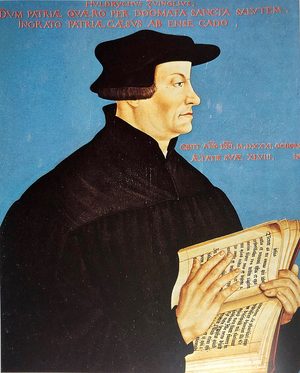

Huldrych (Ulrich) Zwingli was the priest of the Grossmünster in Zurich who led the first Swiss Reformation, a movement that grew beside Luther's and apart from it. He taught that Scripture alone governs the church, removed images and the Mass from Zurich's churches, and read the Lord's Supper as a memorial in which the bread and wine signify Christ's body and blood. He is counted a founder of the Reformed tradition, though its confessions follow Calvin on the Supper, and his death with the Zurich army at Kappel (1531) still divides assessments of him.
| Lived | 1 January 1484, Wildhaus (Toggenburg), to 11 October 1531, Kappel |
|---|---|
| Church | Catholic priest ordained by the bishop of Constance; from 1519 the reformer of the Zurich church |
| Role | Pastor at Glarus (1506–1516) and Einsiedeln (1516–1518); priest and preacher at the Grossmünster, Zurich, from 1 January 1519 |
| Influenced by | Erasmus; a letter of the Dutch lawyer Cornelius Hoen on the Supper |
| Influenced | Heinrich Bullinger, his successor; Johannes Oecolampadius; the Reformed churches of Switzerland |
| Writings | Sixty-seven Articles (1523); Commentary on True and False Religion (1525); On Baptism (1525); A Clear Instruction on the Lord's Supper (1526); Fidei ratio (1530); Exposition of the Christian Faith (1531) |
| Honored | Remembered in the Reformed churches as the reformer of Zurich; the other churches' views are set out below |
Life
Zwingli was born on 1 January 1484 at Wildhaus, studied at Basel, Bern and Vienna, and took his master's degree at Basel in 1506. He was pastor at Glarus from 1506 to 1516 and went three times to Italy as chaplain to the Glarus troops; the defeat at Marignano (1515) turned him against Swiss soldiers serving foreign princes. He drew a papal pension of fifty guilders until he refused it in 1520. In 1516 he moved to Einsiedeln, and in 1518 preached there against the sale of indulgences. The canons of the Grossmünster elected him on 11 December 1518, and he preached his first sermon in Zurich on 1 January 1519, beginning an exposition of Matthew. When plague struck Zurich in 1519 and killed more than a third of its people, he fell ill himself and recovered.
In Lent 1522 friends of Zwingli, among them the printer Christoph Froschauer, ate meat in defiance of the fast; Zwingli defended them in his first printed tract, and the council forbade breaking the fast (9 April). He married the widow Anna Reinhart secretly in 1522 and publicly in April 1524. At the First Zurich Disputation (29 January 1523, about 600 present) the council directed him to go on preaching. After the Second Disputation (October 1523) the churches were cleared of images (completed 20 June 1524), and the Mass gave way to a communion service in Holy Week 1525. Leo Jud did most of the work on the Zurich Bible (1530). Zwingli attended the Bern disputation of January 1528, after which Bern adopted the Reformation. He met Luther at Marburg in early October 1529: the two signed fourteen articles in agreement and a fifteenth, on the Supper, that recorded their disagreement.
In 1531 the Protestant cities blockaded the Catholic Forest Cantons, which marched against Zurich on 9 October, and Zwingli went with Zurich's army. In the battle at Kappel on 11 October more than 500 Zurich men died, and Zwingli, aged 47, was killed. According to Philip Schaff, he was struck down without having used his weapons; his body was quartered for treason and burned for heresy, the sentence being carried out by the sheriff of Lucerne. Heinrich Bullinger succeeded him in Zurich.
What he taught
Zwingli took Scripture alone as the rule for preaching and worship. The first of the Sixty-seven Articles of 1523 says that those who hold the gospel invalid "without the confirmation of the Church" err; the second makes its sum that Christ "has with his innocence released us from death and reconciled God." He held Christ the only mediator (art. 19), that God alone remits sin (art. 50) and that Scripture "knows nothing about purgatory" (art. 57), and he taught that the Mass "is not a sacrifice" but a remembrance of Christ's single sacrifice (art. 18; the Mass as sacrifice). The articles add that rulers are owed obedience only when they do not command what is contrary to God, and may be deposed if they transgress Christ's laws (arts. 38, 42). From these principles came the removal of images and the plain worship of the Zurich churches, which Bruce Gordon sums up as a "piety of the mind."
On the Lord's Supper he taught that "is" in "This is my body" means "signifies": the bread and wine are signs of Christ's body, which is in heaven, and the believer feeds on Christ by faith. He took the reading from a letter of Cornelius Hoen, cited Exodus 12:11 ("it is the Lord's passover") as a parallel, and argued from John 6:63, "the flesh profiteth nothing" (the symbolic view). Gordon notes that for him the sacraments were symbols of God's work, not channels of grace. Zurich held the Supper four times a year. In On Baptism (1525) he conceded that he had once thought it better to wait until children came to years of discretion, then defended infant baptism as the sign of the covenant, as circumcision had been.
What historians say
Gordon, in Zwingli: God's Armed Prophet (2019), calls him the originator of what became the Reformed tradition and a skilled political strategist who worked through Zurich's magistrates, and describes him as "a casualty of his own willingness to use force to religious ends." He argues that Zwingli has been underrated because later generations put Luther and Calvin forward, and credits Erasmus more than Luther with turning him to Scripture. Reviewers of Gordon point readers who want the development of his theology to W. P. Stephens, The Theology of Zwingli (1986). Lutheran writers argue that Calvin and Zwingli agree on the decisive point, that Christ's body is in heaven and received only by faith; Reformed writers answer that Calvin rejected a "vain or empty sign" (Zwingli or Calvin on the Supper).
Two episodes are criticized. When Felix Manz and the Swiss Brethren rejected infant baptism, Zurich's council made repeated rebaptism a capital offense (March 1526), and Manz was drowned in the Limmat on 5 January 1527; Gordon says Zwingli consented to their exile or execution. The Swiss Reformed church apologized in 1983, and in 2004 and 2025 Reformed and Anabaptist leaders met at the Grossmünster in repentance and reconciliation (the Anabaptists in Zurich; the Reformed record). Second, Zwingli backed the use of force against the Catholic cantons; Schaff calls him a "martyr of religious liberty and of the independence of Switzerland" but judges that he was wrong to take the sword.
How the churches see Zwingli
- Catholic:
The Council of Trent (Session 13, 11 October 1551, canon 1) anathematized anyone who denies that Christ is contained in the Eucharist "truly, really, and substantially," or says he is there "only therein as in a sign, or in figure, or virtue." The 1912 Catholic Encyclopedia calls Zwingli the most "liberal" of the Reformers and judges him "inclined rather towards disturbance than towards peace." The army that defeated Zurich at Kappel was that of the Catholic Forest Cantons.
- Orthodox:
The Orthodox Church has made no statement about Zwingli. The Confession of Dositheus (Synod of Jerusalem, 1672) teaches that Christ's body and blood are "truly and really" present in the Eucharist (decree 17) and that the sacraments are "not empty signs" (decree 15), which marks the distance between Orthodox teaching and a memorial view of the Supper.
- Lutheran:
At Marburg (October 1529) Luther wrote "This is my body" in chalk on the table and would not accept Zwingli's reading. Schaff reports that when Zwingli offered the hand of brotherhood Luther declined, saying "Yours is a different spirit from ours." The Solid Declaration of the Formula of Concord, art. VII, rejects the "Sacramentarians," without naming Zwingli, and denies that bread and wine are "nothing more than tokens." The Leuenberg Agreement (1973) declares the old Lutheran and Reformed condemnations inapplicable to the churches that sign it.
- Reformed:
Gordon calls Zwingli the originator of the Reformed tradition, but the confessions follow Calvin on the Supper. The Consensus Tigurinus (1549), agreed between Calvin and the Zurich ministers, says believers are not to look to "the bare signs" (art. 10) and rejects any local presence of Christ in the bread (art. 21). The Second Helvetic Confession (Bullinger, 1566) says Christ is present "not corporeally, but spiritually," and that the believer "not only receives the sign" but enjoys the thing itself (ch. 21); it condemns the Anabaptists on infant baptism (ch. 20). Calvin wrote that the Supper is not "a vain or empty sign" (Institutes 4.17.10). The Swiss Reformed church apologized in 1983 for the Zurich persecution of the Anabaptists.
- Anglican:
Article XXVIII of the Thirty-Nine Articles, which rejects transubstantiation, says the Supper is "not only a sign" of Christians' love but "a Sacrament of our Redemption by Christ's death," and that the bread broken is "a partaking of the Body of Christ" received "after an heavenly and spiritual manner," with faith as the means. It does not name Zwingli.
- Methodist:
Article XVIII of the Methodist Articles of Religion likewise makes faith "the mean whereby the body of Christ is received." This Holy Mystery (2004), adopted by the General Conference, affirms Christ's "real, personal, living presence." Wesley, in The Duty of Constant Communion (1788 text), calls the bread and wine "the outward signs of the inward grace, the body and blood of Christ" and says the grace there given confirms to believers the pardon of their sins. The Methodist churches have made no statement about Zwingli himself.
- Baptist:
The Baptist Faith and Message (2000, art. VII) calls the Supper "a symbolic act of obedience" in which members "memorialize the death of the Redeemer," and baptism the "immersion of a believer," without naming Zwingli. The Second London Confession (1689, ch. 30.7) holds that worthy receivers "spiritually receive and feed upon Christ crucified," a higher view than bare memorialism. Most Baptists hold the memorial view that Zwingli set out. The Zurich Anabaptists whom his council punished baptized only professing believers, as Baptist churches do (Anabaptist churches).
Sources
- Schaff, History of the Christian Church, vol. 8, ch. 2 (Zwingli's early life)
- Schaff, History of the Christian Church, vol. 8, ch. 3 (Zurich reform, 1519-1525)
- Schaff, History of the Christian Church, vol. 8, ch. 5 (Kappel and Zwingli's death)
- Schaff, History of the Christian Church, vol. 7, "The Marburg Conference"
- Catholic Encyclopedia (1912), "Ulrich Zwingli"
- Historisches Lexikon der Schweiz, "Huldrych Zwingli" (C. Moser) Einsiedeln 1516; First Disputation; Kappel
- Sixty-seven Articles (1523), Christian History Institute
- Marburg Articles (1529), German History in Documents and Images
- Stewart, review of Gordon, Zwingli: God's Armed Prophet, Themelios
- Review of Gordon, Zwingli: God's Armed Prophet, Christianity Today (2022)
- Consensus Tigurinus (1549), Bunting translation (creeds.net)
- Second Helvetic Confession (1566), chs. 20-21 (CCEL)
- Solid Declaration of the Formula of Concord, art. VII (Book of Concord)
- Council of Trent, Session 13 (Waterworth translation)
- Confession of Dositheus (1672), in Schaff, Creeds of Christendom, vol. 1
- Church of England, Articles of Religion, art. XXVIII
- This Holy Mystery: A United Methodist Understanding of Holy Communion (2004)
- Wesley, The Duty of Constant Communion (Sermon 101)
- Baptist Faith and Message 2000, art. VII
- Second London Baptist Confession (1689), ch. 30
- Leuenberg Agreement (1973)
- Zwingli portrait by Hans Asper, Wikimedia Commons (public domain)