Martin Luther 1483–1546
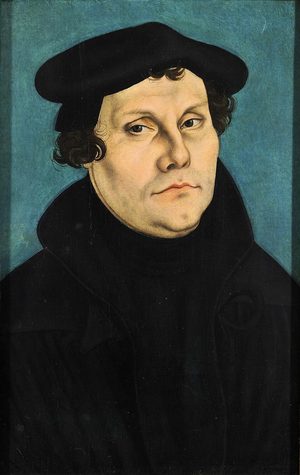

Martin Luther was an Augustinian friar and professor of Scripture at Wittenberg whose 1517 challenge to the sale of indulgences grew into the Reformation; he taught that sinners are justified by faith alone. Every tradition has had to answer him, from a papal bull of condemnation to a day on the church calendar.
| Lived | 10 November 1483, Eisleben, to 18 February 1546, Eisleben |
|---|---|
| Church | Augustinian friar and priest; excommunicated by Pope Leo X (1521) |
| Role | Doctor of theology (1512) and professor of Bible at Wittenberg; translator of the Bible into German |
| Influenced by | Johann von Staupitz, his confessor and predecessor in the Bible chair at Wittenberg; the Letter to the Romans |
| Influenced | Philipp Melanchthon, who drew up the Augsburg Confession (1530); the Lutheran churches |
| Writings | Ninety-five Theses (1517); three treatises of 1520; German New Testament (1522) and Bible (1534); On the Bondage of the Will (1525); Small and Large Catechisms (1529); Smalcald Articles (1537); On the Jews and Their Lies (1543) |
| Honored | 18 February in Lutheran and Episcopal calendars; 31 October in the Church of England calendar (Commemoration) |
Life
Luther studied at Erfurt, where on 17 July 1505, after a thunderstorm in which he had vowed to become a monk, he entered the Augustinian monastery; he was ordained priest in 1507. At Wittenberg he became a doctor of theology in October 1512 and lectured on the Psalms, Romans and Galatians. On 31 October 1517 he sent his Ninety-five Theses on indulgences to Archbishop Albert of Mainz. In 1518–19 he faced Cardinal Cajetan and Johann Eck, and in 1520 published To the Christian Nobility, The Babylonian Captivity of the Church and The Freedom of a Christian. Leo X's bull Exsurge Domine (15 June 1520) gave him sixty days to recant; he burned it, and Decet Romanum Pontificem (3 January 1521) excommunicated him.
At the Diet of Worms (April 1521) he refused to retract unless convinced by Scripture or clear reason, and the Edict of Worms (May 1521) outlawed him. Frederick the Wise hid him in the Wartburg until March 1522; there he began translating the New Testament (published September 1522; the whole Bible, 1534). On 13 June 1525 he married Katharina von Bora, a former nun. In 1529 he issued the catechisms and met Zwingli at Marburg; in 1530 Melanchthon's Augsburg Confession, which Luther endorsed, went to the emperor. He prepared the Smalcald Articles (1537) and died at Eisleben on 18 February 1546.
What he taught
Luther taught that God declares sinners righteous for Christ's sake through faith alone, apart from works (justification; the five solas). In his German New Testament (1522) he rendered Romans 3:28 "allein durch den Glauben", "by faith alone"; the Greek has no word for "alone", and he defended the choice in his Open Letter on Translating (1530) as what German idiom and Paul's meaning required (see question 21 for Lutherans). The Smalcald Articles say that of this article "nothing can be yielded or surrendered" (II.1.5). In the Heidelberg Disputation (1518) he set a "theology of the cross," which "calls the thing what it actually is" (thesis 21), against a theology of glory. He held that Scripture alone binds the conscience, and wrote in The Freedom of a Christian that a Christian is "a perfectly free lord of all, subject to none" and "a perfectly dutiful servant of all, subject to all" (Luther's Works 31:344). On Temporal Authority (1523) distinguished spiritual from worldly government, and To the Christian Nobility argued for the priesthood of all the baptized.
Against Zwingli he held that Christ's body and blood are truly present in the Lord's Supper; the Small Catechism calls it "the true body and blood of our Lord Jesus Christ, under the bread and wine." He held that baptism "works forgiveness of sins" and retained infant baptism. Against Erasmus he wrote On the Bondage of the Will (1525), holding that the sinner cannot turn himself to God (predestination).
What historians say
In 1961 the Catholic historian Erwin Iserloh argued that Luther mailed the theses to bishops and did not nail them to a church door: the first account of nailing is Melanchthon's, written after Luther's death by a man who was not in Wittenberg in 1517. Scott Hendrix reports that this view has won wide acceptance (Christian History 34, 1992); others cite a note by Luther's secretary Georg Rörer, found in 2006, that the theses were posted on the Wittenberg church doors, as university custom required. Hendrix adds that "Here I stand" appears only in the first printed account of the speech at Worms, and most scholars have long doubted it. Tuomo Mannermaa and the Helsinki school hold that for Luther Christ is really present in the believer by faith, close to Orthodox theosis; other Lutheran scholars dispute this.
Two episodes are criticized. In Against the Robbing and Murdering Hordes of Peasants (1525) Luther urged the princes to "smite, slay, and stab" rebels; the historian Michael Bruening argues that this dashed the peasants' faith that the Reformation stood for their freedom, while Lutheran writers answer that Luther had conceded their grievances and the rebel leaders bear the first responsibility (The Peasants' War). In On the Jews and Their Lies (1543) he proposed that synagogues be burned and rabbis forbidden to teach on pain of death. The ELCA's 1994 declaration says, "we reject this violent invective"; the Missouri Synod resolved in 1983 to "deplore and disassociate ourselves" from such statements; the Wisconsin Synod calls them "anti-Judaism rather than anti-Semitism" but cannot "excuse" them (Luther and the Jews; the Lutheran record).
How the churches see Luther
- Catholic:
Exsurge Domine (1520) condemned forty-one propositions from Luther's writings, and Decet Romanum Pontificem (1521) excommunicated him. The Council of Trent (1547, canon 9) anathematized the view that the sinner is justified by faith alone so that nothing else need cooperate. John Paul II's letter of 31 October 1983, for the 500th anniversary of Luther's birth, spoke of his profound religiousness. The 1999 Joint Declaration on the Doctrine of Justification, with the Lutheran World Federation, states that Trent's condemnations do not apply to the Lutheran teaching it sets out. From Conflict to Communion (2013), a joint commission report, speaks of Luther as a "witness to the gospel." At Lund in 2016 Pope Francis acknowledged that the Reformation "helped give greater centrality to sacred Scripture."
- Orthodox:
The Orthodox response has been to Lutheran teaching rather than to Luther as a person. Patriarch Jeremias II of Constantinople answered the Tübingen Lutheran theologians' Greek Augsburg Confession in letters ending in 1581, finding errors in it; the exchange broke down over the Fathers' role in reading Scripture (Orthodox Church in America). Philip Schaff reports that the Synod of Jerusalem (1672) approved the Patriarch's answers and its Confession of Dositheus says man is justified "not by faith alone, but also by works." The Lutheran-Orthodox Joint Commission (from 1981) studied "Salvation: Grace, Justification and Synergy" in 1998.
- Lutheran:
Lutherans honor Luther as a teacher, not an infallible authority. The Solid Declaration of the Formula of Concord calls him "the precious man of God, Dr. Luther," through whom God brought the truth of his Word to light, and confesses his catechisms; yet it says the writings of "no man should be regarded as equal" to Scripture (Rule and Norm, paras. 5, 9). Lutheran Service Book commemorates him on 18 February as "Doctor and Confessor," the ELCA as "renewer of the church," and the Missouri Synod keeps Reformation Day on 31 October.
- Reformed:
John Calvin wrote to Heinrich Bullinger of Zurich (25 November 1544) that even if Luther called him a devil he would still acknowledge him as "an illustrious servant of God," though he deplored Luther's violence. The two traditions parted over the Supper at Marburg (1529) and condemned each other's teaching. The Leuenberg Agreement (1973) declares those condemnations inapplicable to the churches that sign it, and in 2017 the World Communion of Reformed Churches associated itself with the 1999 Joint Declaration on Justification.
- Anglican:
The Church of England's calendar lists "Martin Luther, Reformer, 1546" as a Commemoration on 31 October, and the Episcopal Church's lists him on 18 February. Article XI of the Thirty-Nine Articles holds that "We are accounted righteous before God, only for the merit of our Lord and Saviour Jesus Christ by Faith." In 2016 the Anglican Consultative Council welcomed and affirmed the substance of the Joint Declaration on Justification.
- Methodist:
Wesley's Journal for 24 May 1738 records that at a society in Aldersgate Street, where "Luther's Preface to the Epistle to the Romans" was being read, he felt his heart "strangely warmed." On 15 June 1741 he wrote that he was "utterly ashamed" of having esteemed Luther's commentary on Galatians, finding it "deeply tinctured with mysticism throughout and hence often dangerously wrong." The World Methodist Council affirmed the Joint Declaration on Justification in July 2006.
- Baptist:
The Second London Confession (1677; reissued 1689), which many Baptists hold, calls faith "the alone instrument of Justification" (11.2), but reserves baptism for those who "actually profess" repentance and faith (29.2), so Baptists decline the infant baptism that Luther and the Augsburg Confession (art. IX) kept. R. Albert Mohler Jr. of The Southern Baptist Theological Seminary calls Worms Luther's "great moment of theological clarification" and writes for the seminary, "we do not date our faith to 1517, but to Christ and the Apostles."
Sources
- Luther Timeline, lutheranreformation.org dates of the life
- Catholic Encyclopedia, "Martin Luther" dates: Marburg, marriage
- Hendrix, "Legends About Luther," Christian History 34 (1992)
- Luther.de, "Legends about Luther: 95 Theses" (Iserloh, 1961)
- Cargill Thompson, "Problems of Luther's Tower-Experience," Studies in Church History 15 (1978)
- Smalcald Articles, Part II, Article 1 (Book of Concord)
- Small Catechism (Book of Concord)
- Solid Declaration of the Formula of Concord (Book of Concord)
- Heidelberg Disputation, 1518 (Book of Concord)
- Christian History Institute, "Two Kingdoms"
- Christian History Institute, "Was Luther anti-Semitic?"
- ELCA, Declaration to the Jewish Community (1994; reaffirmed 2021)
- LCMS, "Luther and the Jews" (1983 resolution)
- WELS, "Was Luther anti-Semitic?"
- Peasants' War: Britannica; Bruening, Religion Unplugged (2025)
- Council of Trent, Session 6 (Waterworth translation)
- John Paul II, letter to Cardinal Willebrands, 31 October 1983 (AP translation)
- Joint Declaration on the Doctrine of Justification (1999), paras. 40-41
- Lutheran-Roman Catholic Commission on Unity, From Conflict to Communion (2013)
- Pope Francis, homily at Lund, 31 October 2016
- Orthodox Church in America, "Patriarch Jeremias II and the Dialogue with the Lutherans"
- Schaff, Creeds of Christendom, on the Synod of Jerusalem (1672)
- Lutheran-Orthodox Joint Commission (Pro Unione)
- Lutheran Service Book commemorations (Concordia Publishing House)
- LCMS, Reformation Day
- Schaff, History of the Christian Church, vol. 7, on Calvin's letter to Bullinger
- Leuenberg Agreement (1973)
- Church of England, Morning Prayer for 31 October 2026 (calendar entry)
- Episcopal Church, Calendar of the Church Year
- Church of England, Articles of Religion
- Methodist Church in Britain, Joint Declaration on the Doctrine of Justification (2017 update)
- Wesley, Journal, 15 June 1741 (CCEL)
- Wesley, Journal, 24 May 1738 (quoted by Discipleship Ministries)
- Second London Baptist Confession (1689), chs. 11 and 29
- Mohler, "Here We Stand," Southern Baptist Theological Seminary
- Cranach portrait, Wikimedia Commons (public domain)