The Vulgate 382–405

The Vulgate is the Latin Bible that grew from Jerome's work for Pope Damasus I (from 382) and became the Bible of the Western Church for more than a thousand years. The Council of Trent declared it "authentic" for public use in 1546, and Catholics have worked from it ever since; the Reformers' turn to the Hebrew and Greek made its standing a point of dispute between Rome and the Protestant churches (see the Bible and the people).
| Published | Gospels revised from 382; Old Testament from the Hebrew c. 390–405; Sixtine edition 1590; Clementine edition 1592; Nova Vulgata 1979 |
|---|---|
| Translators | Jerome, at the request of Pope Damasus I (382); the Nova Vulgata by a commission appointed by Paul VI (1965) |
| Language | Latin |
| Old Testament from | Hebrew (Jerome's translation); the Psalter from the Greek Septuagint (the Gallican Psalter); Tobit and Judith from Aramaic; the other deuterocanonical books kept in their Old Latin form |
| New Testament from | Greek: Jerome's revision of the Old Latin, the Gospels against old Greek manuscripts |
| Books | The Catholic canon, with the deuterocanonical books of the Apocrypha in the Old Testament; the Clementine edition adds 3 and 4 Esdras and the Prayer of Manasseh in an appendix |
| Approach | Between word-for-word and sense-for-sense: Jerome said he rendered by sense, except in Scripture, where "the order of the words is a mystery" (Letter 57) |
| Copyright | Public domain (Jerome's text and the Clementine edition); the Nova Vulgata is the Holy See's own edition |
| Used by | The Latin Church through the Middle Ages; the Catholic Church (the Nova Vulgata is its typical Latin edition); the source of the Wycliffe Bible and the Douay-Rheims |
How it was made
Pope Damasus I asked Jerome in 382 to correct the varying Old Latin texts against the Greek. Jerome revised the Gospels against old Greek manuscripts, probably the rest of the New Testament too, and made a quick revision of the Psalter (383). About 388 he revised the Psalms more carefully against the Greek Hexapla text: this is the Gallican Psalter, which stayed in the Vulgate and the breviary. At Bethlehem he began about 390 to translate the Old Testament from the Hebrew and by 405 had finished the books of the Hebrew canon, with Tobit and Judith from Aramaic. The remaining deuterocanonical books, and the additions to Esther and Daniel, were left as the Old Latin had them (Catholic Encyclopedia, "Versions of the Bible"). Augustine wrote to Jerome questioning a Latin Old Testament that departed from the Septuagint the churches used.
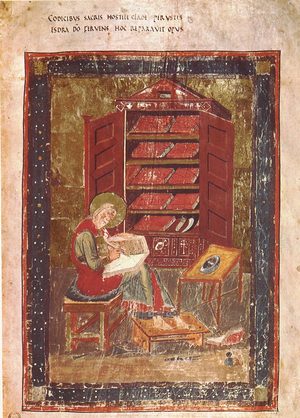
The name Vulgate ("common") came into use later. Alcuin completed a revision in 801, and Theodulf of Orléans made another about the same time. The oldest surviving complete one-volume Latin Bible, the Codex Amiatinus (pictured), was made in Northumbria before 716, and Gutenberg printed the Vulgate in the 1450s.
On 8 April 1546 the Council of Trent received the books "as they are contained in the old Latin vulgate edition," and ordered that this "old and vulgate edition" be held as authentic in "public lectures, disputations, sermons and expositions" and printed as correctly as possible. Sixtus V issued his own edition in 1590; after his death the cardinals halted its sale, and Clement VIII issued the revised Clementine edition in 1592, with a preface by Robert Bellarmine. It was the Roman standard until the Nova Vulgata. Paul VI set up a commission in 1965 to revise the Latin Bible after Vatican II; John Paul II declared its work the "typical" edition on 25 April 1979 (Scripturarum Thesaurus), and a second edition followed in 1986.
How it translates
Jerome held that the Latin Old Testament should rest on the Hebrew (Hebraica veritas) where the Septuagint had been the Church's text. In Letter 57 (c. 395) he said that he translated by sense and not word for word, except in Holy Scripture, "where even the order of the words is a mystery." At Matt 3:2 the Vulgate reads paenitentiam agite, which the Douay-Rheims renders "Do penance" and the KJV "Repent." At Luke 1:28 it reads gratia plena, "full of grace" in the Douay-Rheims, "highly favoured" in the KJV.
The Nova Vulgata (1979) kept the old Vulgate word for word where it rendered the original texts accurately, as set out in modern critical editions, and improved it where it did not (Scripturarum Thesaurus).
Reception and revisions
Erasmus's Greek New Testament (Basel, 1516) set the Greek beside a Latin text, and the Reformers worked from the original languages: Luther published his Bible from them (1522, 1534) and urged the study of Greek and Hebrew in To the Councilmen of All Cities in Germany (1524). In Catholic hands the Vulgate remained the basis of preaching and disputation, and the English Catholic Bibles, the Rheims New Testament (1582) and the Douay Old Testament, were translated from it. The translators of the 1611 King James Bible argued in their preface that Rome's two editions, Sixtus's and Clement's, differed in many places though each was to be held authentic.
In Divino Afflante Spiritu (1943), Pius XII recalled that Trent's presidents had asked for a corrected edition. He wrote that the Vulgate's authenticity is "not specified primarily as critical, but rather as juridical," that it is free from error in matters of faith and morals, and that the decree applies "only to the Latin Church."
Where each church stands on the the Vulgate
- Catholic:
The Council of Trent (1546) declared the "old and vulgate edition" authentic for public use. Divino Afflante Spiritu (1943, nn. 20-22) says this does not lessen the original texts and allows translations made "directly from the original texts." Dei Verbum 22 gives a place of honor to Latin translations, "especially the Latin translation known as the vulgate." Liturgiam Authenticam (2001, nn. 24, 37) calls the Nova Vulgata "the point of reference" for the canonical text and an "auxiliary tool" for translators, who are to work from Hebrew, Aramaic and Greek.
- Orthodox:
The Orthodox Church has made no statement about the Vulgate as a text. Its Old Testament follows the Septuagint (see the Apocrypha). It venerates Jerome as a saint (15 June), and the Orthodox Church in America's life of him says the Vulgate "passed into general use throughout the Western Church."
- Lutheran:
The Lutheran Confessions name no Bible text. Luther translated from the Hebrew and Greek, not the Vulgate, and his 1534 Bible printed the Apocrypha apart as books "useful and good to read" but not equal to Scripture, close to Jerome's distinction. Martin Chemnitz answered Trent point by point in his Examen (1565-73).
- Reformed:
The Westminster Confession (1.8) holds the Hebrew Old Testament and Greek New Testament, "kept pure in all ages," to be "authentical" and the final appeal in controversies, and says they are to be translated into the language of every nation. It does not mention the Vulgate. Its 1.3 excludes the Apocrypha, going beyond Jerome's reading "for the edification of the people."
- Anglican:
Article VI (1571) names the books of the Hebrew canon and then, citing Jerome, says the Church reads the others "for example of life and instruction of manners" but not to establish doctrine. The 1611 translators named the Hebrew and Greek as the sources and discussed Trent's "authentic" Latin in their preface, "The Translators to the Reader."
- Methodist:
The Methodist Articles of Religion (1784) do not mention the Vulgate and omit the Anglican paragraph that cites Jerome. John Wesley's Explanatory Notes upon the New Testament (1755) kept the King James text, with changes made by the Greek. The Methodist churches have made no statement about the Vulgate.
- Baptist:
The Second London Confession (1689, 1.8) follows the Westminster Confession: the Hebrew and Greek are authentic and are to be translated for every nation. Its 1.3 excludes the Apocrypha. It does not mention the Vulgate.
Sources
- Catholic Encyclopedia, "Versions of the Bible" (1912), Latin versions
- Catholic Encyclopedia, "Revision of Vulgate" (1912)
- Council of Trent, Session IV (8 April 1546): canon and edition of the sacred books
- Pius XII, Divino Afflante Spiritu (1943), nn. 20-22
- Vatican II, Dei Verbum (1965), n. 22
- John Paul II, Scripturarum Thesaurus (25 April 1979)
- Congregation for Divine Worship, Liturgiam Authenticam (28 March 2001), nn. 24, 37, 41
- Jerome, Letter 57 to Pammachius, "On the Best Method of Translating"
- Correspondence of Augustine and Jerome concerning the Latin Translation of the Scriptures
- Orthodox Church in America, Saint Jerome of Stridon (15 June)
- "The Translators to the Reader" (King James Bible, 1611)
- Westminster Confession of Faith 1.8
- Wesley, Preface to the Explanatory Notes upon the New Testament (1755)
- Codex Amiatinus, folio 5r (Ezra), Wikimedia Commons