Thomas Helwys c. 1575–c. 1616
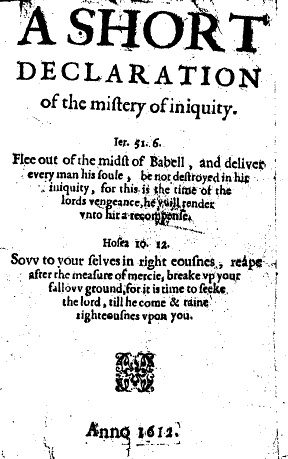

Thomas Helwys was a Nottinghamshire lawyer who joined John Smyth's Separatist congregation, helped lead it into exile in Amsterdam, and in 1612 brought a small Baptist church back to London. His book of that year, A Short Declaration of the Mistery of Iniquity, which he sent to King James I, is widely described as the first English plea for religious liberty for everyone, and every tradition has a view on the state's power over conscience.
| Lived | c. 1575 (the 1570s; some reference works give c. 1550), Nottinghamshire, to c. 1616 (probably 1615 or 1616; some sources give 1614), Newgate prison, London |
|---|---|
| Church | Separatist, then pastor of the English congregation in Amsterdam after the break with Smyth (1610); founder of the first Baptist church on English soil (the General Baptists) |
| Role | Educated at Gray's Inn; landowner at Broxtowe Hall, Nottinghamshire; pastor |
| Influenced by | John Smyth; English Separatism; the Mennonites of Amsterdam (Tony Peck argues this) |
| Influenced | The General Baptists; later Baptist advocates of religious liberty (Peck traces a line to Roger Williams) |
| Writings | A Declaration of Faith of English People Remaining at Amsterdam in Holland (1611); A Short Declaration of the Mistery of Iniquity (1612) |
| Honored | No feast or commemoration day is known. The Baptist World Alliance marked the 400th anniversary of his 1612 book in 2012; Thomas Helwys Baptist Church in Lenton, Nottingham, bears his name |
Life
Helwys came from a Nottinghamshire family whose estate at Broxtowe Hall had been held for generations. He was educated at Gray's Inn in London and returned to Broxtowe, which in the early 1600s became a meeting place for Puritan clergy. There he met the preacher John Smyth, and both moved from Puritanism to Separatism, forming a congregation at Gainsborough, Lincolnshire. Under fines and the threat of prison, they led it to Amsterdam in 1608, where Mennonites let them meet in Jan Munter's bakehouse.
In Amsterdam the group came to hold that baptism belongs only to believers. Smyth baptized himself and then the others, Helwys first among them. In about February 1610 Smyth and some thirty others judged this an error and sought to join the Waterlander Mennonites. Helwys and about a dozen others refused, calling the Mennonite doctrine of succession in the church "contrary to the liberty of the Gospel," and in 1611 they excluded Smyth (John Smyth). The Helwys group published A Declaration of Faith of English People Remaining at Amsterdam in Holland (1611), generally counted the first English Baptist confession.
Helwys came to believe that flight from England had been wrong and that the king should be asked to stop persecuting the faithful. In 1612 he returned with his followers and founded a church at Spitalfields, outside London. Before leaving Amsterdam he had completed A Short Declaration of the Mistery of Iniquity, dated 1612. The Bodleian Library holds the copy he sent to James I, with a handwritten appeal beginning "Heare, o King, and dispise not the counsell of the poore" and ending "God Save the King. Tho: Helwys. Spittlefeild neare London." He was arrested and imprisoned in Newgate and died there, probably in 1615 or 1616; a family will of 1616 already refers to him as dead. No account of his death survives.
What he taught
The 1611 Declaration of Faith teaches that the church of Christ is "a company of faithful people" (art. 10), received by baptism on confession of faith and sins (art. 13), and that baptism "in no wise appertains to infants" (art. 14; infant baptism). It holds that God would have all men saved (art. 5) and that men "may fall away from the grace of GOD" (art. 7), the Arminian teaching that distinguished the General Baptists from Calvinists (predestination). Article 24 calls magistracy "a Holy ordinance of GOD," to be obeyed "for conscience sake," and says magistrates may be church members while keeping office.
The Mistery of Iniquity is a polemic. Helwys reads the book of Revelation as describing England: the pope is the man of sin, the Church of England the second beast, and the Puritans and the Separatists, who kept infant baptism, are criticized in turn (Helwys Society Forum). His plea is the centre of the book: "for men's religion to God is betwixt God and themselves; the King shall not answer for it." The king has an earthly sword only; if subjects are "obedient and true," he can ask no more. Let them be "heretics, Turks, Jews, or whatsoever," it is no business of the earthly power to punish them (modernized spelling; Mercer ed., 1998, p. 53). In his appeal to James he wrote that the king "is a mortal man and not God," with no power over his subjects' immortal souls. Tony Peck notes that Helwys stressed his loyalty to the king in everything but religion, and urged nonconformists to fight for him if the nation were attacked.
He argued from faith, not from natural rights. If Christ is Lord, Peck writes, no other lord may stand in the way of the free response of faith. Christian History adds that his congregation held that all people could repent and believe, so that destroying someone for mistaken beliefs might thwart God's purpose.
What historians say
Historians cannot fix his birth (the 1570s) or his death (1614, 1615 or 1616), and no portrait survives. The Baptist World Alliance calls the Mistery "the first defense of Universal Religious Liberty for all persons to be published in the English language" (Resolution 2012.2). Peck notes that nobody else in England put forward such a vision then, and that thirty years later, in the time of Cromwell, Helwys's ideas found a readier audience. A facsimile edition appeared in 1935, and Richard Groves edited a modern edition for Mercer University Press (1998). Peck argues that a direct line runs from Helwys to Roger Williams (Roger Williams) and, through him, to an influence on the American Constitution.
Historians differ on where the idea came from and what it was. Peck argues that Helwys met it among the Dutch Anabaptists and Mennonites in Amsterdam; this belongs to a wider dispute over how far the first Baptists depended on the Anabaptists (From the Reformation to the Baptists). Jesse Owens argues that it grew out of the Baptist doctrine of the church, since only new birth qualifies a person for membership, and that it needs neither Locke nor the Enlightenment to explain it. Peck notes that the book is no model of ecumenical manners, since it attacks every church in England, yet it claims freedom of worship for all of them and for those of other faiths. Bradley says the liberty covered Roman Catholics, though Helwys called the papacy the man of sin; his most quoted sentence names "heretics, Turks, Jews."
What Helwys suffered is not disputed: the book led to his imprisonment, and he died in prison (Baptists; the Baptist record).
How the churches see Helwys
- Catholic:
The Catholic Church has made no statement about Helwys, whose book called the papacy the man of sin. On religious liberty, the Second Vatican Council declared in Dignitatis Humanae (7 December 1965, art. 2) that "the human person has a right to religious freedom," meaning immunity from coercion by individuals or social groups, and that the right continues in those who do not live up to their obligation to seek the truth. The same declaration says it "leaves untouched traditional Catholic doctrine on the moral duty of men and societies toward the true religion" (art. 1).
- Orthodox:
The Orthodox Church has made no statement about Helwys. The Holy and Great Council of Crete (2016) lists the restriction of human rights in the field of freedom of conscience, "in particular religious freedom," among the evils that afflict the world today (The Mission of the Orthodox Church in Today's World).
- Lutheran:
No Lutheran church has made a statement about Helwys. The Augsburg Confession (1530, art. XXVIII) teaches that the power of the Church "does not interfere with civil government" and that the two powers "must not be confounded," and says bishops act "without human force, simply by the Word." Article XVI condemns Anabaptists who say Christians may not hold civil office, whereas the Helwys Declaration (art. 24) says magistrates may be church members. On 22 July 2010 the Lutheran World Federation's assembly at Stuttgart expressed sorrow for Lutheran persecution of Anabaptists and asked forgiveness of Mennonites.
- Reformed:
The Reformed churches have made no statement about Helwys. The Westminster Confession (1646, 23.3) charged the civil magistrate to see "that all blasphemies and heresies be suppressed." The American Presbyterian church revised that paragraph in 1788 to say that magistrates may not interfere in matters of faith and must protect every person from injury on account of religion. Reformed historians and churches have since made their own answer to the older teaching (the Reformed record).
- Anglican:
The Church of England has made no statement about Helwys. His book was addressed to a king who headed that church. Article XXXVII of the Thirty-Nine Articles says that "The King's Majesty hath the chief power in this Realm of England," and Helwys read the Church of England as the second beast of Revelation 13. The Lambeth Conference of 1948 (Resolution 8) declared that every person has the right to freedom of religion, conscience and belief.
- Methodist:
The Methodist churches have made no statement about Helwys. Methodists and General Baptists share the teaching that Christ died for all, yet Wesley wrote on 12 January 1780, "I persecute no man for his religious principles," while arguing that no Protestant government should tolerate Roman Catholics (Wesley against toleration of Catholics). The United Methodist Social Principles (2024) affirm "the rights of religious minorities to worship in peace."
- Baptist:
Baptists honor Helwys as a pioneer of religious liberty. The Baptist World Alliance's General Council (Santiago, Chile, July 2012, Resolution 2012.2) marked the 400th anniversary of the Mistery and urged Baptist leaders to teach religious liberty and to advocate for those who wish to worship by conscience. The Southern Baptist Baptist Faith and Message (2000, art. XVII) says that "a free church in a free state is the Christian ideal." At a commemoration at Retford in 2016, Tony Peck of the European Baptist Federation said Baptists owe the commitment to religious freedom for all to Helwys, "even if we have not always lived up to the full extent of his vision."
Sources
- Peck, Tony (European Baptist Federation), address at the Thomas Helwys Commemoration Day, Retford, 12 March 2016 Gray's Inn, Broxtowe Hall, Amsterdam, Spitalfields 1612, Newgate, the book and the inscription
- Christian History Institute, "To Walk in All His Ways" (Smyth, Helwys and the first Baptists) the split of 1610, Helwys's reasons for returning, death in Newgate
- Bradley, James E., "The Lord of Consciences," Christian History 94
- Vile, J. R., "Thomas Helwys," The First Amendment Encyclopedia (Middle Tennessee State University, 2024) quotations from Helwys, Mercer University Press edition (1998)
- Thomas Helwys, A Short Declaration of the Mistery of Iniquity (1612), ed. Richard Groves (Mercer University Press, 1998)
- Helwys to King James I, inscription page (Bodleian copy, via EEBO), Wikimedia Commons
- The mistery of iniquity (1935 facsimile edition), Open Library
- New World Encyclopedia, "Thomas Helwys"
- Dictionary of National Biography, "Helwys, Thomas" (Wikisource) the will of 1616
- A Declaration of Faith of English People Remaining at Amsterdam in Holland (1611), arts. 5, 7, 10, 13, 14, 24
- Helwys Society Forum, "A Short Declaration of the Mystery of Iniquity"
- Owens, Jesse, "Is Religious Toleration Accidental to Early Baptist Theology?" Helwys Society Forum (20 December 2022)
- Baptist World Alliance, Resolution 2012.2, Religious Liberty (General Council, Santiago, 2012)
- Second Vatican Council, Dignitatis Humanae (7 December 1965), arts. 1 and 2
- Holy and Great Council of Crete, The Mission of the Orthodox Church in Today's World (2016)
- Augsburg Confession (1530), arts. XVI and XXVIII (Book of Concord)
- Lutheran World Federation, Action on the Legacy of Lutheran Persecution of Anabaptists (Stuttgart, 22 July 2010)
- Westminster Confession of Faith (1646), 23.3, original and American revision of 1788
- Church of England, Articles of Religion, art. XXXVII
- Lambeth Conference 1948, Resolution 8 (Anglican Communion)
- John Wesley, letter to the Printer of the Public Advertiser, 12 January 1780; United Methodist Church, Social Principles (2024), The Political Community, J. Religious Minorities
- Southern Baptist Convention, Baptist Faith and Message (2000), art. XVII
- Title page of A Short Declaration of the Mistery of Iniquity (1612), Wikimedia Commons (public domain)
