Paul Gerhardt 1607–1676
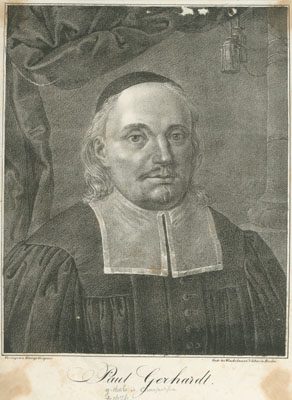

Paul Gerhardt was a Lutheran pastor in Brandenburg and the best-known German hymnwriter after Luther. His hymns, set to music by Johann Crüger, are sung in Lutheran, Reformed, Methodist and other churches in English translation, and Bach set several in the St Matthew Passion. His refusal to sign an edict of a Reformed ruler cost him his Berlin pulpit, and each tradition remembers him for a different part of this.
| Lived | 12 March 1607, Gräfenhainichen (Electoral Saxony), to 27 May 1676, Lübben (some sources give 1606 and 7 June) |
|---|---|
| Church | Lutheran, in the Electorate of Brandenburg, whose ruler was Reformed |
| Role | Tutor in Berlin; chief pastor at Mittenwalde (1651–1657); third deacon of St. Nicholas' Church, Berlin (1657–1667); archdeacon at Lübben (1668–1676) |
| Influenced by | Johann Crüger, cantor of St. Nicholas, who set his hymns; the medieval Latin Passion hymn Salve caput cruentatum |
| Influenced | John Wesley, who translated several of his hymns; J. S. Bach; the English translators Alexander and Winkworth |
| Writings | More than 120 hymns, first printed in Crüger's Praxis pietatis melica (from 1647) and collected by J. G. Ebeling (Berlin, 1666–67): "O Haupt voll Blut und Wunden" (1656), "Befiehl du deine Wege" (1656), "Nun ruhen alle Wälder" (1648), "O Jesu Christ, mein schönstes Licht" (1653) |
| Honored | 26 October, with Philipp Nicolai and Johann Heermann, in Lutheran Service Book (Missouri Synod) and the Lutheran calendar of saints |
Life
Gerhardt was born at Gräfenhainichen, where his father was burgomaster. The Thirty Years' War began in his boyhood, and the Swedes burned the town on 16 April 1637, destroying its church records, which is why some sources give 1606 as his birth year. He matriculated at Wittenberg in 1628 and seems to have stayed there until about 1642, then went to Berlin as tutor in the household of the advocate Andreas Barthold, whose daughter Anna Maria he married on 11 February 1655. In Berlin he came to know Johann Crüger. The war delayed his first appointment: he was chosen chief pastor at Mittenwalde, near Berlin, in 1651 (18 November) and served there until 1657.
In 1657 he became third deacon at St. Nicholas' Church in Berlin. The Elector Frederick William was Reformed, but most of his subjects were Lutheran, and the clergy of the two confessions attacked each other from the pulpit. His edict of 2 January 1662, and a stricter one of 16 September 1664, ordered clergy of both confessions to stop denouncing each other and attributing absurd doctrines to opponents, required every pastor to pledge obedience, and ordered baptism without exorcism when parents asked for it. Gerhardt refused to sign. He was cited before the consistory and deposed on 6 February 1666. Citizens and several guilds petitioned for him, and the Berlin magistrates told the Elector that he had never attacked the Reformed. On 9 January 1667 the Elector restored him and excused him from subscribing, but Gerhardt, who felt still bound by the edicts' conditions, would not resume the office and resigned.
After more than a year without a post he was called in 1668 as archdeacon of Lübben, in Saxon territory, and was installed in June 1669. His wife had died in March 1668, and four of their five children died before him. He died at Lübben on 27 May 1676. His portrait there has hung in the parish church since his death, with the Latin motto Theologus in cribro Satanae versatus (a theologian sifted in Satan's sieve).
What he taught
Gerhardt wrote no treatise; what he taught is in his hymns and in his stand on the Lutheran confessions. His hymns are personal: they address Christ or the singer's own soul, and they sing the Lutheran themes of the cross, forgiveness and trust in providence. "O Haupt voll Blut und Wunden" is a free German version of Salve caput cruentatum, the last part of a medieval Latin cycle on the members of the crucified Christ, in which the singer addresses the head of Christ on the cross. It was long ascribed to Bernard of Clairvaux (it appeared in his collected works of 1609) and is now often credited to Arnulf of Leuven. Gerhardt's version appeared in Crüger's Praxis pietatis melica (1656) with a tune that Hans Leo Hassler had published in 1601 as a love song. "Befiehl du deine Wege" (1656) commits the believer's troubles and path to God's care; "Nun ruhen alle Wälder" is an evening hymn; "Ich steh an deiner Krippen hier" (1653) is a Christmas hymn.
His public stand was on the Lutheran confessions. He told the Elector that he could understand the edicts only literally and could not sign without violating his conscience and the Formula of Concord, the Lutheran confession of 1577 that addresses disputes over the Lord's Supper, the person of Christ and election. He wrote that what he could do with a good conscience he would readily consent and promise to do. The Elector's Lord President, Otto von Schwerin, said in 1667 that Gerhardt must have misunderstood the edicts' purpose.
What historians say
The hymns are better documented than the man. His birth year is given as 1606 or 1607 and his death date as 27 May or 7 June; his Berlin dates also vary between sources, and the edicts are variously dated 1662 and 1664 because both existed. The authorship of Salve caput cruentatum is debated: older hymnals gave it to Bernard of Clairvaux, and the attribution to Arnulf of Leuven is more recent. The order in which Gerhardt's hymns first appeared is also unsettled; the 1656 Frankfurt edition of Crüger is usually given for "O Haupt" while another account dates its first four stanzas to 1653.
The Berlin dispute is read in two ways. Lutheran writers present Gerhardt as a confessor who would not compromise Lutheran teaching under a Reformed ruler; the Elector's side, as Schwerin put it, held that he had misread edicts aimed at ending abuse between the two clergies and that he had been offered exemption. Gerhardt's own reply was that he could take the edicts only as written. His case is part of the wider story of rulers imposing church policy on their subjects (confessional coercion in Lutheran states), seen here from the Lutheran side as a ruler of another confession restraining a Lutheran pastor.
How the churches see Gerhardt
- Catholic:
The Catholic Church has made no statement about Gerhardt. His best-known hymn, "O Haupt voll Blut und Wunden," is a German version of Salve caput cruentatum, a Latin Passion devotion of the Catholic Middle Ages that was printed under Bernard of Clairvaux's name in 1609 and is now often credited to Arnulf of Leuven (Hymnary; Praise Trust).
- Orthodox:
The Orthodox Church has made no statement about Gerhardt.
- Lutheran:
Lutheran Service Book commemorates Gerhardt on 26 October, with Philipp Nicolai and Johann Heermann, as a hymnwriter and confessor; the date is that of Nicolai's death in 1608, and the book contains seventeen of his texts (Concordia Publishing House). The Lutheran calendar of saints marks the same day, and Evangelical Lutheran Worship prints nine of his hymns (Luther Seminary). Confessional Lutheran writers describe him as a pastor who lost his Berlin pulpit "for refusing to compromise his Lutheran convictions" (Steadfast Lutherans).
- Reformed:
No Reformed church has made a statement about Gerhardt. The Elector who deposed him belonged to the Reformed church, and his edicts, by their own terms, forbade pastors of both confessions to vilify each other or to ascribe absurd doctrines to the other side; the Berlin magistrates told him that Gerhardt had never attacked the Reformed (Kelly). In 1973 the Leuenberg Agreement declared the Reformation-era condemnations between Lutheran and Reformed churches inapplicable to the churches that sign it. Gerhardt's hymn "O sacred Head, now wounded" is printed in the Trinity Hymnal (revised edition, no. 247) and the Christian Reformed Psalter Hymnal (no. 383).
- Anglican:
The Church of England has made no statement about Gerhardt. His hymns reach Anglican worship in translation: James W. Alexander's "O sacred Head! now wounded" (1830) was revised by Henry W. Baker for Hymns Ancient and Modern in 1861, and Robert Bridges made a further version, "O sacred Head, sore wounded" (1899) (Hymnary; Praise Trust).
- Methodist:
John Wesley translated Gerhardt's "Befiehl du deine Wege" as "Commit thou all thy griefs," published in Hymns and Sacred Poems (1739), and its second part is sung as "Give to the winds thy fears"; the same book contains his version of "O Jesu Christ, mein schönstes Licht," "Jesus, thy boundless love to me." Wesley had come to know the German hymns among the Moravians on the voyage to Georgia in 1735. The United Methodist Hymnal prints "Give to the winds thy fears" (no. 129) and "O sacred Head, now wounded" (no. 286) (United Methodist Discipleship Ministries; Hymnary).
- Baptist:
No Baptist confession or convention has made a statement about Gerhardt. The Southern Baptist Baptist Hymnal prints "O sacred Head, now wounded" in its 1975 (no. 105), 1991 (no. 137) and 2008 (no. 231) editions, and Alexander's translation was already in the Baptist Psalms and Hymns of 1858 (Hymnary).
Sources
- Kelly, "Paul Gerhardt's Spiritual Songs" (1867), biographical sketch (CCEL) the war, the 1662 and 1664 edicts, deposition and restoration, Lübben
- Nutter, Hymn-writers of the Church: Gerhardt (CCEL) Wittenberg 1628, Mittenwalde 1651
- Hymnary, Paul Gerhardt (from Julian, Dictionary of Hymnology)
- Hymnology Archive, Paul Gerhardt (Julian) 1664 edict, 1666 deposition, death 27 May 1676, Ebeling edition
- Bach Cantatas Website, Paul Gerhardt Berlin dates, Lübben portrait motto, Gerhardt texts used by Bach
- Bach Cantatas Website, St Matthew Passion BWV 244 chorale numbers
- Concordia Publishing House, Composer of the Month: Paul Gerhardt LSB commemoration, 17 texts, Crüger
- Steadfast Lutherans, commemoration of Nicolai, Heermann and Gerhardt, 26 October
- Luther Seminary, God Pause: "O Lord, How Shall I Meet You" (ELW 241) Lutheran calendar of saints; nine hymns in ELW
- Hymnary, "O Haupt, voll Blut und Wunden"
- Hymnary, "O sacred Head, now wounded" (hymnals and translators)
- Hymnology Archive, "O Haupt voll Blut und Wunden"
- Praise Trust, "O sacred head once wounded" Bernard attribution (1609), Hassler tune, Baker and Bridges revisions
- SecondHandSongs, "Salve caput cruentatum" Arnulf of Leuven attribution
- Hymnary, "Commit thou all thy griefs" (Wesley, 1739)
- Hymnary, "Jesus, thy boundless love to me" (Wesley, 1739)
- United Methodist Discipleship Ministries, History of Hymns: "Give to the Winds Thy Fears"
- Leuenberg Agreement (1973)
- Portrait of Paul Gerhardt, Wikimedia Commons (public domain)