Teresa of Ávila 1515–1582
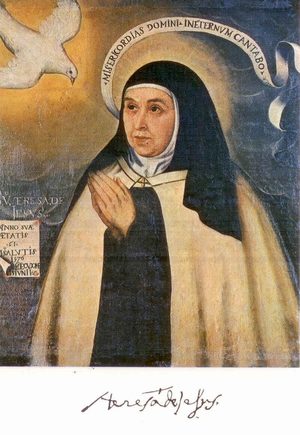

Teresa of Ávila was a Spanish Carmelite nun who reformed her order, founded the Discalced Carmelites, and wrote The Life, The Way of Perfection and The Interior Castle on prayer. Paul VI named her the first woman Doctor of the Church in 1970; her visions, her converso family and her troubles with the Inquisition all draw comment, and the traditions that do not invoke saints or keep monastic vows read her differently.
| Lived | 28 March 1515, Ávila, to 4 October 1582 (reckoned 15 October after the calendar reform), Alba de Tormes |
|---|---|
| Church | Catholic; Carmelite nun of the Convent of the Incarnation, Ávila; founder of the Discalced Carmelites |
| Role | Reformer of the Carmelites; founded St. Joseph's, Ávila (24 August 1562) and about sixteen more convents; mystical writer |
| Influenced by | Peter of Alcántara and Francis Borgia; Dominican and Jesuit confessors, among them Domingo Báñez; the Letters of Jerome |
| Influenced | John of the Cross, who began the reform among the friars (1568); Jerónimo Gracián; the Discalced Carmelites; the Catholic tradition of mystical theology |
| Writings | The Life (completed 1565; printed 1588); The Way of Perfection (printed 1583); The Interior Castle (written 1577; printed 1588); Book of the Foundations (printed 1610); 458 letters and 31 poems survive |
| Honored | Beatified 1614; canonized 1622; Doctor of the Church 1970; feast 15 October in the Catholic calendar, and 15 October in the Church of England, Episcopal and ELCA calendars |
Life
Teresa de Cepeda y Ahumada was born at Ávila on 28 March 1515, the daughter of the merchant Alonso Sánchez de Cepeda and his second wife, Beatriz de Ahumada, who died in 1529. After reading the Letters of Jerome she left her father's house in November 1535 and entered the Carmelite Convent of the Incarnation at Ávila. Within two years her health collapsed; she learned mental prayer during the illness, then gave it up for some fifteen years until, in 1555, she experienced what Britannica calls a religious awakening. Her visions and locutions troubled her confessors, some of whom, with laymen she consulted, thought them the work of an evil spirit; Peter of Alcántara, Francis Borgia and Dominican and Jesuit directors judged them genuine (Catholic Encyclopedia).
In 1558 she began to consider restoring the original austerity of Carmelite life. On 24 August 1562, with the authorization of Pius IV, she opened St. Joseph's at Ávila, which lived on alms rather than endowment and met hostility from the town and from religious. In 1567 the Carmelite prior general, Giovanni Battista Rossi, approved the reform and told her to found more houses; at Medina del Campo she met Juan de Yepes, later John of the Cross, who opened the first friars' house at Duruelo in 1568. In 1575 a jurisdictional dispute broke out between the Discalced and the Calced Carmelites; the general ordered her to retire to a convent in Castile, and John was imprisoned at Toledo in 1577. In 1579, largely through Philip II, the Discalced received their own jurisdiction, confirmed by Gregory XIII in 1580. She died at Alba de Tormes on 4 October 1582, on the way back to Ávila from Burgos; Paul VI reports her last words as "I thank You, Lord, because I die a daughter of the Church."
What she taught
Teresa's reformed convents were meant to be small, enclosed and poor, their nuns praying for the Church; Britannica quotes her phrase "our vocation of reparation." Her books are about prayer. In The Life she tells what God had done in her; in The Way of Perfection, written for her nuns, she sets out the virtues and the degrees of prayer, including contemplative prayer; in The Interior Castle she describes the soul's growth toward the highest mystical union. Paul VI, summarizing The Life (8:5), describes her teaching of prayer as friendship, speaking alone with the God by whom one knows one is loved.
Paul VI also stresses that her teaching centers on Christ, and in particular on his "most sacred Humanity" (Life 22:6), and that she valued obedience to the Church's ministers above visions, revelations and ecstasies. The Catholic Encyclopedia describes her as writing strictly from her own experience: she described the piercing of her heart (transverberation) and her spiritual espousals, but claimed no system or school. Bernini's marble Ecstasy of St. Teresa (1645–52) is based on her account of the former. Her teaching stays within Catholic doctrine on the sacraments and the saints; see praying to saints, which the churches that do not invoke saints read differently.
What historians say
Her ancestry. Her grandfather Juan Sánchez de Toledo, a Toledo cloth merchant of converso family, was reconciled by the Toledo Inquisition in 1485 after confessing relapse into Jewish practice; he then moved to Ávila. In 1519 Teresa's father and his brothers sued to be recognized as hidalgos; the court granted them noble status in August 1522, although testimony about Juan's reconciliation had been put in evidence. The documents were published by Teófanes Egido in 1986. The library at Georgetown describes them as conclusive proof of her converso background, which undercut William Thomas Walsh's earlier claims about her pure lineage. A reviewer of Carlos Eire's 2019 biography, Benjamin Ivry, reports Eire's view that the identity, had it been known, would likely have barred her from the convent and from quick canonization; Egido notes that the canonization documents stressed an Old Christian lineage. Catholic record: treatment of Jews gives the background.
The Inquisition. Teresa wrote in an age when the Inquisition issued edicts against the Alumbrados (1568, 1574) and claims of visions drew suspicion. Her Life was denounced to the Inquisition in 1574; Báñez gave a favorable opinion and Cardinal Quiroga approved it. Báñez said in 1591 that he kept the manuscript at the Holy Office for safety. It was withdrawn after her death and printed in 1588 by Luis de León. Ahlgren counts at least six denunciations of Teresa in her lifetime; another encyclopedia entry says she was threatened with the Inquisition but never charged. Eire reads the Life as an "autohagiography," a self-justification of holiness, written at the Inquisition's command (as the review reports), whereas Paul VI calls it a "story of salvation" (the Spanish Inquisition).
How the churches see Teresa
- Catholic:
Gregory XV canonized Teresa in 1622 (beatified 1614), and her feast is 15 October. On 27 September 1970, in the apostolic letter Multiformis sapientia Dei, Paul VI declared her "Doctor of the Universal Church," the first woman so named, and wrote that her doctrine shows "a singular charism of the Spirit." The Church holds her up as a teacher of prayer and an example of obedience to the Church.
- Orthodox:
The Orthodox Church has made no statement about Teresa, who lived five centuries after the schism of 1054. Some Orthodox writers judge Western mystical experience by the criteria of discernment taught by the Fathers and by Bishop Ignatius Brianchaninov. Alexei Osipov argues in this way that Teresa was so preoccupied with "revelations" that she missed deception, citing her account of Christ calling her his spouse.
- Lutheran:
The ELCA's calendar, following Evangelical Lutheran Worship (2006), commemorates her on 15 October as "teacher, renewer of the church." The Lutheran confessions allow the memory of the saints to be set before us so that we follow "their faith and good works" (Augsburg Confession XXI) but do not teach their invocation; Article XXVII of the Confession treats monastic vows, holding that a vow against God's commandment "is not valid."
- Reformed:
The Westminster Confession (22.7) calls "Popish monastical vows of perpetual single life, professed poverty, and regular obedience" "superstitious and sinful snares," not "degrees of higher perfection." Alexander Whyte (1836–1921), a Free Church of Scotland minister, wrote an admiring biography, Santa Teresa: An Appreciation, in the late nineteenth century. No Reformed commemoration of her has been found.
- Anglican:
The Church of England's Common Worship calendar lists "Teresa of Avila, Teacher of the Faith, 1582" on 15 October as a Lesser Festival, and the Episcopal Church's Lesser Feasts and Fasts (2024) lists "Teresa of Avila, Mystic and Monastic Reformer, 1582." Article XXII of the Thirty-Nine Articles, however, calls the Romish teaching on invocation of saints "a fond thing" (discussion).
- Methodist:
No Methodist commemoration of Teresa and no formal Methodist statement about her has been found. John Wesley wrote to his brother Samuel on 23 November 1736 that "the rock on which I had the nearest made shipwreck of the faith" was "the writings of the Mystics," a term he defined as covering "all, and only those" who slight the means of grace; he did not name Teresa in that letter.
- Baptist:
Baptist churches keep no calendar of saints, and no Baptist body's statement on Teresa has been found. The Second London Confession (1689) calls Scripture "the only sufficient, certain, and infallible rule of all saving Knowledge, Faith and Obedience" (1.1), and the evangelical writer Tim Challies, in 2014, called her a false teacher because "at the heart of mysticism is the primacy of experience over Scripture" (Scripture alone).
Sources
- Britannica, "St. Teresa of Ávila" life, reform, writings
- Catholic Encyclopedia (1912), "St. Teresa of Avila"
- Paul VI, Multiformis sapientia Dei (27 September 1970)
- Life of St. Teresa of Jesus (Lewis translation), introduction denunciation of 1574, Báñez, Quiroga
- Georgetown University Library, "500 Years of Teresa de Ávila" Egido, 1986
- Encyclopedia.com, "Teresa of Ávila" (Webre; Slade; American Eras)
- In Soul Pursuit, "Teresa of Avila, her family and the Inquisition" (on Egido, El linaje judeoconverso de Santa Teresa, 1986)
- Ahlgren, Teresa of Avila and the Politics of Sanctity (Cornell, 1996)
- Ivry, review of Eire, The Life of Saint Teresa of Ávila, America (2019)
- Britannica, "Alumbrado"
- Catholic Culture, liturgical calendar for 15 October (Memorial of St. Teresa of Avila)
- Osipov, "Individual Revelation and Its Indications" (Pravoslavie.ru)
- Living Lutheran, Prayer Ventures, 15 October 2019
- Augsburg Confession, arts. XXI and XXVII (Book of Concord)
- Westminster Confession, ch. 22
- Whyte, Santa Teresa: An Appreciation (CCEL)
- Church of England, Calendar (Common Worship)
- Episcopal Church, Lesser Feasts and Fasts 2024
- Church of England, Articles of Religion
- Wesley, letter to Samuel Wesley, 23 November 1736 (Wesley Corpus)
- Second London Baptist Confession (1689), ch. 1
- Challies, "The False Teachers: Teresa of Avila" (2014)
- Portrait by Fray Juan de la Miseria, 1576, Wikimedia Commons (public domain)