Philipp Jakob Spener 1635–1705
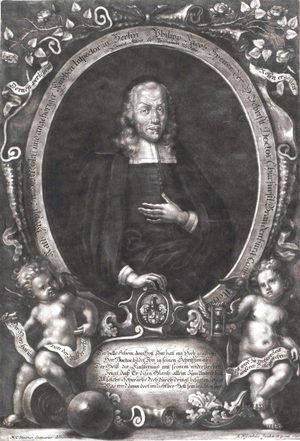

Philipp Jakob Spener was a Lutheran pastor whose small Bible-study circles in Frankfurt and whose book Pia Desideria (1675) began the movement called Pietism. He asked for a Lutheran church of Bible reading, lay ministry and lived faith, and the question whether this renewed Luther or shifted his emphasis divided Lutherans in his lifetime and still does. Through Moravians and Methodists his influence reached well beyond Lutheranism.
| Lived | 13 January 1635, Rappoltsweiler, Upper Alsace (some sources give 23 January), to 5 February 1705, Berlin |
|---|---|
| Church | Lutheran pastor; remained a Lutheran minister to the end of his life |
| Role | Senior (chief) pastor at Frankfurt am Main (1666); court chaplain at Dresden (1686); provost of St. Nicholas, Berlin (1691) |
| Influenced by | Johann Arndt's True Christianity; Luther's teaching on the priesthood of all believers; the preacher Jean de Labadie, who influenced him at Geneva |
| Influenced | August Hermann Francke and the Halle institutions; Nikolaus von Zinzendorf and the Moravians; through them John Wesley |
| Writings | Pia Desideria (1675) |
| Honored | Listed in the North American Lutheran Church's calendar of commemorations, the German Evangelical Calendar of Names (1962) and the Methodist calendar in For All the Saints |
Life
Spener entered the University of Strasbourg in 1651, studied under Johann Konrad Dannhauer, and traveled to Basel, Geneva and Tübingen. He took his doctorate in June 1664. In 1666 he became the chief pastor of the Lutheran church at Frankfurt am Main, where he supervised eleven other clergy. From 1670, at the suggestion of the lawyer Johann Jakob Schütz, he began meeting with small groups on Sunday and Wednesday evenings for Bible reading, prayer and discussion of sermons; they grew from fifteen or twenty men to about a hundred and included non-Lutherans. These were the collegia pietatis ("colleges of piety"), from which Pietism took its name.
Pia Desideria ("Pious Desires") appeared in 1675 as a preface to a new edition of Johann Arndt's True Christianity, and within six months was published on its own. In 1686 Spener became court chaplain to Elector John George III of Saxony at Dresden; the Elector, displeased by his criticism of the court's morals, tried to make him resign, and Spener refused. In 1691 the court of Brandenburg offered him the provostship of St. Nicholas in Berlin, with the title of consistorial councillor. The University of Halle, founded in 1694 under his influence, became the center of Pietism. His protégé August Hermann Francke, whom Spener helped to a pastorate at Glaucha and a chair at Halle, built the orphanage and schools there; construction of the orphanage began in 1698. Spener died in Berlin on 5 February 1705.
What he taught
Pia Desideria describes the state of the church and ends with six proposals: a more extensive use of the Word of God, including Bible study in small groups; the establishment and diligent exercise of the spiritual priesthood, narrowing the gap between clergy and laity (see the priesthood of all believers); more attention to the individual spiritual life, with Christianity understood as practice and not knowledge alone; charity and restraint in religious controversies, on the ground that truth is advanced by repentance and holy living; the training of ministers as true Christians, with devotional exercises in their education; and preaching aimed at building up faith and its fruits and not at displaying the preacher's learning (Christian History Institute's summary of Tappert's translation).
Spener presented these as a call to renew the Lutheran church, not to leave it. The 1911 Britannica says he departed from orthodox Lutheran teaching on only two points: that regeneration is required of a true theologian, and that the conversion of the Jews and the fall of the papacy were to be expected before the church's triumph. Christopher Gehrz writes that he held to the core Lutheran doctrines until he died. The Catholic Encyclopedia (1911) says the founders of Pietism "had no idea of forsaking the basis of Lutheran dogma."
What historians say
Historians and theologians agree that Pia Desideria became the movement's founding text and divide over what it meant. The common view, which John T. Pless of Concordia Theological Seminary, Fort Wayne, reports in order to dispute it, is that Pietism corrected the "frigidity and formality" of orthodoxy and recovered Luther's vitality. Pless argues that "it cannot be claimed that pietism is a return to Luther": in his reading Spener, with no plan for liturgical change, began "not with the Lord's gifts but with the Lord's people," feared that absolution and the Supper were used opus operatum (as acts that work by being performed), and so shifted weight from the means of grace to the believer's experience. He adds that the meetings, meant to supplement worship, in time came to be seen as "the ecclesiola in ecclesia above the ecclesia" (a little church above the church).
Spener himself drew on Luther's treatise to the Bohemians for the spiritual priesthood, and presented his proposals as Lutheran. His followers did not stay united: Encyclopedia.com notes that Halle discouraged conventicles, while Zinzendorf's Herrnhut made them central. Zinzendorf was raised by a grandmother who knew Spener and attended Francke's school at Halle; many biographies call Spener his godfather, but Hutton's History of the Moravian Church cites a study that finds no mention of Spener in the baptismal register. John Wesley's contact with Pietism came largely through the Moravians (below).
Spener's critics in his own time were orthodox Lutheran theologians. In 1695 the theological faculty at Wittenberg formally charged him with 264 errors (the 1911 Britannica's count; other sources give 283 or 284), and the controversy ended only with his death. For the wrongs done and suffered in Lutheran history, see the Lutheran record.
How the churches see Spener
- Catholic:
The Catholic Church has issued no statement about Spener. The Catholic Encyclopedia (Friedrich Lauchert, 1911) judges that "so far as it followed the paths traced by Spener and Francke, Pietism produced some beneficial results," but that "in the subjective bias of the whole movement" there lay from the beginning "the danger of many abuses," and that it often degenerated into fanaticism.
- Orthodox:
The Orthodox Church has made no statement about Spener or the collegia pietatis.
- Lutheran:
No Lutheran confession names Spener; the Book of Concord (1580) is older than his work. The Wittenberg faculty condemned his teaching in 1695. A confessional Lutheran assessment today is John T. Pless's, of the Missouri Synod's seminary at Fort Wayne: "The objectivity (extra nos) of the means of grace is overcome by the subjectivity of the believer's experience." The North American Lutheran Church, by contrast, has an entry for Spener in its calendar of commemorations, which also notes that he appears in the German Evangelical Calendar of Names (1962).
- Reformed:
No Reformed confession or synod names Spener. Spener himself was influenced at Geneva by the preacher Jean de Labadie, then a Reformed minister, and his Frankfurt groups included non-Lutherans (Christian History; Christianity Today).
- Anglican:
The Church of England has made no statement about Spener. The Society for Promoting Christian Knowledge, an Anglican society, took an interest in the Danish-Halle mission to Tranquebar, South India, run from Francke's Halle foundations: in 1709 Anthony William Boehm published its reports in English at London, and in 1710 the Society invited the missionaries to become its corresponding members.
- Methodist:
The United Methodist Church's history says the Wesley brothers had transforming experiences in May 1738 under the influence of Moravian missionaries. Wesley's Journal for 24 May 1738 places his experience at a society in Aldersgate Street, and he visited the Moravian community at Herrnhut in the summer of that year. Wesley Scholar reports that he read Pia Desideria in April 1738 and that the Wesleys read Francke's works at Oxford; the Wesleys broke with the Moravians in 1740. For All the Saints, a Methodist calendar, lists Spener. See John Wesley.
- Baptist:
Baptist bodies have made no statement about Spener.
Sources
- Gehrz, "Philipp Jakob Spener," Christianity Today (2019) Frankfurt, the collegia, Pia Desideria, Dresden, Berlin
- Christian History Institute, "From the Archives: The Pia Desideria (Pious Desires)" the six proposals
- Christian History Institute, "Philipp Spener wanted Christians to practice heart-felt faith" Frankfurt 1666, death 5 February 1705, Wittenberg
- Encyclopedia.com, "Spener, Philipp Jakob" education, Geneva, Dresden, Berlin, Halle
- Encyclopaedia Britannica, 11th ed. (1911), "Spener, Philipp Jakob" Dresden, Berlin, Halle, the 264 charges, two departures from orthodoxy
- Francke Foundations archive, entry for Spener (birth and death) 13 January 1635 and 5 February 1705
- Christian History Institute, "Recovering true Christianity" (issue 151) Spener's help to Francke at Halle
- Francke Foundations, "August Hermann Francke" and the Orphanage orphanage building begun 1698
- Pless, "Liturgy and Pietism: Then and Now," Pieper Lectures, Concordia Seminary, St. Louis (1998)
- Lauchert, "Pietism," Catholic Encyclopedia, vol. 12 (1911)
- Britannica, "Nikolaus Ludwig, count von Zinzendorf" grandmother, Francke's school at Halle
- Encyclopedia.com, "Pietism" Halle and Herrnhut on conventicles
- Hutton, A History of the Moravian Church (CCEL), ch. 1, footnote on Zinzendorf's baptism
- North American Lutheran Church, commemoration of Philipp Jakob Spener calendar listings
- United Methodist Church, "Roots (1736–1816)"
- Wesley Scholar, "Pietist, Moravian, & Quaker Sources" Wesley's reading of Pia Desideria and Francke; Herrnhut; 1740 break
- Wesley, Journal, 24 May 1738 (quoted by Discipleship Ministries)
- An early 18th-century mission partnership between the Danish-Halle Mission and the SPCK SPCK and the Tranquebar mission, 1709-1710
- Portrait of Spener, Elias Nessenthaler, 1695, Wikimedia Commons (public domain)
- Spener on the spiritual priesthood, Pietisten Luther's treatise to the Bohemians