Philip Melanchthon 1497–1560
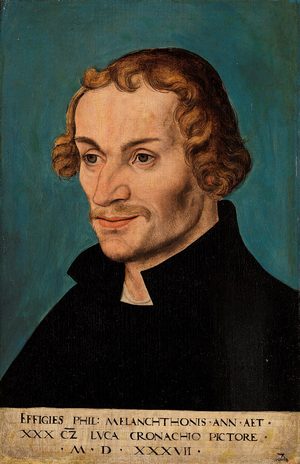

Philip Melanchthon was a young professor of Greek at Wittenberg who became Luther's closest colleague and wrote the Augsburg Confession (1530), the founding statement of the Lutheran churches. He also drew up its Apology, the Treatise on the Power and Primacy of the Pope, and a revised edition of the Confession that Lutherans have argued over ever since. Catholics, Orthodox, Reformed and Anglicans each had dealings with him, and each tradition remembers him differently.
| Lived | 16 February 1497, Bretten, to 19 April 1560, Wittenberg |
|---|---|
| Church | Lutheran; never ordained |
| Role | Professor of Greek at Wittenberg from 1518; author of the Augsburg Confession; adviser to the Saxon electors; called Praeceptor Germaniae ("Teacher of Germany") |
| Influenced by | His great-uncle Johann Reuchlin, who recommended him to Wittenberg; Renaissance humanism; Luther |
| Influenced | Lutheran theology through the Loci Communes; the Philippists; Zacharias Ursinus, his pupil, later a co-author of the Heidelberg Catechism |
| Writings | Loci Communes (1521; revised 1535); Augsburg Confession (1530); Apology (1531); Treatise on the Power and Primacy of the Pope (1537); the altered Augsburg Confession, the Variata (1540) |
| Honored | 16 February (his birth) in Lutheran Service Book, as "Confessor"; buried beside Luther in the Castle Church, Wittenberg |
Life
Born Philipp Schwartzerd at Bretten, he took the Greek form of his name from his great-uncle, the humanist Johann Reuchlin. He studied at Heidelberg (B.A. 1511) and Tübingen (Master 1514). In 1518 Frederick the Wise appointed him professor of Greek at Wittenberg on Reuchlin's recommendation, and on 28 August 1518 he gave his inaugural address, "On Reforming the Studies of Youth." He married Katharina Krapp in 1520 (she died in 1557) and published the first Loci Communes in 1521. He was never ordained and, Robert Kolb notes, was shy of preaching because of a speech impediment.
At the Diet of Augsburg he drafted the Confession, which was read before Charles V on 25 June 1530. Luther, who read the draft from Coburg, wrote that he was "well pleased with it." The emperor's theologians answered with the Confutatio on 3 August; Melanchthon replied with the Apology, finished at Wittenberg in April 1531. At Smalcald in February 1537 he wrote the Treatise on the Power and Primacy of the Pope. He dedicated the 1535 Loci to Henry VIII and was invited to England, but his elector refused him leave to go. He revised the Confession in 1540, used the revision at the Worms colloquy that October, and in May 1541 took part in the Regensburg colloquy with Catholic theologians, which broke down over the Church and the sacraments.
Luther died on 18 February 1546. After the emperor's victory at Mühlberg in 1547 Melanchthon rejected the Augsburg Interim but shared in drafting the Leipzig Interim (1548), which accepted Catholic ceremonies and bishops' authority in Saxony; the quarrels that followed filled his last years. In 1557 he attended the Worms colloquy with Catholics, and he died at Wittenberg on 19 April 1560 after a journey to Leipzig. He lies in the Castle Church beside Luther.
What he taught
The Augsburg Confession (28 articles) states Lutheran teaching. Article IV holds that people are not justified by "their own strength, merits, or works" but freely, for Christ's sake, through faith (justification). Article IX holds that baptism is necessary to salvation and that children are to be baptized (infant baptism), and it condemns the Anabaptists. Article X says that Christ's body and blood are "truly present" in the Lord's Supper and given to those who eat. Kolb calls the Confession "a document that remains the fundamental definition of what it means to be Lutheran."
His Loci Communes arranged doctrine by topics, a method Kolb says underlies Lutheran doctrinal instruction. In the Treatise of 1537 he rejected the pope's claim to rule all bishops by divine right and judged that the marks of Antichrist agree with the papal kingdom (par. 39; the pope as Antichrist). Yet in his own signature to the Smalcald Articles he wrote that if the pope "would allow the Gospel," his superiority over the bishops could be conceded to him by human right (the papacy). As a humanist he wrote widely used textbooks on rhetoric and dialectic and helped reform schools and universities, which earned him the title Praeceptor Germaniae.
What historians say
The main debate is whether Melanchthon kept to Luther's theology. The Catholic Encyclopedia (Klemens Löffler, 1913) says he supported synergism against the determinism of the Reformation and that his departures from Luther softened doctrine; the Schaff-Herzog Encyclopedia (after Kirn) dates his synergism to the 1535 Loci and reports that he denied having left Luther's teaching. On the Supper, the 1540 Variata changed Article X so that the body and blood are "exhibited" with the bread and wine. Johann Eck pointed out the change at Worms, the Lutheran historian Friedrich Bente counted it a real change, and Melanchthon wrote to Flacius in 1556, "I have never changed the doctrine of the Confession." Kolb writes that Melanchthon "had never used exactly the same language as Luther" but held that rescue from sin comes only through God's gracious action, and that the Variata's main change concerned justification. Timothy Wengert argues that the two men's relation was a compatible collaboration, that Melanchthon's method was sharply opposed to Erasmus's, and that their chief difference lay in cosmology: Melanchthon, who believed the stars influenced human evil, was moderate where Luther saw a struggle with the devil.
The Leipzig Interim is the most debated act of his later life. Kolb says he accepted compromises on adiaphora to keep Lutheran preachers in their pulpits; Matthias Flacius and others accused him of betrayal (the debate). Another wrong is attributed to him: when the pastor Friedrich Myconius wrote to him about Anabaptists executed in Electoral Saxony, he replied that the rebaptizers were "angels of the devil" and defended the elector's severity, and in 1536 he and Luther wrote an opinion defending the death penalty for obstinate leaders. The Lutheran–Mennonite commission said "the only adequate response is repentance," and the Lutheran World Federation asked forgiveness at Stuttgart on 22 July 2010 (Anabaptists in Lutheran lands; the Lutheran record).
How the churches see Melanchthon
- Catholic:
The Confutatio read at Augsburg on 3 August 1530 approved eighteen articles of the Confession's first part in full or with qualifications and rejected those on the Church (VII), faith and good works (XX) and the saints (XXI), and the whole second part (Schaff); Lutherans never received a copy (Bente). At Regensburg in 1541 the Catholic and Protestant theologians agreed an article on justification, but Rome rejected it that June. In 1976–77 Joseph Ratzinger distinguished Catholic recognition of the Augsburg Confession from recognition of it as Catholic; a 1981 Catholic Theological Society of America seminar found no consensus on what such recognition would mean. Löffler's 1913 article describes Melanchthon as shy, moderate and devout, never wholly detached from the Church and some of its ceremonies.
- Orthodox:
A Greek text of the Augsburg Confession appeared in 1559 under the name of Paul Dolscius; Georges Florovsky judges that Melanchthon himself probably took the initiative. Melanchthon sent a copy to Patriarch Joasaph of Constantinople with a letter suggesting that the Lutheran movement was close to Orthodoxy; Florovsky says the letter apparently never arrived. In 1574 the Tübingen theologians sent the Greek text to Constantinople, and Patriarch Jeremias II answered in letters ending in 1581, finding errors in it (Orthodox Church in America). The Orthodox Church has made no statement about Melanchthon himself.
- Lutheran:
The Book of Concord contains his Augsburg Confession, Apology and Treatise. The Solid Declaration adopts "the First, Unaltered Augsburg Confession" of 1530 (Rule and Norm, par. 5), lists the Apology among writings sent forth "before the divisions" (par. 12), and notes that divisions arose "on account of the Interim" (par. 19). Article X rules that at "the time of confession" Christians "must not yield" even in adiaphora (par. 10). The Formula never names him. Lutheran Service Book commemorates him on 16 February as "Confessor." Kolb writes in the Missouri Synod's Lutheran Witness: "We recognize Philip Melanchthon as one who has put words of confession of the faith in our mouths."
- Reformed:
Calvin went to Frankfurt in February 1539 to meet Melanchthon, and attended Regensburg in 1541 at his special request (Schaff). According to Bente, Calvin signed the Augsburg Confession at Strasbourg (1539 or 1540); in 1557 he wrote to Westphal, "Nor do I repudiate the Augsburg Confession, to which I have previously subscribed," in the sense given by its author. Ursinus, Melanchthon's pupil, accompanied him to Worms in 1557 and later helped write the Heidelberg Catechism. Schaff reports that the Melanchthonians and the Reformed kept the altered Confession even after the Book of Concord (1580).
- Anglican:
Melanchthon dedicated the 1535 Loci to Henry VIII, who sent him 200 crowns; invitations to England followed, but his elector refused him leave to go. The Thirteen Articles drawn up with Lutheran divines in 1538 are "based upon the Augsburg Confession" and never received the king's sanction, but they were used as a basis for several of the Forty-two Articles of Edward VI's reign (Schaff), which the Thirty-Nine Articles later revised. Anglican formularies do not name him.
- Methodist:
No Methodist church has made a statement about Melanchthon. Britannica says the Augsburg Confession influenced both the Thirty-Nine Articles and the Twenty-Five Articles of Religion of the Methodists.
- Baptist:
Baptist confessions do not name Melanchthon. Article IX of the Augsburg Confession condemns the Anabaptist rejection of infant baptism, which Baptists, who baptize only believers, also reject; his part in the persecution of Anabaptists is told in the Lutheran record.
Sources
- Wittenberg city, "The life of Philipp Melanchthon" dates of study, 1518 appointment, inaugural address, death
- Kolb, "Philip Melanchthon: Confessor of the Faith," The Lutheran Witness (2010)
- Schaff-Herzog Encyclopedia, "Melanchthon"
- Catholic Encyclopedia (1913), Löffler, "Philipp Melancthon"
- Bente, Historical Introduction to the Augsburg Confession (Book of Concord)
- Bente, Historical Introduction to the Formula of Concord (Calvin, the Variata, 1556 letter to Flacius)
- Augsburg Confession, Articles IV, IX, X (Book of Concord)
- Treatise on the Power and Primacy of the Pope (Book of Concord)
- Smalcald Articles, subscriptions (Book of Concord)
- Solid Declaration of the Formula of Concord, Article X (Book of Concord)
- Solid Declaration of the Formula of Concord, Rule and Norm (Book of Concord)
- Schaff, Creeds of Christendom, on the Augsburg Confession, Confutatio and Apology
- Schaff, Creeds of Christendom, on the Thirteen Articles of 1538
- Schaff, History of the Christian Church, vol. 8, on Calvin at Frankfurt and Regensburg
- Leithart, "Luther und Melanchthon" (on Wengert, Lutherjahrbuch 1999), First Things (2004)
- Wengert, Human Freedom, Christian Righteousness (Oxford University Press, 1998)
- Florovsky, "The Greek Version of the Augsburg Confession," Christianity and Culture
- Orthodox Church in America, "Patriarch Jeremias II and the Dialogue with the Lutherans"
- Penaskovic, "Roman Catholic Recognition of the Augsburg Confession," Theological Studies 41 (1980)
- Christian History Institute, "The road not taken" (Regensburg Colloquy, 1541)
- Lutheran Service Book commemorations (Concordia Publishing House)
- 1517, "Meeting Melanchthon: Theological Ambassador: Going to England?"
- Lutheran–Mennonite International Study Commission, Healing Memories (2010), via the Lutheran record chapter
- Encyclopedia.com, "Augsburg Confession" (influence on the Thirty-Nine and Methodist Articles)
- Cranach portrait, Wikimedia Commons (public domain)