Medjugorje from 1981
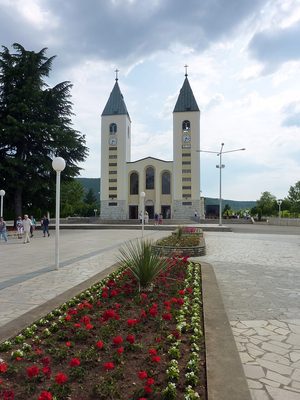

Medjugorje is a village in Bosnia and Herzegovina where six young people said in June 1981 that the Virgin Mary was appearing to them, and where the visionaries say messages continue. Local bishops judged against the claims; a Vatican commission reported in 2014 without a published verdict; in 2024 the Vatican approved devotion there without declaring the apparitions supernatural. How the other traditions respond depends on their teaching about revelation and about Mary and the saints.
| Date | From 24 June 1981; the visionaries say the apparitions continue |
|---|---|
| Place | Medjugorje, parish of St James, diocese of Mostar-Duvno, Bosnia and Herzegovina (Yugoslavia in 1981) |
| Claimed by | Six young people of the parish, aged 10 to 16 in 1981; the parish was run by Franciscans |
| Type | Reported continuing apparitions of the Virgin Mary, with messages |
| Official status | Not declared supernatural. Nihil obstat from the Dicastery for the Doctrine of the Faith, 19 September 2024: devotion and pilgrimage permitted, belief not required |
| Investigations | Diocesan commission (1986); Yugoslav bishops' commission (1987–91); Ruini commission (reported 2014); papal envoy Henryk Hoser (2017); Dicastery note (2024) |
What is claimed
According to the six young people, the Virgin Mary began to appear to them on 24 June 1981 on the hillside above the village, and appeared to all six in the days that followed; the Dicastery for the Doctrine of the Faith dates the first seven apparitions from 24 June to 3 July 1981. The visionaries say they have kept receiving messages since, calling for peace, conversion, prayer and fasting (Catholic World Report). "Queen of Peace" is, in the Dicastery's words, "the most original title in the messages." They also say they were told secrets about future events.
Supporters point to the fruits: the Dicastery's note describes conversions, a renewal of the sacraments, vocations and charitable work among pilgrims.
History and devotion
The parish of St James was run by Franciscans, in a diocese where the Franciscans and the bishop were in dispute over parishes after Paul VI's decree Romanis Pontificibus (1975). Bishop Pavao Žanić met the six on 21 July 1981 and said, "the children do not lie"; by 19 November 1983 he had written to Rome with "very strong doubts." On 12 October 1984 the Yugoslav bishops' conference recalled the Church's competence to judge apparitions and prohibited official pilgrimages. The Congregation for the Doctrine of the Faith allowed private pilgrimages on 2 March 1998, provided Medjugorje was not presented as a place of authentic apparitions.
Pilgrimage grew regardless. In 2017 Pope Francis appointed Archbishop Henryk Hoser to study the pastoral situation; in 2019 a papal disposition permitted organized pilgrimages as long as they are not read as authenticating the events. The Dicastery's note says people come mainly to renew their faith and that Orthodox Christians and Muslims also visit.
Investigations
Church bodies. A diocesan commission voted 11 to 4 on 19 May 1986 for non constat de supernaturalitate (supernatural character not established). The Yugoslav bishops' declaration of Zadar (10 April 1991) said it could not be affirmed that these were supernatural apparitions, while urging healthy devotion to Mary. In a letter of 2 October 1997 Bishop Ratko Perić of Mostar went further, writing that non-supernaturality was established (constat de non supernaturalitate), "my conviction and position"; the Congregation for the Doctrine of the Faith stated in 1998 that his position did not match its own. Žanić criticized the Franciscans' guidance of the seers (Catholic News Service).
The Ruini commission. Benedict XVI set up an international commission under Cardinal Camillo Ruini (announced in March 2010; the Vatican has said the decision was taken in 2008); it reported in January 2014 and its report was not published. According to Vatican Insider (2017), 13 members voted to recognize the first seven apparitions as supernatural, one against and one abstaining; on the later ones, the Dicastery reports, 12 withheld judgment and 2 voted against. The commission found the seers "psychically normal" and uninfluenced by the parish Franciscans or anyone else, but found the later apparitions "pre-announced and programmed" and noted "heavy interference" from the bishop-Franciscan dispute. The Congregation under Cardinal Müller doubted the report was conclusive. On 13 May 2017 Francis said the first apparitions needed more study and of the later ones, "these alleged apparitions have no great value," which he called his "personal opinion."
Scientific tests. A French team led by Henri Joyeux tested the seers during apparitions in 1984; Marco Corvaglia, an Italian writer on miracle claims, reports that it concluded they were "scientifically inexplicable." He argues that its screening test rested on "the subjects' claims" and that no paper on the results appeared in a peer-reviewed specialist journal. Denis Janz, a historian of theology, wrote in Christian Century (1987) that he largely accepted the bishops' finding, noted commercial interests around the pilgrimages, and wrote that "it is deep doubt, not deep faith," that drives people there.
Official status
The Dicastery's note "The Queen of Peace" (approved by Francis on 28 August 2024, published 19 September) grants a nihil obstat under the new Norms of 17 May 2024: the faithful may give the spiritual experience "their adherence in a prudent manner," and public devotion is authorized. It states that this "does not imply a declaration of the supernatural character of the phenomenon," so belief is not required, and that the messages are to be called "alleged." It adds that some messages may contain contradictions or reflect the interests of the seers or others, that it makes no judgment on the visionaries' moral lives, that pilgrims go to meet Mary and Christ and not the visionaries, and that the Bishop of Mostar-Duvno keeps his authority over abuses. The Norms say that as a rule neither a bishop nor the Dicastery will declare such phenomena supernatural (Part I, par. 23).
Where each church stands
- Catholic:
The Catholic Church has not declared the apparitions supernatural. Its acts are the Zadar declaration of 1991, the 2019 permission for pilgrimages and the 2024 note described above. The Catechism teaches that private revelations, even approved ones, do not belong to the deposit of faith and cannot "improve" or "complete" Christ's revelation (CCC 67), so a Catholic may accept, doubt or ignore Medjugorje. Local bishops from Žanić to Perić judged against it; Francis said in 2017 that the spiritual and pastoral fact "cannot be denied." Compare Lourdes and Fatima.
- Orthodox:
No Orthodox synod or patriarchate is known to have issued a statement on Medjugorje. Orthodox spiritual writing is cautious about visions. St Ignatius Brianchaninov (On Prelest), as summarized by OrthodoxWiki, held that people who seek visions without a mind renewed by the Holy Spirit fall into pride; later elders advise telling one's spiritual father at once, and hold that a vision joined to pride cannot be from God. The Orthodox honor miracles chiefly through their saints (see gifts and healing).
- Lutheran:
No Lutheran church body is known to have addressed Medjugorje. The Smalcald Articles say God gives his Spirit or grace to no one except "through or with the preceding outward Word" (III.8.3), and the Lutheran Church–Missouri Synod holds that "the Word and the sacraments are the only means of grace" (Commission on Theology and Church Relations, 1972). On that teaching a message attributed to Mary would not bind a Lutheran conscience.
- Reformed:
No Reformed body is known to have ruled on Medjugorje. The Westminster Confession says God's "former ways" of revealing his will are "now ceased" (1.1) and that nothing is to be added "by new revelations of the Spirit, or traditions of men" (1.6). Calvin held that miracles confirm the gospel already preached, and noted that Scripture warns of false wonders (Matt 24:24; Institutes, Prefatory Address). Not all Reformed churches are cessationist: see the question of the former ways.
- Anglican:
No statement on Medjugorje by the Church of England is known. The Anglican–Roman Catholic commission's report Mary: Grace and Hope in Christ (2005, par. 73), which is not an act of either church, says "There is need for careful discernment in assessing the spiritual value of any alleged apparition," that the test of a private revelation is "its orientation to Christ himself," and that such private devotion is acceptable but never required. Article XXII of the Thirty-Nine Articles calls the "invocation of Saints" "a fond thing vainly invented."
- Methodist:
The United Methodist Church has made no statement on Medjugorje that is known. Article XIV of its Articles of Religion rejects the "Romish doctrine" of the invocation of saints, among other things, as unsupported by Scripture. Wesley held that the extraordinary gifts ceased because love "waxed cold," not because God withdrew them (Sermon 89, 1787), and Methodists are generally open to the Spirit's gifts under guidelines (see gifts and healing).
- Baptist:
No Baptist body is known to have addressed Medjugorje. The Second London Confession (1677/1689, 1.6) says nothing is to be added to the whole counsel of God "whether by new Revelation of the Spirit, or traditions of men." Baptists are divided between cessationists and continuationists on whether the miraculous gifts continue, but Baptist churches generally rest their teaching on Scripture alone.
Sources
- Press conference presenting the Note "The Queen of Peace" (Vatican press office, 19 September 2024) chronology 1981-2024; Ruini votes; the Zadar declaration
- Dicastery for the Doctrine of the Faith, Note "The Queen of Peace" about the spiritual experience connected with Medjugorje (19 September 2024) paras 1-6, 38-41
- Dicastery for the Doctrine of the Faith, Norms for Proceeding in the Discernment of Alleged Supernatural Phenomena (17 May 2024)
- Pope Francis, press conference on the flight from Fátima to Rome, 13 May 2017
- Catholic World Report, "What has the Catholic Church said about Medjugorje? A timeline" (18 September 2024)
- Catholic News Service, "Church leaders have been studying Medjugorje phenomenon for decades" (2024)
- Vatican Insider (La Stampa), "Medjugorje, the findings of the Ruini report" (17 May 2017)
- Bishop Ratko Perić, letter to Thierry Boutet, 2 October 1997
- Marco Corvaglia, "Scientific Tests on the Medjugorje Seers?" a sceptical account of the 1984 tests
- Denis R. Janz, "Medjugorje's Miracles: Faith and Profit," Christian Century (1987)
- Catechism of the Catholic Church, 67
- Anglican-Roman Catholic International Commission, Mary: Grace and Hope in Christ (2005), par. 73
- Church of England, Articles of Religion (Article XXII)
- Smalcald Articles, Part III, Article VIII (Book of Concord)
- LCMS Commission on Theology and Church Relations, The Charismatic Movement and Lutheran Theology (1972)
- Westminster Confession of Faith, chapter 1
- Calvin, Institutes of the Christian Religion (1559), Prefatory Address to King Francis I, sec. 3
- Second London Baptist Confession (1689), chapter 1
- The Articles of Religion of the Methodist Church (Article XIV)
- Wesley, Sermon 89, The More Excellent Way (1787)
- OrthodoxWiki, "Prelest" (summarizing Ignatius Brianchaninov, On Prelest)
- St James Church, Medjugorje, Wikimedia Commons (CC BY 2.0)